
Back on top
After harrowing flying accident, local highliner steps back out with renewed mission

Sean Englund during his record-setting 2.16km highline outside Bend, Ore., in May 2023. It took about 2½ days to rig due to weather delays, with 17-18 individuals involved. The rigging involved use of the "curtain rod" method, which he also plans to use on a 4km line Oct. 4 in Moab./ Photo by Daniel Teitelbaum
You could say Durango resident and world renowned highliner Sean Englund is a hard guy to keep down. In October 2023, a near-fatal speed-flying crash off Smelter Mountain almost ended not just his flying and highlining careers, but his life.
Nearly two years after the accident, the 29-year-old – who suffered too many broken bones to list as well as a spinal injury – is introspective. He knows such risks come with the territory, especially when that territory is all too familiar.
“Accidents happen close to home where your comfort level is high, and your complacency can also be high,” said Englund, who underwent several surgeries and months of intense physical therapy. “There’s a lot of things that play into it. Things happen quickly. I had appropriate certifications. I take safety very seriously.”
An avid outdoorsman, Englund holds nationally recognized certifications in paragliding and avalanche safety. He is also a board member of the International Slacklining Association and is a certified instructor. Over the last few years, he has successfully rigged technical and record-setting highlining routes all over the world. And despite the setback, he shows no signs of stopping.
Since the accident, not only has he made good on a promise to fly again, but he has won international highlining speed competitions and laid down first routes everywhere from an ancient church in Germany to the Royal Gorge. But, he admits the accident has taken a toll physically; he can’t quite compete at the same level as before. “My body is just not the same, and I’m OK with it. I have other ambitions now,” he said.
Those latest ambitions are to share his passion for highlining – as well as love for its little sister sport, slacklining (done close to the ground, typically between two trees) – through his new company, Uncharted Lines.
“I had a lot of down time, because I couldn’t walk or do anything physical,” he said of his forced convalescence after the accident. “I had to stay motivated and inspired, so I decided to launch my company that I always dreamt of doing but never had time for.”
Englund started Uncharted Lines in January 2024 and considers its mission twofold: to host competitions in conjunction with the ISA, and to help grow interest in and understanding of the sport. “At our core, we are working to further the sport through direct exposure like performances and competitions,” said Englund, who has a crew of four working alongside him. “The other main facet is advocating for the sport of slacklining. We work with different entities in the area, the Hive being one of them, to do free clinics and try to get slacklining in front of more youth.”
To that end, Englund recently hosted the Art in Motion event at Buckley Park, which drew about 100 of the slacklining curious. In addition to slacklining clinics, the day also included yoga, mobility and mindfulness training – all necessary ingredients for a successful foray into the sport.
An Eagle Scout who graduated high school on the East Coast, Englund first got into slacklining as a student at Fort Lewis College, where he graduated with a degree in geography and cartography in 2020. He said highlining and slacklining were a respite from the rigors of studying, which were compounded by learning disabilities. “Highlining was my get away. It was my quiet space from all the daily stresses of life,” he said. “School was hard for me, so slacklining truly gave me that outlet to step away. I couldn’t think of anything when I was on the line or else I’d fall off.”
In addition to providing an outlet, it also helped the self-professed introvert meet others. “Slacklining out on the quad allowed me to meet people – that’s where I met a lot of my friends that I still have today,” he said.
Englund, who got his first sponsor when he was 19, said there are a lot of misconceptions around the sport, namely that it is dangerous. However, he said highlining is actually safer than rock climbing, due to safety measures and redundancies that are built in, from double anchors to highliners being roped in, so when they fall they can climb back onto the line.
He also noted that when it comes to other adventure sports, lining has a relatively low financial barrier and is accessible to almost anyone.
“It is a very cheap, low-cost adventure sport. It’s $80, and you can do it by yourself in the park,” he said. “Skiing, rockclimbing, mountain biking – I love all those hobbies and personally recreate in all of them – but the reality is, they are very expensive. Not everyone can afford all this. I’m trying to provide people a way to be outside and connect with each other.”
On the performance side of his business, Englund said he wants to keep pushing for things that have never been done in the world of highlining. “I knew I always wanted to do more urban highlining. It’s very prominent in Europe, yet in the U.S. no one has really broken down that door because of the legality of it.”
Ah yes, that good, old American tradition of liability, which goes hand in hand with that other thorny topic: access, the historic bane of unorganized sports from rock climbing and skateboarding to, yes, even snowboarding once upon a time. Englund said he keeps his natural highlining endeavors to mostly BLM land, where regulations are more lax. But he said he hopes wider exposure to the sport will lead to broader acceptance and, ultimately, access.
Since launching, Uncharted Lines has done seven projects – one being what Englund calls the “most advanced urban highline” that’s been done in the United States to date. The feat took place between two hotels in Virginia Beach, Va., during last spring’s Jackalope Festival (a sort of up-and-coming X Games). He also has his sights set on performances at the 2026 FIFA World Cup, which will be held in North America, as well as the 2028 Summer Olympics in L.A.
And while seeing highlining as an actual Olympic sport may be a ways off, Englund said he sees it as a lot like rock climbing in the ’90s: fringe and misunderstood. “Do I believe we could get to a similar place as rock climbing is today: yes. Do I think we could be as established as having eight indoor climbing gyms like in Denver? No – we’re still in the fringe and misunderstood … for now,” he said.
But, that fringe is getting bigger by the day. “It definitely is a growing sport; competitions are ever growing,” he said, adding that he is taking leave from his day job as a GIS specialist to attend the International Speed Highline Championships in China in a few weeks. “I was just in Europe for two different speed highlining world cups, and all continents except Africa were represented,” he said. And they aren’t just young twentysomething guys, with one of his fiercest competitors Dayoung Cheong, a female from South Korea.
In the meantime, while Englund waits for his sport to become a little more mainstream and understood, he will keep returning to his happy place on the line. Even if doubts or nerves creep in (yes, even Englund admits to having a healthy fear of heights) – which, it turns out, is a great metaphor for life in general.
“Sometimes, you just need to commit, and it’s going to feel uncomfortable and it’s going to feel weird, and you’re not going to know the outcome. But you’re going to know you should be there doing exactly what you’re doing,” he waxed somewhat philosophically. “It feels good exploring the ‘What if?’ You’re going to have to push through those hard times and know it’s going to work out – a body in motion stays in motion … breathe, put the music on and just go walk and have fun.”
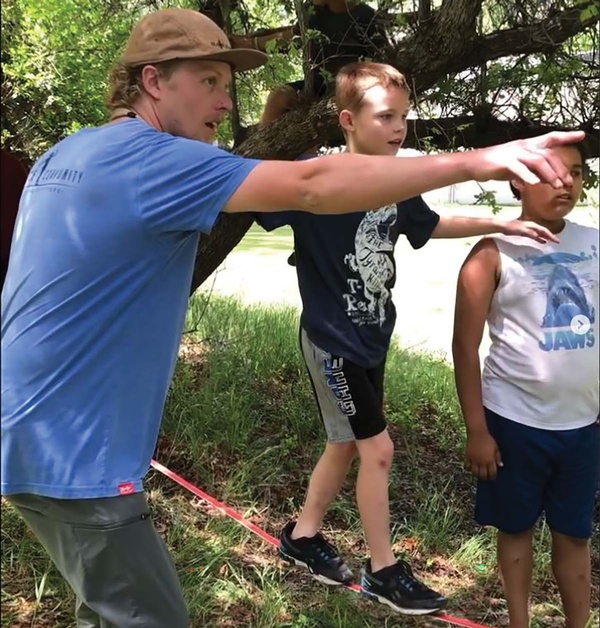
Englund spot a young slackliner during the Art in Motion events on Aug. 16 in Buckley Park./ Instagram screengrab