
Electric avenue
City officials to host community open forum on e-bike debate

Janet Wiley uses her pedal-assist bike to commute to and from work. She thinks e-bikes will be the wave of the future because they help get people out of their cars and on two wheels. "I wish everyone would hold judgement till they try it," she said. "It opens up a whole new world for people."/Photo by Jennaye Derge
Go back just a few years and it wasn’t even something people were talking about. If someone in Durango wanted to take the latest addition to the e-revolution for a ride, they had to special order it.
Today, however, anyone can walk into a local shop and ride out on a brand new electric bike. The growing popularity and accessibility of e-bikes – and their emergence on the streets and trails around Durango – has made them a hot topic of debate.
“It’s an issue that’s being discussed all over the United States,” explained Parks and Recreation Director Cathy Metz, “and opinions are very diverse.”
The City plans to host a community meeting on the issue from 5-7 p.m. Mon., Sept. 19, at the Durango Rec Center. It’s a joint board meeting for members of the Parks and Recreation, Multi Modal, and Natural Lands & Preservation advisory boards.
Metz said the idea is to give the board members a chance to hear public input before making a recommendation to the City Council. The meeting might even be expanded to a second night since so many residents are likely to attend, she added.
Other communities have already attempted to tackle the growing popularity of e-bikes. Boulder began its journey along the electric avenue with a year-long trial period in 2014 and later decided to allow e-bikes on local trails with specific speed limits.
Metz said it’s too soon to speculate on what the recommendation to the City Council would be, but it’s likely to include a trial period for Durango in which residents and city leaders can gauge the impact of e-bikes – including whether or not accident reports increase, how often trails are used and which ones are more popular.
The motor city
In recent years, Durango has been doing some maintenance on the city code. While updating ordinances this past April, staff came to the section on motorized vehicles and city trails. As per the process, advisory board meetings were held along with a public hearing, which no one really attended, according to Metz. That’s when the ordinance was clarified to include the latest two-wheeled trend, and it was determined electric bikes would be considered motorized vehicles.
Once word got out, people who owned them began contacting the city and the diversity of ideas has been pouring in ever since.
For the owners of electric or pedal-assist bikes, it often comes down to education. They want to explain there is no throttle – the rider must be pedaling for the electric motor to kick in and assist – and most feel that once someone takes a ride, they’ll become converts.
For those who’d rather not see e-bikes on the city’s trails, it’s about safety. Adding e-bikes to an already crowded Animas River Trail, for example, where some motorless riders are already moving too fast, is concerning.
Public safety is the top concern for City Councilor Sweetie Marbury, who said she often walks the river trail with her two small grandchildren and sees firsthand the potential conflict between fast-moving cyclists and slow-moving pedestrians.
Years ago when the trend in commuter convenience was the Segway, Marbury said she was against allowing those on the River Trail for the same reason.
Enforcement is a key issue, she added, and there’s simply not enough of it. “When I have a 3-year-old on her tricycle, I will always stand on the side of public safety.”
Currently, the river trail doesn’t have posted speed limits, but it does have signs at each major trailhead reminding users to share the trail and respect other users, Metz said.
“There is an image on the sign that clarifies that bicycles should yield to pedestrians, which is a common requirement on all trails,” she explained in an email.
Violations for reckless endangerment on the trail are enforced by the Durango Police Department, while park rangers provide additional patrols and education during high-use times like the summer months.
Long-time Durango resident Kathryn Eppich knows all too well about the potential dangers of a collision. Back in 2005, her daughter was hit by a motor bike on the river trail and airlifted on a Flight for Life to Grand Junction. The numerous injuries and long path to recovery is something Eppich hasn’t forgotten.
She said she doesn’t often enter the local political fray, but felt compelled to speak up on this issue. “If you can’t regulate regular bikes going too fast, how are e-bikes going to be regulated?” she asked.
She and Marbury aren’t the only ones focused on safety. Other residents have submitted public comments to the city, specifically mentioning their concerns with speeding down the River Trail.
But many owners of e-bikes say the problem with speeding and the possibility of collisions isn’t about the equipment, it’s about the rider.
“They’re only as fast as you pedal,” explained Janet Wiley, who uses her e-bike as a daily commuter. She said she’s often passed on the road by bicyclists and doesn’t think the addition of e-bikes to the list of trail users would increase the number of reported incidents.
She said education about trail use and courteous choices by trail users is the key to addressing those issues. “I think this society could be a lot more courteous,” she added.
Wiley has turned to the e-bike because she wants to get out of her car. Commuting on two wheels is better for both the environment and her health, she explained, but the long trip from home to work and all the errands in between were a little too much for two legs.
The e-bike’s pedal-assist technology gives Wiley the help she needs getting up the hills and tackling all the miles.
“I wish everyone would hold judgement till they try it,” she said. “It opens up a whole new world for people.”
It did for Wiley and her husband, Andy Corra. The local bicycle enthusiast said he was originally lukewarm about the whole thing – then he took his first ride. “Everyone who rides one comes back with a big smile on their face,” he said.
Corra owns an electric mountain bike, which is different than the one Wiley uses to commute to work.
As a mountain biker, he didn’t ride on trails like Animas Mountain because of the brutal climbs and rocky terrain. With his pedal assist e-bike, though, now he can.
It’s not because he can sit on the bike while it zooms up the slope. It’s because the electric motor kicks in while he’s pedaling and gives him that little bit of help he needs. He said the ride up Animas is still difficult and challenging, but the e-bike made it fun again.
“When I’m 70 years old and I don’t have the ability, I’m going to be all about the e-bikes,” Corra said.
Many of the e-bike supporters who’ve reached out to city officials share stories of how they haven’t been able to ride bikes of any kind because of their age. The e-bike is giving them the freedom to park the car and get back on two wheels.
“A lot of people in Durango have started to ride again,” explained Mary Monroe Brown, executive director of Trails 2000. “It’s an investment in their health and wellness.”
As the population grows in Durango and all over the Southwest, the local trails will continue to get busier and new types of users will continue to emerge, Monroe Brown said.
With those changes, the challenge is not just about learning to coexist with new users, like e-bike riders, it’s about learning to coexist with all users.
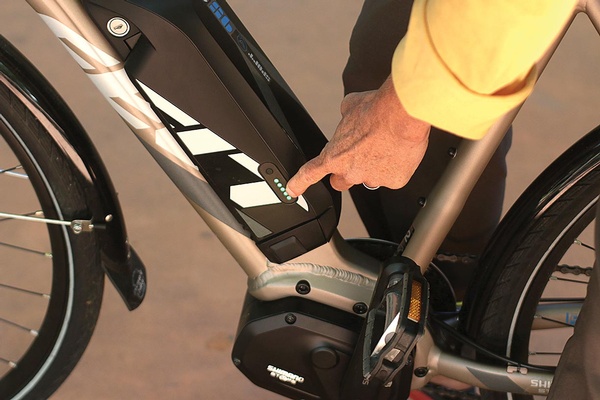
E-bike owner Janet Wiley points out the battery. The battery adds about 20-25 pounds to the average pedal assist bike and lasts 4-6 hours. Most pedal assist bikes top out at 20 miles per hour and cost $1,000-$8,000. The electric motors only kick in while the rider is pedaling – there's no throttle to be found./Photo by Jennaye Derge