
Preying on superstition
Utah plan to cull mountain lions to save deer unsound, dangerous
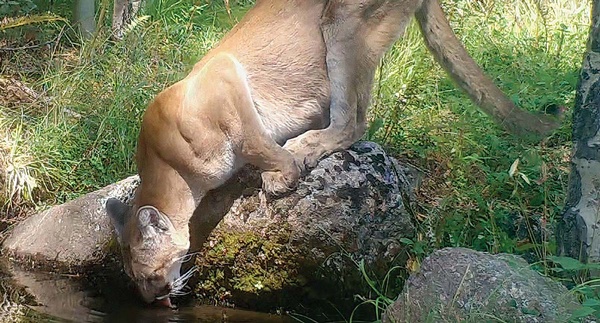
A mountain lion stops for a drink. The state of Utah is conducting a "study" to kill off mountain lions in order to boost mule deer populations. There is no evidence that such culling is effective, and in fact, has been shown to have deleterious effects./Photo by David Niels, Wild Nature Media
This year, in what it calls a “study,” Utah’s Division of Wildlife Resources is killing off mountain lions in an effort to increase mule deer herds. It has hired trappers from the Utah Department of Agriculture and Food, authorizing them to dispatch lions with any method, including banned traps and neck snares.
The study, covering roughly 8.6 million acres in six management units, will run for at least three years with the goal of indiscriminately exterminating “as many (lions) as possible.”
Buying into this ancient predator-prey superstition are the nonprofits Sportsmen for Fish and Wildlife and Utah Wild Sheep Foundation. Each has contributed $150,000 to the cull.
Wildlife managers have no idea how many mountain lions roam the state because estimating populations is essentially impossible. Lions are solitary, elusive and range over vast territories they defend. Unlike ungulates that compensate for mortality with fecundity, predators don’t “overpopulate,” and they’re much slower to recover from culling or hunting.
I asked veteran mountain lion researcher Rick Hopkins, board president of the Cougar Fund, what science supports a claim that killing mountain lions generates more deer. “None,” he replied. “For years, agencies have made such claims, but when pushed to provide evidence, they can’t. Predator control has never worked anywhere.”
Utah’s Division of Wildlife Resources estimates the state’s mule deer population at 295,200 – 73% of the “long-term goal.” That goal is based more on desired hunting-license sales than science. Still, considering the natural ebb and flow of deer populations, 73% isn’t bad.
Mountain lions have little or nothing to do with the decline of Utah’s mule deer. Predator populations are limited by available prey. What we learned in Biology 101 – that predators control prey – is incorrect: Prey controls predators. Utah has experienced prolonged drought, which peaked in 2022. Reduced forage starved female deer so that fewer fawns were born, and those fawns were sickly and therefore less likely to survive winters. When record-breaking snowfall occurred during the winter of 2022-23, there were massive mule deer die-offs.
Utah’s mountain lion cull follows hard upon a 2023 state law that opened up year-round, mountain lion killing without permits. Both this law and the current cull outrage environmental and animal wellness communities. The Western Wildlife Conservancy and Mountain Lion Foundation have filed a lawsuit (ongoing), asserting that the law violates the state’s Right to Hunt and Fish Act, which requires a “reasonable regulation of hunting.”
The Mountain Lion Foundation dismisses the mountain lion cull study as a “lethal program without rigorous science” and reports: “Decades of peer-reviewed research across the West shows that intensive predator removal rarely delivers sustained or landscape-scale recovery of prey populations. Instead, it often destabilizes predator populations, leading to younger, transient animals, increased conflict and little long-term benefit for deer.”
And this from Wayne Pacelle, president of Animal Wellness Action: “The science shows that healthy lion populations create robust and healthier deer herds, with lions selectively removing deer afflicted with the 100% fatal and highly contagious brain-wasting scourge known as Chronic Wasting Disease (CWD) caused by malformed, self-replicating proteins called ‘prions.’”
All threats to mule deer pale in comparison with CWD. The Theodore Roosevelt Conservation Partnership, a hunter-support group, calls it “the No. 1 threat to deer hunting.”
In Utah, CWD has been detected in 356 of the few mule deer checked. Symptoms include fearlessness and loss of coordination, behaviors inviting lion predation and thereby removal of disease vectors.
What’s more, mountain lions are resistant to CWD. They deactivate prions through digestion, removing them from the environment. That further protects mule deer as well as possibly protecting people. In 2022, two hunters who ate venison from a CWD-ravaged deer herd in Texas died from prion disease. Given the rarity of human prion infections, this seems an unlikely coincidence.
The Idaho Capital Sun quoted Dr. Michael Osterholm, director of the Center for Infectious Disease at the University of Minnesota, as follows: “We are quite unprepared. If we saw a (CWD) spillover right now, we would be in free fall. There are no contingency plans.”
Mark Elbroch of Panthera, a nonprofit dedicated to conserving wild felines, told me this: “Heaps of science show the beneficial contributions of mountain lions. Humans are healthier when we live with mountain lions.”
So are mule deer.
Ted Williams, a longtime environmental writer, is a contributor to Writers on the Range, writersontherange.org, an independent nonprofit dedicated to spurring lively conversation about the West.
-

- 06/04/2026
- Tougher on trash
- By Missy Votel
-
As human-bear conflicts rise, new state law targets ‘knowingly’ allowing attractants
- Read More
-

- 06/04/2026
- Redefining the business of art
- By Parker Yamasaki / The Colorado Sun
-
Colorado’s new A Corp model helps creatives retain control while attracting investment
- Read More
-
- 05/28/2026
- Quick 'n' Dirty
- By Missy Votel
-
Help for the Demon Bridge, Highway 550 N closure, and fire mitigation falls off
- Read More
-

- 05/28/2026
- Getting crafty
- By Haylee May / Colorado Public Radio
-
Colorado brewers buck national trend by adapting to changing times
- Read More
- Getting gassed
- 06/04/2026
-
Gas prices are once again giving America something to complain about. And while the local beer meisters at Ska Brewing can’t fix the price at the pump, the brewery is offering one small bit of relief: a new light beer that costs one cent less than the price of a gallon of unleaded gas.
Introducing Ska’s newest brew: West’s Easy Light Lager, because “everything else is so hard.”
- Short legs, big party
- 05/28/2026
-
On most days, Tracy Harwood spends her time as a court clerk for the City of Durango. But next Thurs., June 4 – International Corgi Day – she hopes to bring something entirely different to town: short legs, wiggly butts and oversized personalities.
- River cowboy
- 05/21/2026
-
It’s a mash-up made in Westernwear heaven. Sort of. Seems Chaco, the purveyor of the iconic strappy dirtbag river rat footwear, has joined forces with Wrangler, as in tight jeans, big belt buckles, bull riding and snap shirt fame.
- Making plans
- 05/14/2026
-
Wondering what’s up with the old 9-R Admin building at the end of E. 2nd Avenue that was going to be a fire department, then wasn’t going to be a fire department and is now going to be City Hall and the Police Department?The City of Durango will demystify plans for the historic building during a public session Wed., May 20, 5:30-7:30 p.m. at the Durango Recreation Center.