
A long road
Bicycles, not cars, are the ones who paved the way for the nation's roadways
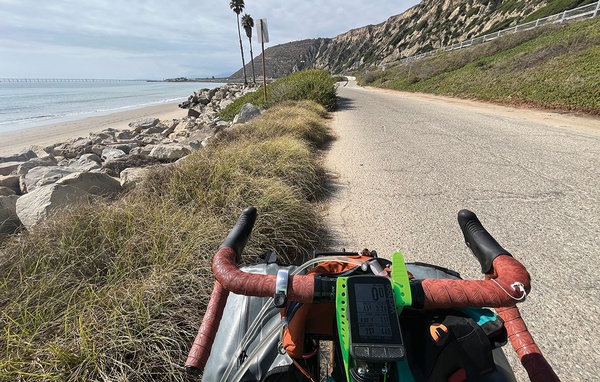
A view of a shoulderless California road during a traffic-intense bike tour last fall. / Photo by Jennaye Derge
Last fall, I decided to take a solo bike tour up the California coast from L.A. to San Francisco. One evening, around dusk, I was riding my bike on California State Highway 1 (also known as the “PCH”.) I was beyond tired from a long day of pedaling on a heavy bike, and white-knuckling while cars passed me way too close, going way too fast, when suddenly, a semi-truck appeared behind me.
If you’ve ever been on Highway 1, you know that sections of the road are skinny, crumbling and have no shoulder. The full width of the road butts up to either a rock retaining wall, or a soft sand pit, and if you are a cyclist, and there is a semi-truck behind you – or any other vehicle for that matter – there really isn’t anywhere to go to get out of the way.
So, this particular evening, while I was just trying to get to camp, I held my space on the edge of the road, and I continued to pedal while the truck inched closer behind me. I was expecting it would pass when traffic was clear (which was easy enough). Instead, the semi blew its horn on my back. The shock sent me off the road and straight into the soft sandy shoulder, where I stood, silently shaking and then, eventually, crying.
Ironically, I read about the Good Roads Movement just a few months prior to this incident. The article was about cyclists in the 1880s – some of the original road users – championing for better roads for all, including the semi-truck that just ran me off the road.
It was cyclists who first fought to improve road conditions and petitioned local governments to take better care of our roadways so we could all get around easier and safer.
Although interesting to me as a cyclist and advocate, the Good Roads Movement should be interesting to anyone that is a road user. The grassroots movement started in the late 1870s in Newport, R.I., and became an official roadway improvement movement in 1880. It was founded by a group of bicycle commuters and racers who were tired of riding on ravaged and rutted roads that were being destroyed by – get this – vehicles.
Heavy steel wheels and clompy horse hooves from horse carriages wreaked havoc on the roads. So, cyclists partnered up with ranchers and farmers, who at the time privately owned many of these roadways, to brainstorm a solution for the problem.
Through this cyclist/farmer (and eventually mail deliverers) partnership, the Good Road Movement took shape to fix the vehicle-damaged roads and incentivize larger action. The efforts spread nationally, and the original group of cycling advocates helped form the League of American Wheelmen. By 1898, the Wheelmen had 103,000 members and created a national movement demanding federal and state funding take over the responsibility of road maintenance and building. Which, fun fact, is how and why our streets are now government- owned instead of owned privately.
It is said that the Good Roads Movement, the Wheelmen and their coalition of farmers, legislators and other partners, are what fueled the expansion of roadways throughout the United States. There was even the Good Roads magazine that had a circulation of 1 million, as well as the “The Gospel for Good Roads” pamphlet.
This was all done mostly for and by cyclists until, eventually, the auto industry caught up and caught on.
The auto industry got involved with the Good Roads Movement around 1910, and lobbies such as the American Automobile Association (AAA) joined the campaign and took up their battle alongside the National Good Roads Association. As motor vehicles gained popularity, so did long distance travel and, therefore, long distance interstate roadways. Eventually, under President Woodrow Wilson, The Federal Aid Road Act of 1916 was signed, and 18 years later, in 1934, California Highway 1 was built, and semi trucks have been pushing cyclists off the road ever since.
History doesn’t always write the rules, and when it comes to our current road culture, that is certainly the case. Historically, cyclists were the first advocates for better roads, but that doesn’t change how our culture sees cyclists vs. how we see motor vehicles. Cyclists will continue to be treated as inferior and “not allowed” on roads.
Closer to home, in Durango, we will continue to have to navigate our own bad roads. Roads with poorly marked shoulders, no bike lanes, and potholes and erosion caused by motor vehicles. Roads where there is overgrown brush, broken glass, trash cans or gravel and where it’s often impossible to get to where you’re going without having to dodge an inattentive driver. Roads that don’t quite seem to want to acknowledge cyclists; faded paint simply alludes to bike infrastructure and is generally hardly noticeable or half paved over.
The Good Roads Movement is officially over – instead favoring a movement for faster, wider highways, more parking and bigger trucks. A movement where cars will continue to pass too close and too fast, and semi-trucks will continue to blast their horns on cyclists’ backs when they’re just trying to find a nice place to camp.
-

- An Americana icon
- By Chris Aaland
- 08/31/2023
-
Folk Fest headliner on climate change, indigenous rights and summer road trips
-

- 'Matli crew
- By Chris Aaland
- 06/29/2023
-
Party in the Park returns with Latin rock supergroup
-

- The bottom of the barrel
- By Chris Aaland
- 08/19/2021
-
After 14 years, ‘Top Shelf’ hangs up the pint glass
-

- Back in the groove
- By Chris Aaland
- 07/29/2021
-
Local favorites the Motet return for KSUT’s Party in the Park
- Half a century
-

- 05/26/2022
-
A look back at the blood, sweat and gears as the Iron Horse turns 50
- Bottoms up!
-

- By Stephen Eginoire
- 05/27/2021
-
With this year's runoff more like a slow bleed, it is easy to let one's whitewater guard down. But remember: flips and swims can happen any place at any time.
- Cold comfort
-

- 12/17/2020
-
Seeking solstice solace in the dog days of winter
- A Grand escape
-

- By Stephen Eginoire
- 11/19/2020
-
Pandemic fatigue? Forget the world with three weeks on the Colorado