
Finding strength
Local group aims to tap into what makes a town strong
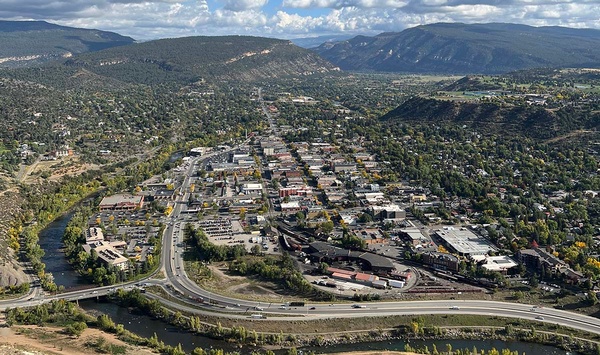
Since starting last fall, the local Strong Towns group meets monthly to discuss small incremental steps that can be taken to make Durango a stronger town based upon five tenets: housing, streets, highways, parking and accounting./Photo by Missy Votel
Durango isn’t necessarily a weak town, but it isn’t a strong town, either. For all its good points, it still has a high cost of living, shortage of affordable housing and lack of well-paying jobs, among other drawbacks. And for the nonprofit organization Strong Towns, that is a problem.
Founded in 2009 by Charles Marohn, the Minnesota-based organization has created a system to objectively measure if a town is strong – or weak. Marohm, whose background was in engineering and city planning, often faced the same frustrations as anyone advocating for civic improvements: stubborn officials resisting change and financial roadblocks. Which, to be fair, are often one in the same.
Since starting, Small Towns has exponentially grown and serves communities around the world, including a chapter recently launched in Durango. The local arm was started by Alan Millar, a life-long bicycle commuter who has spent time bike touring in Europe. Those experiences made him realize that the United States is severely lacking in a lot of things, specifically bicycle/pedestrian infrastructure. Things here, he thought, could be done differently.
About four years ago, he found out about Strong Towns, did some research and reached out to see how he could get involved. Trying to change the whole country at once was a little out of his league, so he decided to help his local community first.
Millar got the local chapter off the ground last fall and held the first monthly meeting at Anarchy Brewing, where it has taken place ever since. The group (which includes yours truly) meets to talk about things that make Durango a strong town and, more specifically, what can be done to make it stronger. So far, topics have included: bicycle and pedestrian infrastructure and safety; the proposed (and now defunct) mall acquisition; and economic strengths. Meetings have also tied in environmental impacts and issues, and pointed out the importance of cohesive advocacy.
“I think every town needs some version of a Strong Towns initiative,” Millar said. “Durango has all the problems of mountain communities in Colorado, but we also have a chance to remain a working and college town that relies on tourism but is not consumed by it.”
In all, Strong Towns is based upon five pillars:
• Housing: This includes more affordable housing, obviously, but also less governmental restrictions on building housing. Strong Towns believes that if it’s easier to build high-density and/or multi-family homes, housing becomes more approachable for everyone. Locally, this means less building restrictions, fees and ordinances as well as more restrictions on short-term housing. In Durango, we recently saw one step toward this with a win for ADUs and the elimination of minimum parcel requirements.
• Streets: This is probably the most discussed, because it is so layered and, disappointingly, so controversial. Working toward safer streets makes a lot of people angry for some reason. But Strong Towns has a great approach, in that they try to make street safety as easy, simple and innovative as possible.
They often take examples from the world’s safest streets (not surprisingly, usually in Europe) and apply those ideas here. Many of the suggestions don’t include major construction or deep budgets, but instead promote simple things like different striping patterns, better placed stop signs or more street lighting. Of course, permanent infrastructure like bike lanes and pedestrian paths are acknowledged, but, holistically, the goal is to “prioritize human movement, not automobile movement.” And sometimes even a stop sign or two will help do that.
Additionally, according to Strong Towns, streets are also a direct picture of a town’s economic vitality. If done properly, safe streets enable folks to spend money, make money and create community. The easier it is to get around, the more likely people are to keep local dollars moving.
• Accounting: Strong Towns calls for transparency when it comes to government spending, and more so, to create a clear outlook for what future spending will look like. It advises to take care of what you have and think about the long-term costs for what you might build. For example: if a city builds new infrastructure, that development brings in some quick revenue. But the long-term cost of maintaining that infrastructure is far greater than the revenue generated. When the bills come due, the city doesn’t have the money, so it approves more development on the edge of town to get another hit of short-term cash. And the cycle repeats.
If you want a clear picture of this, think of all the strip malls and big box stores that were built and have since been abandoned or roads and highways that are in desperate need of repair. In other words, if you can’t make it last, don’t build it to begin with.
• Parking: Honestly, any time I hear this word, my eyes roll 720 degrees. It’s not because of parking itself, it’s because of the people who fight tooth and nail, at the expense of their own sanity and relationships, to preserve their right to VIP parking. I can’t tell you the number of city meetings I’ve attended where folks scream at city staff because a couple parking spots might go away. And yes, that’s me scowling at you from across the room.
Anyway … Strong Town’s approach to the “P” word is to – hold onto your knickers – get rid of parking requirements. This is so developers aren’t forced to spend time and money paving over land that could otherwise be used for housing, green spaces or other things that benefit quality of life.
Fighting for your life about parking is one thing, but forcing businesses and homeowners to provide a certain number of parking spaces is a whole other thing.
Honestly, all bad signs point to parking. Let’s just get rid of it all together.
• Highways: Highways are gross-looking, and we all know it, but they also are a huge sunken cost because of upkeep and requirements to keep things moving. Studies show that they don’t actually bring in any money because, if you think about it, you’re usually on a highway to quickly move in or out of a city, not necessarily stop at the local bookstore or coffee shop. This isn’t a major problem for Durango – yet. However, it does help identify what infrastructure we should spend our money on in order to get a return; i.e. infrastructure that prioritizes humans, not cars just passing through.
Millar hopes the conversations around these topics become a collection point not just for the group, but other organizations around town, and that Strong Towns can help bring about positive change.
“Other neighborhood and community groups have discovered our meetings and joined in at times,” he said. “This may be because we meet at Anarchy. But I think it is really because there are lots of folks in our town who want to make it a better place.”
He also said city councilors and staff have joined in on the meetings to work on the next, incremental improvements, which is what Smart Towns is all about. “I know it’s not an easy process to change the way our city operates … The Strong Towns approach is to figure out what the smallest incremental change would be and organize to try and make that happen,” Millar said.
Durango Strong Towns meets the first Wednesday of each month at 4:15 p.m. at Anarchy Brewing. The next meeting is March 4. To find out more, email: strongtownsdurango@gmail.com
-

- An Americana icon
- By Chris Aaland
- 08/31/2023
-
Folk Fest headliner on climate change, indigenous rights and summer road trips
-

- 'Matli crew
- By Chris Aaland
- 06/29/2023
-
Party in the Park returns with Latin rock supergroup
-

- The bottom of the barrel
- By Chris Aaland
- 08/19/2021
-
After 14 years, ‘Top Shelf’ hangs up the pint glass
-

- Back in the groove
- By Chris Aaland
- 07/29/2021
-
Local favorites the Motet return for KSUT’s Party in the Park
- Half a century
-

- 05/26/2022
-
A look back at the blood, sweat and gears as the Iron Horse turns 50
- Bottoms up!
-

- By Stephen Eginoire
- 05/27/2021
-
With this year's runoff more like a slow bleed, it is easy to let one's whitewater guard down. But remember: flips and swims can happen any place at any time.
- Cold comfort
-

- 12/17/2020
-
Seeking solstice solace in the dog days of winter
- A Grand escape
-

- By Stephen Eginoire
- 11/19/2020
-
Pandemic fatigue? Forget the world with three weeks on the Colorado