
A bear of a year
2025 was a very bad year for local bears; 2026 may be even worse

A resident black bear parks in a tree in Durango in 2025. Last year, La Plata County led the state in bear reports, euthenasias and relocations./ Photo courtesy Bear Smart Durango
The bears are only just emerging from their seasonal slumber, yet local wildlife officials and experts are already worried. The winter, if you could call it that, has been the driest and warmest in decades – with the local snowpack sitting at just 21% of normal – leading to fears over a lack of bears’ natural food sources.
“Unless we get a ton of rain this spring, everyone's thinking this is going to be worse than last year,” Bryan Peterson, director of Bear Smart Durango, said this week.
And for the record, last year was a doozy.
In 2025, according to Bear Smart Durango, La Plata County was the statewide leader in total bear reports (1,549); the number of bears relocated (22); and the number of bears euthanized (19.) Another 30 bears were killed by vehicles, two by landowners and two by “other” means.
In contrast, there were 5,298 bear reports throughout the entire state, with 52 relocated and 78 euthanized. This means 24% of bear euthanizations and 42% of relocations occurred in La Plata County, representing increases of 66% and 42%, respectively, over 2024. (For more detailed stats, see the handy dandy Bear Smart graphic on p. 2 in this week’s Telegraph.)
So what gives? Well, as with most things of this nature, it’s complicated.
“Natural food conditions across our area were incredibly poor last year,” John Livingston, CPW Southwest Region Public Information Officer, said. “We saw that reflected in higher levels of conflict and even saw it in female bears abandoning cubs.”
Nevertheless, he said there is still hope that this summer won’t be as bad as the last. “While we know the snowpack this year is historically bad, it is too early to know what production of natural food sources will look like,” he said. “The biggest problem is if we get a freeze now that kills off production of natural food sources, that could lead to a very bad year.”
The southwest corner of Colorado is prime bear habitat, with the omnivores preferring the area’s abundant oak brush, which provides a main source of food. Of course, when these natural food sources falter, the so-called bear problem turns into a human problem. When bears can’t find their typical rations of acorns and berries, they wander into yards looking for an easy meal – usually dining from an unsecured trash can or fruit tree. Once bears become habituated to these quick hits, conflicts with humans arise.
“While natural food conditions do correlate directly to many of Durango's worst recorded years of human-bear conflict, the continuing expansion of human development in areas that are quality bear habitat also play a role,” Livingston said. “All of Durango and its surrounding areas are ideal black bear habitat, some of the best in the state.”
According to Amanda Garrison, Public Information Office for the Durango Police Department, out of bear 322 incidents logged in 2025 with her department, 300 involved trash.
“The overwhelming majority of bear-related incidents were tied to trash as an attractant which really underscores that unsecured garbage continues to be the main driver of conflicts in the city,” Garrison said. A majority of the calls within city limits were handled by the city’s Code Enforcement division, which operates under the umbrella of the Police Department.
Under city code, residents who are caught failing to secure their trash from bears will be issued a wildlife-resistant trash container, which includes a one-time delivery fee of $100 and a $4.35 monthly fee for 4½ years (until the can is paid off). They are also required to pick up the scattered trash within 24 hours. A second violation carries a $100 fine and subsequent violations are $200. In the county, fines for failure to secure trash are $200.
However, Garrison said the City rarely issues fines, preferring education over enforcement. In 2025, only one citation was issued, with 25 written warnings, 23 verbal warnings, 41 education/bear-awareness actions, 119 trash can repair orders and 224 “citizen assists.”
“From the city’s standpoint, the approach in 2025 was largely education- and compliance-based, with citations used very sparingly,” said Garrison.
And while residents who experience a temporary lapse in judgement or a faulty locking mechanism on their trash can may be thankful for the leniency, Peterson would like to see the City add more teeth to its ordinance.
“Education without enforcement has little impact in changing human behavior in not feeding bears,” said Peterson.
He points to the Aspen-Snowmass area – another hotbed for bear activity – as an example. In 2024, Aspen and Snowmass Village hired full-time wildlife coordinators and created a bear hotline. As a result, the town saw a 69% increase in compliance with trash containers and a 25% decrease in trash accessed by bears.
“In 2025, CPW had 86 reports of trash accessed by bears in Pitkin County, home to Aspen and Snowmass Village. Officers in both communities conduct proactive evening-before and morning-of bear and trash patrolling,” Peterson said.
La Plata County had a similar bear resource officer position, funded by a $350,000 grant from CPW, in 2024. But, the funding ran out and the job was terminated halfway through 2025. However, in that short year and a half, Peterson said he saw a marked decrease in reports of human-bear conflicts.
“I think a big part of it is, it's really hard to get people to change their behavior when there's no threat of penalty,” he said. “And just having an officer going out doing morning patrols throughout the county definitely helped with awareness and compliance.”
Peterson, who has been working with Bear Smart since its inception 23 years ago, said he first proposed the idea of a dedicated bear trash officer in 2009. He said there was talk when the City ended its agreement with the La Plata County Humane Society last year and took over animal protection duties that the city would hire additional officers to work on bears and trash. “But then they said no,” Peterson said. “What's going to happen is currently unknown.”
Garrison said she was not aware of any plans to reinstate the position. “That was a county position in partnership with Colorado Parks and Wildlife, so I won’t speak for the county on funding or staffing decisions tied to that role,” she said.
For its part, in February, the City passed an ordinance allowing residents to use electric bear mats and fencing, which is a step in the right direction, Peterson said.
And speaking of deterrents, Livingston urges residents not to be shy about scaring bears off. “It is OK to haze a bear away. Don't make them feel comfortable around your homes,” he said. “You can yell, bang pots and pans, set off car alarms, use an airhorn or otherwise try to scare a bear away and leave them with a negative correlation with being around human spaces.”
Looking ahead to 2026, Garrison said education and prevention are still the biggest focus for the City. “Public outreach, reducing attractants and getting residents to take those preventive steps early are really the best tools we have for cutting down on conflicts before they escalate,” she said. “Enforcement is part of that picture, but community awareness and cooperation are what make the biggest difference over time.”
In the meantime, Peterson is optimistic that more money will become available to fund a bear resource officer. CPW is holding another round of grant funding for human-bear conflict reduction programs for 2026, with applications due May 29. Time will tell if Durango or La Plata County is a recipient.
“We know what the answers are; we've seen it in other communities across the West and Canada – Aspen and Snowmass are great examples, with dedicated employees that do bear-in-trash work in the summer,” said Peterson. “We’re a community trying to address growing conflict by not addressing the No. 1 cause of human-bear conflict: trash.”
Bear Smart will host its inaugural “Bear Film Festival” fundraiser at 6 p.m., Thurs., May 7, at the Durango Arts Center, 802 E. 2nd Ave. Stay tuned for dets.
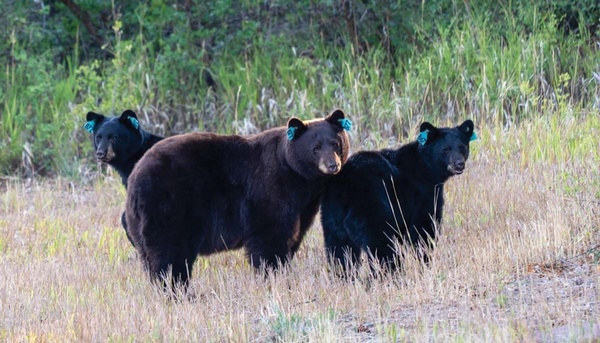
A family of bears sports the telltale blue ear tags in Durango in 2025. Bears are tagged by wildlife officials for many reasons, including population monitoring, research and tracking bears that have been relocated or run into trouble in the past./Photo courtesy Bear Smart Durango