
A growing interest
Farming revival in the Animas Valley as much about land as lifestyle
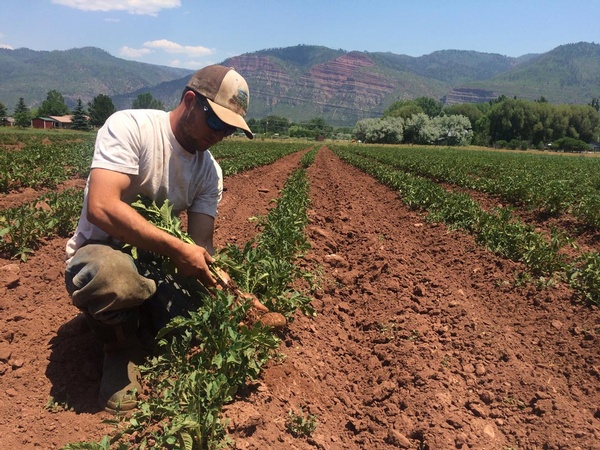
Tom Markle, owner of 550 Farms, located on the south end of the Animas Valley, tends to his crops on the land he leases. This is his fourth season farming here./ Photo by Jules Masterjohn
I’d rather see a cow than a condo,” states an iconic, barely readable billboard west of Hesperus on Hwy 160. This sentiment appears to be alive and well in the Animas Valley as well, where efforts to preserve the land and its agricultural heritage are being championed by everyone from long-time valley families to first-generation farmers.
Falling into the old-school category is the iconic James Ranch, located on the north end of the valley. Owners Kay and Dave James and their extended family recently placed a large section of their 420-acre ranch into a conservation easement, preserving it for agricultural use into perpetuity.
Farther south down the valley, Patty and Ed Zink, at the historic Waterfall Ranch, have been restoring wetlands since 2006, converting hayfields back into wildlife habitat. In June, the Zink family celebrated its 100th anniversary on the land.
The James and Zinks are active examples of a growing number of area residents who believe a livelihood made from the land has intrinsic value beyond money.
“I walk out my door, and I am at work,” Tom Markle, the one-man operation known as 550 Farms, said. He operates his farm on leased land at the south end of the valley. Now farming his fourth season, he said it’s exhausting work, especially at the beginning of the growing season. But the rewards of being outdoors, growing food and being his own boss keep him going. “Working for myself is priceless,” he said.
Markle recently expanded his organic vegetable farm onto additional acreage on the historic Feller farm, located across County Road 203 from the Animas Valley Grange. Dating back to the 1940s, he said the Feller family was a major grower of produce in the valley. In honor of their heritage as celery farmers, this season Markle planted 1,500 celery plants. He said growing the crop made more sense back then, when the area was in the flood plain. “Since then, the water table has changed,” he said.
Across the valley and farther north on CR 250, young farmers James Plate and Max Fields, of Fields to Plate Produce, are engaged in the revival of the valley’s agricultural heritage by restoring an earthen root cellar that was last used in the 1970s. They will begin using it this fall to store numerous varieties of organic carrots and beets that are grown on leased land nearby.
This year, Linley Dixon and her husband, Peter, of Adobe House Farm, moved their home, family and farming operation from leased land off 32nd Street to a 6-acre parcel just off Hwy 550 in Hermosa. The Dixons are in the process of buying the property, said Dixon, so they can make an investment in the land and build the soil so it is more productive than when we found it. “Renting land is so temporary – new farmers are searching for their own place so that they can stay on their land forever,” she said.
Dixon admits that in spite of the challenges of farming on leased land, long, hard hours of physical work, and the uncertainty of the weather, it is encouraging to see more people growing food, whether for profit or personal consumption. People are finding ways to satisfy a desire to connect to the land and to their food.
Deb Paulson, who lives in Hermosa and serves as the secretary for the Animas Valley Grange, said folks are returning to what families used to do here, with multiple generations living together on the land. And for those who can’t do that, there’s a smaller-scale resurgence as well. “Our neighbors, on 11⁄2 acres, raise milk goats, ducks, rabbits and chickens,” she said. “I think while most people decide it is hard to make a living farming, they fill their calling to the land with backyard production for their own enjoyment and food production.”
When Paulson and Marie Roessler, valley resident and president of the Grange, saw the renewed interest in back- yard farming, they strategized how to position the Grange as a social gathering place and education hub for agricultural practices.
“Granges need to be alive. What occurred to me is, ‘How do you grow a grange?’” said Roessler. Along with renting the Grange out for a weekly yoga class, the Grange started a speaker series covering
general topics from how to raise bees to identifying back-yard apple varieties.
“A growing number of people are interested in what they are eating – we want the Grange to be a resource to the community ... not just the farming community,” she said. “The Animas Valley Grange is part of the national movement to eat unadulterated food that is concerned with healthy land and clean water.”
Dixon added, “It’s exciting that quality agricultural land is so near Durango. That means people can easily find a connection to the natural world through eating healthy, local food.”
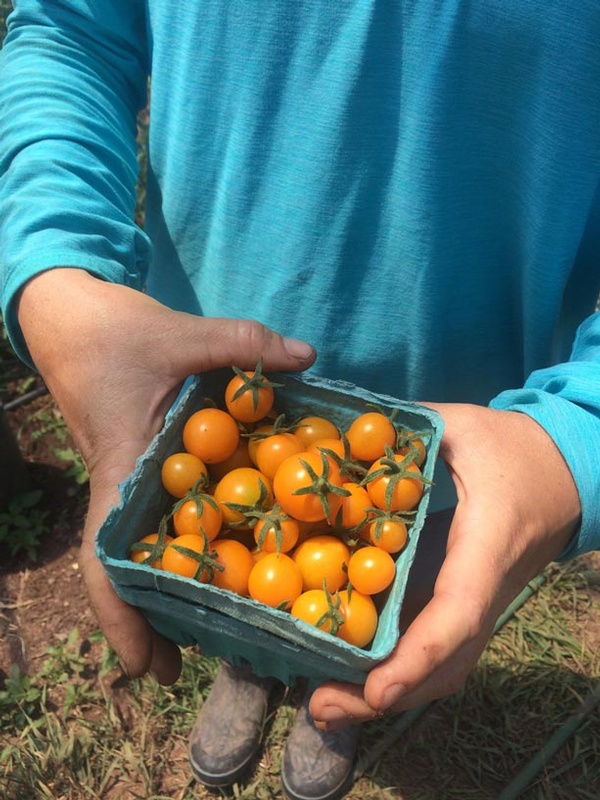
Linley Dixon, of Adobe House Farm, holds a stash of sungold tomatoes. She and husband, Peter, recently bought their own Animas Valley plot after years of leasing./Photo by Jules Masterjohn