
A new hook
Overfishing, pollution lead former Sushitarian owner to retool mission
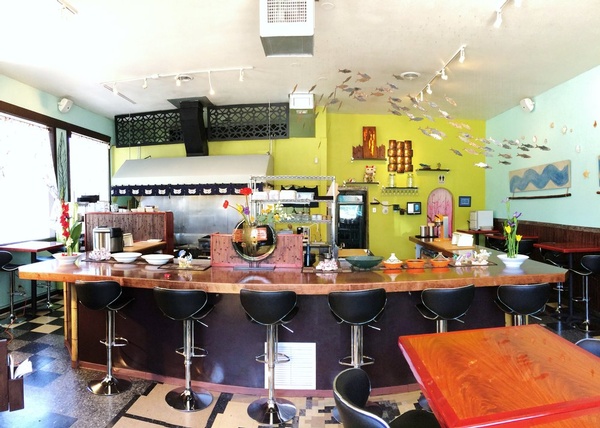
Turns out Durango’s newest restaurant on the block isn’t so new after all. Toshi’s, an Organic Kitchen, is the latest iteration of former local favorite Sushitarian. But, after a three-year hiatus, the restaurant has been reborn with a new menu and mission: save the health of Durango and the world, one bowl of enzyme rice at a time.
The newly reopened restaurant has expressed the goal of becoming a certified organic restaurant. This is no small feat. As of now, only a handful of restaurants nationally have gotten the certification. Washington D.C.’s Restaurant Nora was the first to be certified in 1999, but it closed in June after 30 years in business. Toshi’s would be the first in Colorado to receive the certification.
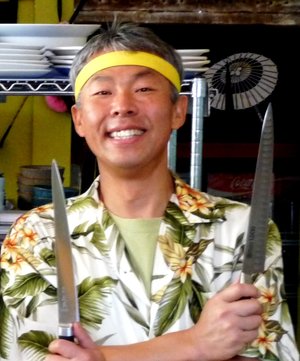 |
To become a certified organic restaurant by the USDA, a restaurant not only has to use organically sourced products but has to maintain organic integrity throughout preparation and serving. For many restaurant owners, it’s too hard a requirement to meet, let alone keep up. Not so for the owner and chef of the eponymous kitchen, Toshihiro Hiraoka. When asked if he was nervous about obtaining the certification and meeting the stringent standards he responded with his characteristic electrifying grin, “Not at all.”
As exciting as the shift may be, sushi lovers may not be so excited. The restaurant will no longer be serving up the dragon, caterpillar and dynamite rolls that once were its mainstay. Why the sudden change of heart? Hiraoka, better known as Toshi to locals, said as ironic as it may sound, it’s really all about the fish.
“I grew up by the ocean, I love fish,” he said.
But to understand the whole story, one must start way back at the beginning, the small coastal town in Japan where Toshi grew up. His father was a fish trader, so Toshi spent most of his childhood playing in the fish market. “That was my playground,” he smiled, while not-so coincidentally also wearing a “Life is Good” shirt. “Kicking jellyfish, throwing fish to the seagulls and seeing all the schools of fish. That’s how I grew up. I loved fish.”
When he became an adult, he moved to Tokyo where he learned how to prepare sushi. He continued working with sushi after moving to San Francisco in the ’80s, where he joined the local Audubon Society. But he said after environmental protections were relaxed for the Bay Area, he watched the bay he had come to love become polluted and dirty. “There were signs that said ‘No swimming’ and ‘No fishing,’” he recalled.
Eventually the degradation was too much, and he left the Bay Area for the mountains. He spent a few years as an opener for sushi restaurants around the West, helping them get established in different places. Finally he decided it was time to settle down and start his own restaurant. His sushi knife landed in Durango, where he opened Sushitarian at the corner of College Drive and East Second Avenue in 2005. He said he chose Durango because it “was the limit” – the farthest he could get into the country while also having a population to support a sushi restaurant. Toshi laughed musing that any farther into the country and he’d be serving bears.
He said he was also impressed that such a small mountain town could have so many natural food stores, three at the time. “I was very happy with this community,” said Toshi.
However, while Sushitarian had become a local favorite, with its cheap happy hour and casual neighborhood sushi bar feel, Toshi was growing increasingly disenchanted with the effects of overfishing. And it’s no small wonder. In 2010, the United Nations reported that 85 percent of the world’s commercial fishing stocks were exploited, overexploited, depleted or recovering from depletion. In layman’s terms, we were, and still are, fishing the ocean dry.
“About eight years ago, I started to feel guilty,” said Toshi.
One solution to overfishing was to buy farm-raised fish. But that wasn’t necessarily an improvement for the restaurant. The quality of the farm-raised fish was inferior to wild-caught fish, and Toshi noticed that the bone structure of the fish had changed and the spines were deformed. Add to that the fact that most farmed fish are loaded with antibiotics, which contributes to the growing problem of antibiotic resistance, and the decision was clear. “Every time I sliced a fish, I felt guilty,” he recalled. There was no way around it for the nature-loving Toshi, the sushi had to go.
Before he tossed the fish – not to mention his restaurant’s beloved name – out with the bathwater, Toshi considered serving organic fish. But the cost would have been too extreme. While such prices might be OK in New York or San Francisco, locals might balk, and there was no way Toshi wanted to do business anywhere else.
So, sushi had to go. But rest assured for die-hard fish lovers, if the lack of sushi smells fishy, the new menu isn’t totally without its gilled offerings. Toshi’s does offer albacore tuna, the only fish he trusts to serve. “Albacore is still sustainable and still safe,” said Toshi. As well, Monterey Bay’s Seafood Watch lists albacore as a “Best Choice” on its Consumer Guide (www.seafoodwatch.org.)
Of course, there’s no way a fish caught in the ocean can be labeled organic. But for the coastal native, that’s beside the point. “Fish have to be free to swim around,” he said. When he thinks of farmed fish, even though new techniques may make it organic, he cringes. “So many fish in a small area, I think, is not tasty,” he said.
Once he decided he was done with sushi, Toshi needed to figure out what he was going to do next. The sea change in the menu would require some careful thought, so he shuttered the restaurant for several months and took off back to Japan.
In that time, he also happened to get married and start a family, but he knew he would eventually come back to Durango. Returning to town last winter, he said he had half a mind to sell the space. But once here, he remembered there was nowhere else he’d rather be.
So, he decided to take the plunge into uncharted waters: an all-organic, healthy-minded restaurant. And sorry – until it can be caught sustainably, no sushi. According to Toshi, it took five months and help from organic consultants from around the nation to get the restaurant up and running. “It was all new for me,” said Toshi.
While the inside of the restaurant may still look familiar, a lot of the kitchen appliances had to be scrapped, like the deep fryers. He said he got rid of them because he couldn't find organic fry oil that was affordable. “My tempura was going to be a hundred dollars,” he said.
Not only that, Toshi had to delineate between organic suppliers and those who merely claim to be “green.” Like Kermit the Frog with some soap, the food industry is ripe with green washing. “What is ‘green pork?’” mused Toshi, “It makes no sense.”
But the revamp of the restaurant doesn’t only seek to make a difference in the environment, but bodies as well. “People want a good car, a good house, good clothes, but they first need a good body,” said Toshi. He sees a lot of the medical problems that people have as being the result of using “the wrong gasoline.”
Therefore, one of the most prevalent items on the new menu is enzyme rice. The rice is part of the restaurant’s “sandwiches,” which use the rice as a “bread.” Toshi swears by it, promising that eating the rice, which is loaded with digestive enzymes, six days a week for two weeks will revolutionize one’s digestive tract. Other offerings include “Fat Burning Soup,” “Healing Vegetable Box,” “Mixed Dandelion Salad” – and well, you get the idea.
“A lot of the food on the menu, like the enzyme rice, is meant to promote healthy living,” said Toshi.
In addition, all dishes are gluten-free and many are vegan, too (but not to worry, meat-lovers, there is a green chicken curry and James Ranch skirt steak on there, too.) The restaurant even makes its own drinks and its own pickles (complete with gut refurbishing micro-flora). Eventually, Toshi hopes to make it a zero-waste enterprise and set up a composting system as well. To that end, many of the portions are smaller than what most Americans have grown accustomed to. “Our meals are designed to be eaten in full, they're not overly big,” he said.
When musing on his new mission, Toshi said it was something he couldn’t refuse. “I saw how beautiful the ocean was, but not now,” he said, with a slightly dimmer smile. “I can’t get out now. I have to push myself to make a difference for the next generation.”
If you’re interested in testing the new Toshi’s, stop by the corner of College Drive and East Second Avenue. A menu can be found at: toshisorganickitchen.com. They’re open for lunch and dinner Wednesday through Sunday.
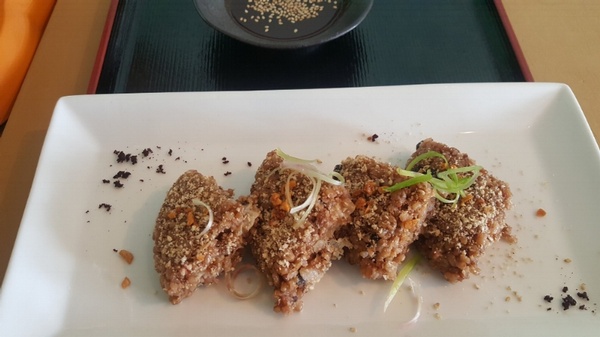
Toshi's "tuna sandwich," using enzyme rice as "bread."/ Courtesy photo