
A new reality
Is paying ranchers to raise 'wolf friendly' beef the answer to conflicts?

Ranchers meet at the McCabe Ranch in Old Snowmass on June 11. / Photo by Kelsey Brunner, special to the Colorado Sun
(Editor’s note: The following is the second in a two-part deep dive into conflicts – and potential solutions – between wolves and ranchers on the Western Slope. The story first appeared July 6 in Colorado Sunday, a special magazine of The Colorado Sun.)
Idaho rancher Lowell Cerise’s idea to pay Roaring Fork Valley ranchers – either through private donations or funds from a nongovernmental organization – to live with wolves may sound crazy. But it’s not without precedent.
In 2019, The National Wildlife Federation paid fair market value for a 33,000-acre Upper Crystal River Valley grazing allotment to protect native bighorn sheep from pathogens that could have been carried by domestic sheep.
In 2023, the federation paid a family of sheepherders an undisclosed amount to waive their grazing permits on 10 large, high-elevation allotments in the San Juan Mountains near Silverton for the same reason.
And in 2022 in Montana, the federation partnered with a conservation-minded rancher besieged by grizzly bears on his grazing allotment along the Madison River near Yellowstone National Park. The federation says “what started as an attempt to retire grazing from a portion of the allotment transformed into a new model in addressing conflicts” when they negotiated a 12-year deal with the rancher in the form of a forgivable loan of $300,000 if the rancher used nonlethal management strategies (paid for by the wildlife federation).
But some think ranchers should be doing more to advance coexistence without any special benefits.
Rainer Gerbatsch, an Arvada resident and vocal wolf supporter with the advocacy group ColoradoWild, thinks the plight of ranchers gets too much play in the media.
“What about the rest of the world? What about the rapidly changing climate in the West, in Colorado, the water scarcity, the riparian destruction?” he asked The Colorado Sun in an email.
And why the hyperbole over a few ranchers losing a few cattle, when, according to the USDA’s 2024 Colorado Agricultural Overview, Colorado’s cattle inventory in early 2025 was approximately 2.55 million head, while confirmed wolf-related cattle losses for 2024/ 25 so far are less than 30.
Extreme focus on the so-called negative impacts of wolves upsets Gerbatsch as a grandfather worried about his grandchildren’s future, and wolves “are ecological regulators,” he wrote. “Their presence initiates trophic cascades that restore riparian vegetation, reduce elk and deer overbrowsing, limit mesopredator populations (such as coyotes) and indirectly enhances carbon storage through increased vegetative cover … when Colorado is entering a new era of climate stress.”
Gerbatsch thinks killing “a whole wolf family” or putting it in a sanctuary is not a solution. “Once ... the next predation occurs the same people will be screaming again to kill the next family for the noble cause of saving the wolf reintroduction program!” he wrote. “Coexistence is not a checkbox. It is a dynamic, adaptive practice requiring commitment, communication, ecological knowledge and trust.”
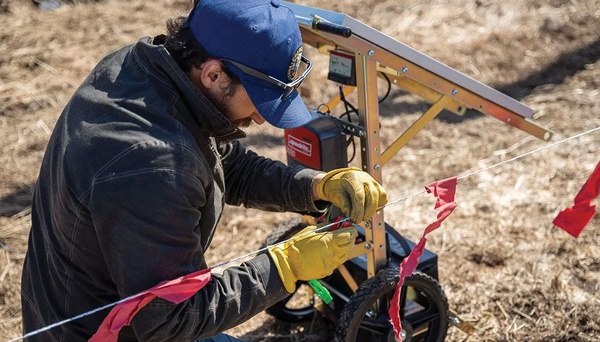
A CPW wolf conflict coordinator installs fladry – flagging used on fences around ranches to deter wolves from harassing or attacking livestock./ Photo by Rachel Gonzalez, CPW