
A plan for all seasons
The time has come to get a handle on recreation northwest of Durango
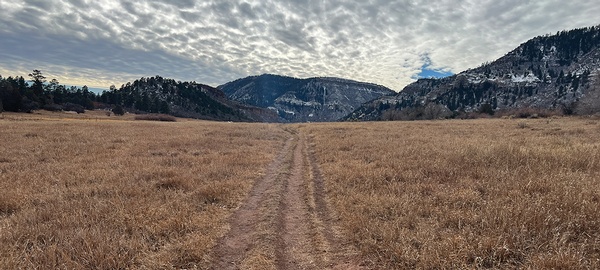
Falls Creek in December 2022. A?little known fact – all of the trails in Falls Creek are technically unauthorized. A new recreation plan aims to better manage the area./ Photo by Missy Votel
If you enjoy recreating on the public lands northwest of Durango – think Junction Creek, Kennebec Pass, Animas City Mountain and Falls Creek – you might want to listen up.
The U.S. Forest Service is about to launch a long-range, robust recreation plan for what’s being called the “Durango Northwest Recreation Project,” in the general aforementioned area. An open house will be held 5-7 p.m. Thurs., March 2, at the San Juan National Forest Headquarters Office at 15 Burnett Ct.
A couple years ago, the Forest Service started planning for the “Junction-Falls Integrated Resource Management” (J-FIRM) project, which, among many goals, was largely focused on developing a plan to reduce wildfire risk.
The area in question, on the northwest outskirts of Durango, is within the “wild-urban interface,” a zone between wilderness and development that could pose a risk of wildfire to the city of Durango.
Included in J-FIRM was an effort to manage all the recreational pressure in the area, which have been exacerbated since the increased use on public lands in the wake of the COVID-19 pandemic and the rise of social, unauthorized trails.
It became clear, however, that the recreation side of the plan was far too complex and complicated, warranting its own separate process, Nick Glidden, the San Juan National Forest’s Columbine District Ranger, said.
As a result, the Forest Service started a separate plan for recreation, allowing the agency to go ahead with fire mitigation efforts. “We didn’t want to slow down that project when the threat (of wildfire) is real,” Glidden said.
Hikers, mountain bikers, ATVers, snowmobilers and skiers all use the public lands northwest of Durango. It’s home to the southern terminus of the Colorado Trail, the popular Log Chutes mountain biking trails as well as the heavily used Falls Creek area.
Tackling recreation management will be no easy task, however. Many of the trails, for instance, aren’t even authorized within the Forest Service trail system (and that includes Long Chutes and all of the trails in Falls Creek).
Parking, too, is a continual problem, leading to even more social trails. Many unauthorized trails, Glidden said, travel through important wildlife habitat. And, there are a vast number of important Native American cultural sites, especially in Falls Creek, at risk.
“It’s just not possible to have trails everywhere, especially when they’re in areas that come at an ultimate detriment to other resources,” Glidden said. “We really need to go into this landscape with a holistic approach.”
The “Durango Northwest Recreation Project” is in the very early stages, Glidden said. The open house on March 2 is the first major community engagement, but it won’t be the last. He expects the process could take more than a year.
“As of now we’re just at the drawing board,” he said. “And we want the public’s input.”
When original J-FIRM documents were released, the Forest Service did include some ideas for recreation improvements, which are still just proposed ideas.
For starters, the Forest Service proposed hardening (not paving with concrete) a small segment on the lower end of the Colorado Trail to be ADA-compliant, which would allow persons with disabilities to enjoy the area.
Also, the Forest Service proposed chip sealing Junction Creek Road up to the Animas Overlook but keeping the seasonal closure (Glidden said a common misconception he’s heard is to pave the road and keep it open year round). One idea, too, would be to groom the road under a special use permit in the winter.
Another misconception, Glidden said, is that the plan would open public lands on the west side of County Road 205 (Falls Creek Road) that are currently off-limits. The area, which is rich in Native American sites, will remain closed.
Glidden said some ideas are still on the table, but ultimately, it’s too early to say what the final plan will look like. “The menu of options is open, and we’re looking for things we’ve missed on the menu and taking input,” he said.
Dealing with social trails is another difficult component, Glidden said. While Log Chutes is not a system trail, it is well-known and heavily used. “We’re not naïve to that fact,” he said.
The challenge going forward will be finding a balance to keeping trails open while not sacrificing other resources, like wildlife such as elk and deer that use the habitat, especially in winter.
“This area has a ton of sensitive resources in it, and we need to account for everything,” he said.
Indeed, Jimbo Buickerood with San Juan Citizens Alliance, said more and more studies are coming out about the adverse impacts of all forms of recreation on the environment, namely wildlife.
In Falls Creek, for instance, the whole reason a citizens group formed in the 1990s to save the area from a proposed massive development was to save elk habitat. Now, recreation has become the dominant use there, pushing out wildlife.
Ultimately, though, Buickerood said the Forest Service hitting the brakes and going back to the drawing board could have some seriously positive outcomes.
“There can be some really creative, smart way to use this area that could support all these recreational uses and support wildlife,” he said. “The community just needs to recognize that this resource now needs to be managed and maintained.”