
A slow retreat
Once a foregone conclusion, the death of coal is being dragged out
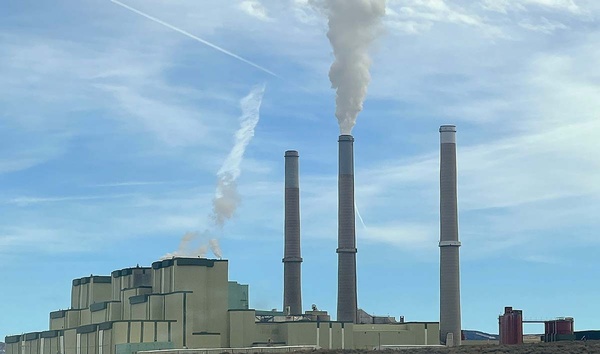
Smoke continued to spew from the coal-burning power station in Craig in January 2026. Slated to close at the end of 2025, a last-minute "emergency" order from the Trump administration kept it open, much to the detriment of Tri-State ratepayers./ Photo by Missy Votel
In Craig, the foremost coal town in Colorado, a sign a decade ago hung on a garden railing: “Coal Keeps the Lights On!” it insisted proudly, defiantly.
Coal really isn’t needed to keep the lights on. Maybe air conditioners. But coal-burning units in Craig, as well as Hayden, Colorado Springs and Pueblo, may linger past scheduled retirements because of growing demand from data centers and possibly wild, wacky and way-warm weather. Ninety degrees across parts of Colorado on the first day of spring? What does that mean for summer?
Most curious is the potential delayed retirement of coal units at Hayden. There, Xcel Energy had planned retirement of the two units in 2027 and 2028. But in a March 2 filing with the Colorado Public Utilities Commission, the company suggested it might want to delay retirement of the two units by a year or even until 2030. The company won’t say formally until June.
Then there’s Pueblo. Xcel was scheduled to close the second of three units there at the end of 2025. That was before Comanche 3, the state’s largest and youngest coal-burning unit, went down – again – last August. The company now says it can’t get the unit operating until this coming August. PUC commissioners wonder whether Comanche 3 will be available even then.
So much for coal being the reliable fuel. Unlike the sun, coal doesn’t set at night. However, Megan Gilman, a PUC commissioner from Edwards, noted this week that the coal unit at Pueblo has been down two of the six years she has served on the PUC.
Incidentally, Xcel has not publicly reported the estimated cost of repairing Comanche 3. Boulder’s Leslie Glustrom rightly asks why this information needs to be confidential. So far, the PUC has rebuffed her.
Xcel, said Eric Blank, the PUC chair, will likely have a shortfall of 492 megawatts of generating capacity this summer. He and other PUC commissioners want Xcel to step up its demand-side management, for example, getting large-demand customers to shift their use.
PUC commissioners were clearly unnerved by March’s high temperatures. “Given that Denver metro temperatures were 30 to 40 degrees above normal, it may provide more urgency in the company’s contingency planning for 2026,” said Blank.
Growth in electrical demand has been sluggish for a couple decades. However, during the last 18 months, Xcel has been making noise about needing more electricity to meet demands, particularly those of data centers. But just how much of that projected growth is real can’t be said right now.
Colorado legislators are debating whether to implement tax subsidies in an attempt to lure more data centers. A competing bill would erect tall guardrails regarding energy and water use.
No one really knows where this will end up. The two bills might cancel each other. A major consideration is whether Colorado can afford additional tax breaks during a time of relative fiscal austerity. The state’s budget gap has grown to $1.5 billion. That’s $500 million more than when the legislative session began.
Subsidies are always an awkward subject. Why tax cuts for data centers? Big tech is America’s wealthiest sector. Just seven companies are responsible for a third of the S&P 500.
Many people also object to tax subsidies for renewables. Meanwhile, fossil fuel companies have long enjoyed subsidies, this time for data centers. A case in point: Craig.
Nearly a decade ago, Tri-State Generation & Transmission planned to close one of its coal-burning units there on Dec. 31, 2025. But on Dec. 30, Energy Secretary Chris Wright cited an “emergency” in ordering the unit to stay open. That so-called emergency has caused head-scratching far and wide. People responsible for ensuring resource adequacy, i.e. keeping the lights on, said there were no worries this winter. It took Tri-State about a month to get the plant running again. Alas, it has not been used since.
Based on similar orders in Washington state and elsewhere, Wright issued another 90-day order on March 30.
Tri-State has not objected to Wright’s order but has challenged the cost. Why should it pay? It doesn’t need the power. Wright, at a recent press conference in Weld County, dodged the question. Instead, he cited revenues for a coal plant in Michigan exceeding the expense of keeping the plant open.
President Donald Trump, in his executive orders clearing the way for Wright’s emergency, cited “the expansion of artificial intelligence data centers.”
At a March 9 press conference, Wright was even more forthright about the need for coal: “If we’re going to lead in artificial intelligence, we have to lead in electricity production. In the last 20 years, we’ve tripled our oil production, doubled our natural gas production and barely grown our electricity production, because electricity is the part that’s been infected with politics, with over-regulation, with bureaucracy.”
So, to correct the problem, Wright is over-regulating with his bureaucracy in a decidedly political push.
Colorado Attorney General Phil Weiser, the Sierra Club and two other environmental groups appealed Wright’s order. Wright’s agency rejected it. In filings with a federal court in Washington, D.C., the Colorado organizations argued that the federal government had delivered no evidence of an emergency. Long-term concerns about power are beyond the scope of the law. Wright was out too far over his skis. The court case will likely take many months to resolve.
As for Colorado Springs, it was to have closed the Ray Nixon coal plant by the end of 2030. Now, it says it just can’t do so. It cites supply-chain problems and transmission constraints.
Supply-chain kinks and transmission are very real problems. Funny thing, to the north about 100 miles, United Power built a gas plant and has added a ton of batteries plus solar. It has Colorado’s most significant growth in demand. That includes power for new data centers. Still, United has figured out a way to move forward. So why does Colorado Springs think it needs to burn coal until 2035, even 2040?
No doubt, we all use data centers, be it storage of our photos or transcribed notes. The question is, what subsidies do these data centers require? Right now, it seems obvious that we plan to burn coal – and pollute the atmosphere – further into the future for this short-term gain.
Allen Best publishes Big Pivots, which tracks Colorado’s energy and water transitions. See more at BigPivots.com.