At the ready
Local land managers gird for what could be hot, dry spring and summer
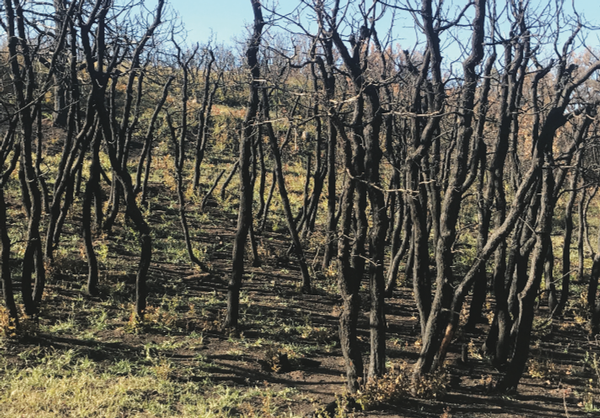
Durango's most recent fire was the Lightner Creek Fire, which torched more than 400 acres, including parts of Perins Peak (seen here) and forced the evacuation of 170 homes. Opposite this year, the area had enjoyed plenty of snow over the winter and had plenty of water in reservoir storage. The big difference was the lack of spring precipitation. By the tail end of the season, conditions were dangerously dry./Photo by Missy Votel
Heading into the first day of spring, March 20, with less than half of the region’s normal snowpack, it’s no surprise land managers and locals alike are already talking about the dangers of a hot, dry summer in the Southwest.
Aaron Kimple, program director of forest health for Mountain Studies Institute, said his organization has been getting calls from land managers and others asking about current conditions and what it all means for the coming spring and summer seasons. Questions like: What’s going to happen to the river season? What kind of fire danger are we looking at? How do I prepare for that?
In an effort to address those questions and concerns, Kimple – along with Jimbo Buickerood, public
lands coordinator for San Juan Citizens Alliance, and former Colorado state senator Ellen Roberts – came up with an idea to host a three-part “Forest and Fire” learning series. The series begins Wed., March 21, running from 6-8 p.m. at the Powerhouse Science Center.
In the first presentation, titled “Forest Health 101,” attendees will get the basics about forest health and wildfires – including key terms and an overall picture of the forests in this region – from Julie Korb, a biology professor at Fort Lewis College, and Kelley Barsanti, a chemical and environmental engineering professor from UC Riverside.
“We wanted to give people a basic understanding, lay the groundwork,” Laurel Sebastian, forest health education coordinator for Mountain Studies Institute, said.
The second night in the series is about understanding who’s who.
Representatives from FireWise of Southwest Colorado, La Plata County Emergency Management, San Juan National Forest, Colorado State Forest Service and San Juan Citizens Alliance will all be on hand. They’ll talk about their roles in forest management, fighting fires, insect infestation and, more importantly, how their decisions impact forest health.
They’ll also begin to address the dry conditions in the Southwest and how their local agencies are prepping for the spring and summer seasons.
The final night concludes with a conversation about the future – new management strategies, innovation, economic opportunities and other ways to improve how fires and forest health is managed in the years ahead.
One of the biggest changes to forest management in recent decades is that fire is becoming a critical component in the equation.
Wildfires had been a part of the landscape long before Smokey Bear came to life. In fact, the ponderosa pine, one of the most common trees in the Southwest, has a regular fire interval of 10-20 years, according to Kimple.
Suppression tactics over the past 100-plus years may have actually kept the pine tree – and the forest – from completing their natural growth cycle and, instead, allowed for unhealthy growth in the understory. Such overgrowth adds even more fuel for wildfires.
“As a community, we need to think about the health of our forests,” Kimple said. “We need to allow some fire back in the picture.”
The panel discussing these issues features state and federal Forest Service employees and local conservationists, as well as JR Ford with the Pagosa-based Forest Health Co. Ford has worked with the Forest Service in the past with fire mitigation, using innovative ways to clear and process some of the dead trees from the beetle infestations near Wolf Creek Pass.
One of the top things officials want residents to know is that local agencies are already working together to address current drought conditions.
“We’ve had several meetings across agencies,” Sebastian said. “We are all talking.”
Those who work on the prevention side of things, like with forest health, prescribed burns and fire mitigation, and those who work on the frontline of fire suppression, like firefighters and emergency personnel, are already collaborating on the best way to move forward this year.
“It’s easy to be concerned,” Kimple explained. “We all tend to reflect on 2002.”
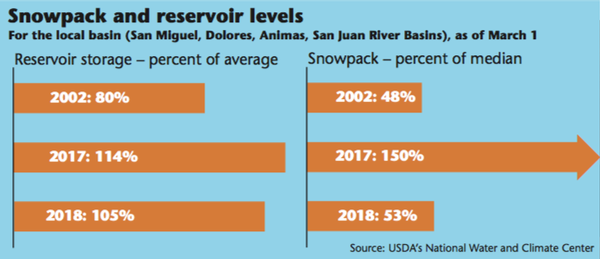
That year, the Valley and Missionary Ridge fires burned more than 72,000 acres just north of Durango, and the snowpack levels this year are similar to 2002. Today the percent of median snowpack, according to the USDA’s National Water and Climate Center, is 53. In 2002, it was 48.
One of the big differences between the current situation and back then, however, was the run of drought years leading up to the Missionary Ridge Fire.
The Southwest had been suffering from drought conditions for years. This year, however, the region heads into the spring and summer months with full reservoirs.
Reservoir storage for the local river basin, which includes the San Miguel, Dolores, Animas and San Juan, is currently 105 percent of average.
“It’s not exactly a 2002 year,” Kimple explained.
Another blaze on everyone’s mind is last summer’s Lightner Creek fire, which forced the evacuation of 170 homes a couple miles west of Durango.
Opposite this year, the area enjoyed plenty of snow over the winter months in 2017, and had plenty of reservoir storage. The big difference was the lack of spring precipitation. By the tail end of the season, conditions were dangerously dry.
According to the latest Drought Update from the Colorado Water Conservation Board, it’s unlikely local river basins will reach average snow accumulation this season.
A weak La Nin?a is still in play, and warm, dry conditions are forecasted this spring.
Kimple said it’s hard to predict what’s going to happen in the next few months. “Without a crystal ball, just having folks ready will help our community be a bit more resilient and prepared,” he added.