
Back to the future
City unveils draft of Comp Plan, asks for public comment
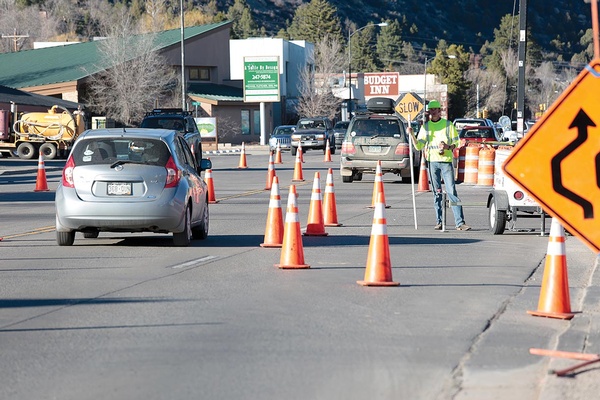
Although the Colorado Dept. of Transportation is paying for current construction on N. Main Avenue, upcoming changes to their funding formulas will force the Durango community to ask what future projects it really wants./Photo by Jennaye Derge
Imagine a sprawling entertainment venue, surrounded by open space and a new site for the La Plata County Fairgrounds atop Ewing Mesa; or, perhaps a new hub for homes and shopping to the south along a re-routed High-way 550 as it cuts across Webb Ranch on the mesa.
What if driverless cars become the norm, changing the way Durango and communities across the country manage parking, traffic and public transit?
All these possibilities and more make up the vision of Durango unveiled in the city’s Community Review Draft of the Comprehensive Plan, released March 13.
The plan offers guidance as the city grows and develops over the next 20 years. In fact, that’s the key assumption in the plan – it will grow. The population is expected to increase each year, topping 85,000 county residents by 2040.
In order to preserve Durango’s character while at the same time keep up with the demand on city services, staff and residents have collaborated over the past year to update the 2007 Comp Plan.
In a recent meeting, Durango’s Community Development Director Kevin Hall called it a cleanup of the 2007 plan, rather than a wholesale change. One of the key reasons for the cleanup was a change in the ownership of Ewing Mesa.
In the 2007 version, the mesa’s previous owner envisioned full-scale development with residential and commercial properties. The new owner, Mark Katz, has an entirely different vision – one driven by entertainment and recreation.
Future plans include a concert venue, open space and a new home for the La Plata County Fairgrounds. These changes also meant the city needed to consider other options when it comes to housing the growing population.
Development is expected to spike south of town, along La Posta Road, near Walmart, and along Highway 550 after it’s rerouted from Farmington Hill.
Not all the development, though, will happen on undeveloped land. The city also expects growth in and around the downtown area. With that in mind, the Comp Plan identifies future issues like height restrictions on buildings and land-use designations.
With all this growth comes the need for services, so the plan does address the opening of Lake Nighthorse, the need to provide water to the La Plata Archuleta Water District and La Posta Road, and the need to coordinate with La Plata County.
Housing is still one of the top priorities for the city. Completing a years-long housing study and addressing Durango’s shortage of affordable housing is likely at the top of the list for the city’s Community Development Department. It is followed closely by the development of the North Main and Camino del Rio districts and updating the La Posta Road plan.
Another stand out in the updated Comp Plan is the addition of an arts and culture element, which City Planner Vicki Vandegrift said people are excited about.
Durango’s arts community is considered a key component of the city’s identity and an economic driver in the region.
“The creative economy (which includes the arts, culture, science and heritage) is central to every aspect of life in Durango,” the plan reads. “Economic data shows that the formal nonprofit arts and cultural sector accounted for $9.1 million in economic activity in Durango in 2011.”
For years, city officials and residents have floated some big ideas for the future of Durango – from the arts and sciences STEAM Park envisioned along the riverfront to a host of new facilities, like a new downtown fire station, police station and City Hall.
What’s kept some of these ideas from translating into shovels in the dirt is money.
Funding is one of the top challenges, especially when it comes to transportation. “Durango will pursue a transportation system that is built and operated in a sustainable fashion,” the plan reads.
For the past several years, the city has wrestled with how to make its transit system pay its own way. The most recent attempt to quell the funding shortfalls was a $1 charge to ride the trolley. Although it’s brought in some revenue, it’s not nearly enough to balance the bottom line. And, the problem is only going to get worse.
Today, Durango’s transit system gets most of its funding through state and federal grants. However, according to city officials, the Colorado Department of Transportation plans to change the way it distributes grants to local communities. Under the new formula, Durango will lose almost half of its funding.
“Thankfully, we have five years to get our ducks in a row,” Amber Blake, Durango’s director of transportation and sustainability, explained.
Blake said the state plans to transition from its current funding formulas to the new ones over a five-year time period, giving communities the chance to adjust their budgets. With that in mind, Blake, along with the city’s Multi Modal Advisory Board, brought a list of possible future funding sources to a City Council meeting Tuesday afternoon.
Among the options were a new 1?2-cent sales tax, reauthorization of a 2005 sales and use tax, a marijuana tax, and lodger’s tax. Some additional ideas, which Blake called “more creative options,” were unoccupied-building fees, unimproved-lot fees and a “flush” tax on usage of city utilities.
The new 1?2-cent sales tax is the only option that could fund future expansions of transit services, according to Blake. These include offering consistent routes year-round instead of trimming schedules during the winter season.
But, not everyone was on board with new taxes.
City Councilor Sweetie Marbury expressed concerns with increasing city sales tax. Not only did she say it could hurt seniors, working class families and low-income residents, she felt it wouldn’t get voter approval.
“I agree with Sweetie,” added City Councilor Dick White. “The community is going to find it hard to swallow.”
After all, last November, property tax increases to fund roads, bridges and a new airport terminal were voted down. White also mentioned other funding needs, including housing and stormwater management. He said the needs are
real, and it’s a conversation the community needs to have. So with a vision of Durango’s future laid out in the up-dated Comp Plan, the question remains – where do residents want to put their money?