
Beyond guilt & granola
Durango Sustainable Goods rejects shame and stereotypes in favor of lasting, closed-loop design
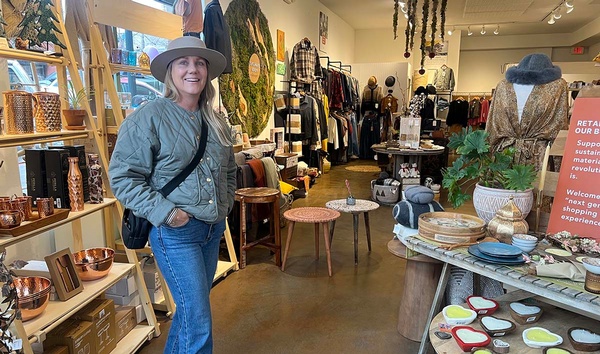
Owner Claire Attkisson inside Durango Sustainable Goods, which just celebrated a year at its space at 7th and Main. She shares the space with Emily Schmidt, who owns Revival Goods, a store focused on fair-trade items./ Photo by Missy Votel
In a world of throw-away goods, one Durango shop owner is working to turn that paradigm around. “It’s about supporting a sustainable material revolution,” Claire Attkisson, owner of Durango Sustainable Goods, said at the Main Avenue store recently. “That's the passion that I have; it's the focus. It's how I think in terms of the products that we bring in. It's really helping people to think newly about how we make everything,”
Attkisson has owned the store for four years – a year at its current location on the corner of 7th and Main. She said everything in the store, from reusable Q-tips to tote bags made of apple leather (more on that in a second) is made from upcycled or regenerative, aka “next-gen,” materials. She throws out a staggering statistic: 30% of our carbon output comes from the production of goods through the product's lifecycle, from raw material extraction to production, transport, usage and final disposal.
“It’s just looking at a closed-loop system, where we are not just throwing our clothes away, but we're actually seeing them as the material for something else,” she said. “It's switching from a linear extraction model – creating something beautiful, and it goes in the dump – to turning it more into a circular economy.”
Attkisson, who moved to Durango about 20 years ago and is originally from the Bay Area, became interested in the environmental movement in her 20s and went on to get an MBA in sustainable business from Pinchot University in Seattle. She said, like many, one of the big influences in getting involved in environmental movement was pioneering activist Rachel Carson and her watershed 1962 book, “Silent Spring,” about species die-offs due to pollution and habitat loss.
“There's a huge connection back to, obviously, Rachel Carson and understanding the pollution aspect of killing species,” Attkisson said. “But my lens is really more about, ‘How do we also understand the interconnections of what is causing us to cut down the forests in the first place? And who's making all the money doing that?’ And, you know, it's goods and services. So, there's this tension between jobs and the environment – it's a dichotomy.”
Admittedly, that is heavy stuff for your average shopper, who, say, is just looking for a cute sweater or purse. Which is exactly where Attkisson comes in. She said the goal of her store is not to “shop shame” people into feeling guilty about buying goods – after all, we all need toothbrushes and shoes. And the people making and selling the toothbrushes and shoes need jobs. Rather, it’s to show people the possibilities, and that consumption can be done in a way that’s easier on the Earth.
“I've started thinking about how do we look beyond that dichotomy?” she said. “We all need jobs. We need goods and services – exchange of goods and services is part of human life and nature. The evil is not necessarily buying goods. It’s the system, and it's what they're made of. I love to think about how do we not feel so guilty?”
Which is where something like the apple leather tote bag comes in. Attkisson said many so-called vegan leathers are made from petroleum, plastic and other toxic, non-renewable materials. However, apple leather – made from the waste that comes from juicing apples – is not only biodegradable but comes from a raw material that otherwise would go to waste. And while it still contains a polyurethan amalgam to hold its shape, she said it is much less than a typical vegan leather purse, say 10% compared to 90%. “So we've at least begun to flip the numbers,” she said.
Another thing she is working to flip is the idea that sustainable, earth-friendly equates to, well, ugly (think Earth Shoes of the ’70s, which the kids are probably making cool again) or low-quality. In the last few decades, Attkisson said strides have been made to make sustainable products that not only pass the test of time, but are actually stylish.
In fact, she got her start when friends would admire an item of hers and ask her to order one for them. Eventually, she was selling things from her former office in the Smiley Building (where she also rented e-bikes) and ultimately, opened a storefront in the 1200 block of Main, next to the Durango Herald’s building. She moved into the space at 680 Main, formerly home to the late local artist Kayrn Gabaldon’s gallery (RIP.)
“We feel extremely honored to be here. We were asked by her husband, Jeff Solon, to take over the lease. He said he felt like Karyn would have wanted a woman and a woman entrepreneur who cares about beautiful things,” she said.
To the end, the space – which she shares with Emily Schmidt, owner of Revival Goods, which specializes in fair-trade sustainable goods – is filled with artfully displayed options for even the most fashion-conscious shopper, from alpaca sweaters to jackets made of recycled wool to recycled Levi’s. There are even jewelry and skincare products from more than 18 local artists and makers.
“When people think about eco-friendly products or eco-friendly clothing, you know, not to poo-poo it, but there’s sort of a stereotype that it's not as good quality, or you look like a hippie,” Attkisson, who was sporting a sustainably made jacket from the store, said. “People want style, too. And why can't we have style and have something that is actually biodegradable?”
And the goods news is, the field is only growing. New uses and materials, from cactus, tomato and cork leather to old bicycle tires and chip bags, are coming out all the time. And, as these items become more mainstream and demand grows, price has come more into reach for buyers.
“I wanted to open a shop like this 10 years ago, and everything was still so expensive. And I was like, I just don't want to do it,” Attkisson said. “The prices have gone down as these companies have actually figured out how to have a better kind of scale in manufacturing.”
Mostly, though, Attkisson said her goal is to get people thinking outside the plastic box (and to the end, you will not find anything made of rayon or polyester in the store.)
“This concept of the full, closed-loop circular textile and second hand, it’s nothing new and novel,” she said. “It's building a new way of thinking about design. It's understanding that we when we think of something as garbage, it’s still a material that we can use. I see the shop as sort of this little museum of what's possible.”
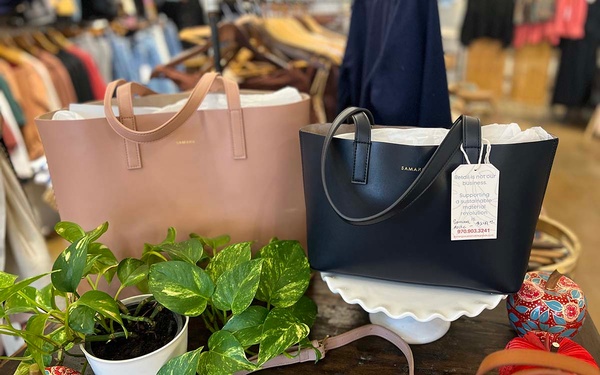
The bag that started it all: a tote partly made of recycled apple skins by Samara.