
BLM rule to slash methane emissions
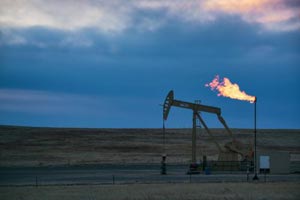
The Four Corners’ Methane Hot Spot could be getting little cooler thanks to new rules announced Tuesday by the Obama Administration. The Bureau of Land Management’s new Methane and Waste Prevention Rule aims to cut flaring, venting and leaking at natural gas wells a key contributor to methane emissions by nearly half over the next eight years. The rule will apply to all wells on federal and tribal lands. Overall, the rule will cut flaring by 41–60 percent and venting by 44–46 per- cent compared to 2013 rates.
The rule, which was first proposed in February, is meant to curb not just harmful greenhouse emissions but the waste of resources and money to both producers and taxpayers. Starting in 2018, the rule will require producers to retrofit equipment to eliminate flares and detect and stop leaks.
The rule, which updates the BLM’s 36-year-old plan, was lauded by environmental groups and health care professionals across the Southwest. Although Colorado already has stringent methane emission rules in place, neighboring tribes and states, such as New Mexico, do not. This will bring the entire region, which shares the same airshed, under the same umbrella despite borders.
“Sitting, as we do, under the highest concentrations of methane emissions in the nation, residents of the Four Corners are uniquely appreciative of the administration’s efforts to curb excessive methane emissions,” Dan Olson, executive director of the San Juan Citizens Alliance, said. “This rule will not only save money and resources, but will protect the climate and the health of local communities.”
A NASA study released in August confirms that a methane “hot spot” over the Four Corners is directly related to the natural gas industry. The 2,500-square mile plume, first detected in 2003 and confirmed by satellite in 2014, is said to be the largest concentration of atmospheric methane in the U.S.
Methane, the primary component of natural gas, is a highly potent greenhouse gas 84 times more powerful than carbon dioxide, making it responsible for roughly
one-fifth of overall climate change. Methane waste on public lands equals the pollution of about 14 coal-fired power plants, and the biggest culprit in this waste is the oil and gas industry. Companies routinely vent methane into the atmosphere, burn it as waste or allow it to leak from equipment.
According to the BLM, from 2009- 15, oil and gas producers on public lands vented, flared and leaked about 462 billion cubic feet (Bcf) of natural gas. That’s enough to supply about 6.2 million households for a year. The rule will minimize waste, saving up to 41 Bcf of gas a year – enough to supply about 760,000 households.
In addition, it is estimated that $330 million worth of natural gas is wasted every year, $100 million of that in New Mexico alone. This results in a loss of $23 million a year in royalties to federal and state governments, according to the Government Accountability Office.
“Our members applaud the BLM for taking common- sense action to capture a publicly owned natural resource
that is being wasted,” Camilla Feibelman, director of the Rio Grande Chapter of the Sierra Club, said. “With the state’s budget so tight, we can’t stand by while we lose out on mil- lions of dollars in revenue. Safeguards to capture methane are common sense, job intensive, revenue earning, royalty generating and health improving.”
In addition to harming the climate and coffers, methane is also fingered in a host of health problems, from cancer to asthma.
“It is estimated that 60,000 tons of VOCs are emitted every year in the New Mexico portion alone of the San Juan Basin,” Dr. Richard Grossman, of Durango, said. “These VOCs include known carcinogens such as benzene and, when associated with oxides of nitrogen from coal-fired generating plants, form ozone. Together these pollutants cause or exacerbate respiratory illnesses such as asthma and increase illness and death.”
Although the BLM estimates the cost to operators of implementing the new rules to be minimal, less than two-tenths of one percent of profits, already the industry is planning a repeal of the rules. The BLM rule is part of a larger effort by the Obama Ad- ministration to curb methane emissions. In March, President Obama and Canadian Prime Minister Justin Trudeau pledged that the U.S. and Canada would cut methane emissions by 40-45 percent by 2025. In May, the EPA announced its own set of methane rules related to drilling.