
Character building
Camino del Rio latest to come under city's planning microscope
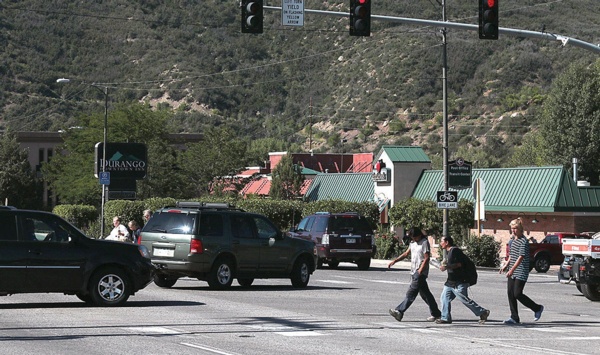
Safe pedestrian crossings on Camino del Rio have been a hot topic of conversation with increased traffic and growth. Options for the corridor will be discussed tonight at an open house at City Hall. It is the latest meeting on the City's "Districts Initiative."/ Photo by Jennaye Derge
New York has its five boroughs. San Francisco is synonymous with Haight-Ashbury and Fisherman’s Wharf. Each neighborhood within these sprawling metropolises has its own style, its own identity, and its own character.
Even though Durango is a bit smaller, it too has unique areas like North Main, Downtown or Bodo. Each one has its own challenges, opportunities and a distinct sense of place.
In an effort to identify the characteristics of these neighborhoods in a way that can directly influence city projects and future planning decisions, city officials created the Durango Districts Initiative.
“It’s an opportunity to think about what we have and what it is we want,” explained Sherri Dugdale, Assistant to the City Manager.
Whether it’s more trees, public art spaces, longer turning lanes, or just a chance to inspire local entrepreneurs to take the leap, the initiative is about starting the conversation.
It all began with the city’s North Main Corridor planning efforts. As city officials walked the area north of downtown with an eye on solving many of the thoroughfare’s challenges, like accessibility, traffic and walkability, they also found themselves asking what made the area unique. What was it about North Main that gave it a sense of place?
Simultaneously, the Durango City Council grabbed onto the idea of character districts as one of its goals, wanting to protect what was unique about these areas as they changed and grew over the years.
The two came together and the Durango Districts Initiative was born. It identifies 10 specific areas: North Main, Camino del Rio, College & 8th, Rocket South Durango, South Fork, 160 West, Northeast, Bodo, Sawmill and Downtown. This year the plan is to focus on the two city officials feel a sense of urgency about – North Main, which is already a work in progress, and Camino del Rio.
The two key points of the discussion on Camino are how to connect the riverfront with downtown and what to do with the riverfront in the first place.
The corridor along Camino del Rio connects the city’s lifeblood, the Animas River, to its historic downtown. Because it is both a place to stop and a major thoroughfare, traversing the high traffic area is, for many pedestrians, a game of chicken.
As city officials attempt to address, and even solve, some of these challenges, they want to get an idea of what Camino is in the eyes of its residents. What makes the area unique? What works and what needs to be changed?
They are asking the community for input on the neighborhood’s identity, challenges and possible solutions at a meeting from 5-7 p.m. Thurs., Aug. 11, at City Hall, 949 E. 2nd Ave.
It’s an open house format, so residents can show up anytime during the two-hour window and take part. Representatives from the Community Development and Multi Modal departments, City Manager’s Office and Colorado Department of Transportation will be on hand to both ask and answer questions.
There will also be interactive surveys, housing information and even some possible solutions.
One of the ideas on the table is a pedestrian underpass or tunnel connecting the riverfront to downtown Durango. The concept of an underground tunnel was talked about years ago and, recently, found its way back into the conversation.
Amber Blake, director of transportation and sustainability for the city, said the next step would be a feasibility study for an overpass or underpass. Then, real design solutions could start to take shape. Right now, however, it’s all about gathering input.
Some residents have also offered up visions of the riverfront’s future in the form of the STEAM Park Project. The concept of highlighting science, theatre, education, art and music in the area between the river and Camino del Rio lost some momentum after a 2015 study found significant private funding would be needed to move forward. But, the idea of private citizens taking the reins on projects is actually a big part of the Durango Districts Initiative.
City planners are hoping that the conversations started in these meetings will spark innovation, create momentum and inspire private development in these neighborhoods.
Scott Shine, planning manager for the city’s Community Development Department, specifically cited Purgatory Resort’s remodel of the former Hasslefree Sports building on North Main as an example of this kind of private investment.
“Even by just starting the conversation, we’re seeing people who see the potential,” Shine said. “It’s exciting to see that already happening on North Main.”
The initiative does have its downsides. For some, it can be overwhelming to have yet another city program in the mix, another meeting to attend and another website to visit.
But Blake said residents can offer input via a number of channels, whether it be through the Multi Modal Master Plan update, Durango Districts Initiative or the City’s Comprehensive Plan, to name a few.
“No matter how they can engage in this process, it will be helpful,” Blake said. “What they have to say matters.”
Because of the collaboration between city departments, ideas and input can be shared from numerous sources. It turns out such collaborations are a boon for the Durango Districts Initiative.
And, it’s not just city departments who can thrive from the collaboration. The Colorado Department of Transportation is another partner.
An example is a resurfacing project already on the calendar for next year. CDOT has long planned to resurface the roadway along North Main Avenue and Camino del Rio. Because of the relationship between the city and CDOT, as well as the flood of ideas coming out of community discussions on the city’s Multi Modal Master Plan, bike lanes were added to the plan to improve traffic flow and prepare for future connectivity projects.
In many ways, it’s about getting ahead of the game and being proactive. Durango’s population has exploded in recent decades, and finding affordable housing for the thousands who already live here is a constant battle. Traffic and parking continue to be issues, especially during the summer months when visitors flock to the area.
City planners don’t want to address the infrastructure needs and challenges created by urban sprawl decades from now. They’re hoping the conversations started today can inform planning efforts and land-use decisions that just might solve some problems before they even start.
“There’s still a sense that we respond to development proposals,” Shine said. “We want to try and get ahead of it.”