
Ditch democracy
A deep dive into Northern New Mexico's acequia culture

Carlos Arguello opens and closes the headgate on the acequia on his property. When open, the water flows through to his fields to provide irrigation./ Photo by Ilana Newman
One of the first things you notice when you enter Taos County, N.M., is the water. Driving in from the south, you follow the Rio Grande through its canyon, as it heads toward Santa Fe and Albuquerque. The land is crisscrossed by ditches, called acequias, that turn the high desert an improbable green. Acequias have been a cornerstone of agriculture and community in the Southwest since the arrival of Spanish settlers in the 17th century. These settlers drew inspiration from the irrigation systems of the Indigenous Pueblo communities already living in the Southwest, as well as from their own Spanish and Moorish roots. Still in use today, there are around 700 of these hand-built, community-led irrigation ditches in the New Mexico high country.
While acequia systems are concentrated heavily in Northern New Mexico, they exist on every river system in the state and extend north to Colorado, especially in the San Luis Valley, an area more culturally similar to Northern New Mexico than most of the rest of Colorado.
Two Perspectives on Acequias
On a spring day in 1972, someone knocked on Hank Saxe’s door. Saxe was new to Taos County. He had just moved to the unincorporated town of Arroyo Seco, where he was taking care of an abandoned house that might otherwise have fallen into disrepair. Saxe’s surprise visitor turned out to be a neighbor with an invitation. “We’re cleaning the ditch in a few days, you’ve got to come,” he said. That first annual spring cleaning was Saxe’s introduction to acequias. Today, Saxe and his wife, Cynthia Patterson, sit on the board for their acequia – Acequia Madre del Rio Chiquito – one of two acequias on the Rio Chiquito, a creek that comes out of Carson National Forest.
In contrast to Saxe, acequias are a way of life built into Carlos Arguello’s lineage. There’s an acequia named after his great-great-grandfather in the Valdez Valley, north of Taos, where Arguello grew up. His mother was a commissioner on an acequia in Valdez. “It is part of the culture of growing up, and not only was I born into it and raised in it, I’ve been living it, and it just becomes ingrained,” said Arguello, who is now a commissioner on the Acequia del Monte del Río Chiquito, the other acequia that comes off the Rio Chiquito.
The governance of each acequia includes a mayordomo, or a ditch boss, who physically controls the water during the season. The mayordomo has relationships with every member, or parciante, of the acequia and manages any issues that arise while water is flowing. The other two elected commissioners are a treasurer and a secretary. Each is elected by the parciantes.
“The governance of the acequias is the longest historical practice of democracy in the U.S.,” Arguello said.
In the West, Water is Political
Democratic principles are especially crucial for dry Western states where water is inherently political. Without water, there is no life. Many western cities, like Phoenix and Las Vegas, would not exist without water diversion technology. In rural communities, water diversion is vital for agriculture and economic growth, as well as simply for drinking.
In the West, there’s a water law principle known colloquially as “use it or lose it.” It’s part of the doctrine of prior appropriation, which forms the backbone of water law in the region. Within the doctrine, water rights are first come first serve – whoever claims the water first, gets it first.
Prior appropriation creates a pecking order, too. The most senior water right holders get water first, based on their date of priority – the date the water was put into “beneficial use.” More junior water right holders sometimes get less water than promised in drought years – of which there are many in the Southwest
The “lose it” part comes if someone isn’t making “beneficial use” of the water. In New Mexico, if water isn’t used for four consecutive years, water rights can be forfeited. These complexities are the subject of many lawsuits that can drag on for decades. The Abeyta Settlement, a case that determined water rights for the Taos Valley, lasted more than 30 years.
Acequias and their governance were community-led long before modern Western water law was created. The acequia board and its members determined where water needed to go based on what each piece of land needed and how much water there was at any given time. In 1907 things changed with the enactment of New Mexico’s water code. The 1907 Acequia Act brought acequias under New Mexico territorial law (New Mexico didn’t become a state until 1912), which followed the doctrine of prior appropriations and set up each water right to be held by an individual, instead of the acequia. This directly contradicted the historical, community-led approach. Because of “use it or lose it,” individuals are less likely to think about the system as a whole when they are worried about their own personal ability to use water. It’s one of the biggest issues with Western water law generally. Even during a drought, farmers will use every drop of water they are legally entitled to, even if they don’t need it. The fear is that if they don’t, it will be taken away.
Since the original water code was instituted, legislative efforts have worked to take back community control over each acequia. Acequias are again able to own their own water rights and manage the transfer of water between parciantes.
Because of both the doctrine of prior appropriation, which incentivizes the consistent use of water, and the deep cultural connection to water and land, Northern New Mexicans are incredibly protective of their water rights. “We don’t want to lose any water. We don’t want water going down the Red River and down south. We are barely getting enough, but we get the water that we get. So we want to keep it in community as much as we can,” landowner Maria Gonzalez said.
Gonzalez, who is the LOR Foundation program officer for Questa, N.M., owns land in Taos County that she and her husband irrigate. She has been learning “the art of irrigation” over the past few years, although her family also irrigated a bit when she was growing up. It’s an intensive process that involves flood-irrigating fields via ditches that branch off of the main acequia. Every few hours, someone has to open and close gates to move the flowing water and then move the tarps to catch the runoff. One day, Gonzalez’ husband asked her to move the water in the middle of her work day, so she went out in the field in office attire and irrigation boots. There she sat, in the middle of the field on a camp chair, taking Zoom meetings while she irrigated.
“We are trying to teach the younger generation that when we irrigate, that goes back into our water reservoir and it keeps water, drinking water for us. So we need to have those irrigations,” she said.
A Trip to the Source
On a spring day, not unlike the day a neighbor first knocked on Saxe’s door in 1972, Arguello took us out to visit the Rio Chiquito where it splits into its two acequias. We drove down dirt roads until they ended in a driveway. Arguello called the homeowner to let her know we’d be walking across her property. Acequias all have an easement on private property, which allows anyone working on an acequia, including commissioners, to legally access it at any time. However, the commissioners still spend a lot of time getting to know landowners and building relationships in order to maintain cordiality.
At the mouth of the acequia, water streams out into two chutes. The slightly larger one, on the left, is the Acequia Madre del Rio Chiquito. On the right, the water flows into the Acequia del Monte del Río Chiquito. Arguello spotted a branch caught in the junction between the two waterways, and he pried open a hatch on the grate covering the splitting creek. He lowered his body into the streaming water, fishing the branch out, standing ankle deep in the water.
The community acequia cleaning day happened only weeks before, but keeping the ditch clear of debris is a never-ending task. Arguello said issues can arise when newcomers move onto a property that has an acequia on it. Not everyone is as open to understanding this community-driven water system. Historically speaking, Arguello feels he’s not that much different. His father’s family arrived in Santa Fe in 1695. “I’m a newcomer too. I mean, I’ve just been here longer, but I’m still a newcomer. I’m not Indigenous, although I’ve got Indigenous blood in me,” said Arguello.
He sees how his ancestors’ influence changed the community over generations, as well as how newcomers today might not understand the area’s unique history and culture. “Land softly,” Arguello recommends to newcomers. “Then look around you. ‘What kind of a neighborhood am I in? What’s this about? What’s this water thing?’ Get to know your neighbors, get to understand them. They’re different from you. They’re different from where you came. That’s part of the reason you came here.”
Whether their existence is a surprise or deeply ingrained, acequias are a way of life for most people in Taos County. “It’s part of what we call around here “querencia – the love of land, the love of heritage, the love of place,” Arguello said.
Ilana Newman writes for the Daily Yonder and lives in Mancos. This story was produced with support from the LOR (“Livability, Opportunity and Responsibility”) Foundation. LOR works with people in rural places to improve quality of life.
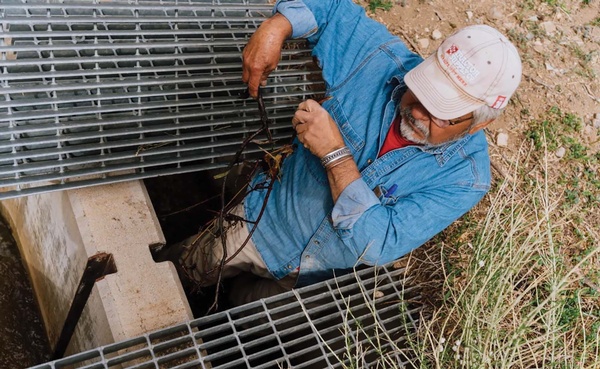
Carlos Arguello cleans a branch out of the Acequia del Monte del Río Chiquito. Keeping the ditch clear is a never-ending task./ Photo by Ilana Newman