
Down to the wire
City inches closer to April opening of Lake Nighthorse
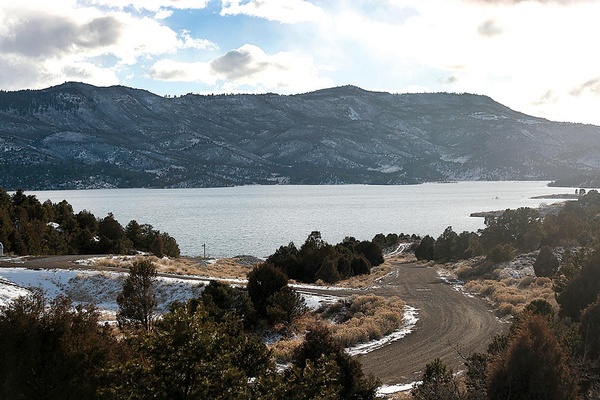
County Road 210, above, could see a lot of traffic on April 1 when the city is scheduled to open Lake Nighthorse to the public. The lake already has a boat ramp, inspection station, parking lot and restrooms. The city has also hired some full- time staff and plans to put in additional parking before opening day./Photo by Jennaye Derge
It’s only about a month until the gates at Lake Nighthorse finally swing open to the public. This doesn’t mean, however, everyone’s ready to celebrate.
Some of the biggest – and most controversial – questions are still unanswered. Like who gets to use the lake? And when?
Last June, a group of residents called the Quiet No Wake Lake Nighthorse Coalition presented the Durango City Council with a petition of 1,200 signatures, asking the city to keep the lake a no-wake zone and limit motorboats to 5 mph.
In response, city officials made some adjustments to their proposed management plan for the lake. But, not everyone was on board.
In an effort to address the current clash between motorized and nonmotorized use, as well as come up with solutions the community can live with, city officials are hosting a week-long series of public events. After all, the clock is ticking.
The first meeting starts with an open house at 4 p.m., followed by a presentation and open discussion at 5 p.m. on Tues., Feb. 27, at the Durango Rec Center.
The second meeting is from 2-6 p.m. on Thurs., March 1, also at the Rec Center.
The city hired Joy Lujan with Connected Realities, a Denver-based consulting firm specializing in public engagement and collaboration, to help guide the meetings. Lujan, a former National Park Service employee, has worked with city officials on past projects and is familiar with the Durango community.
In those meetings, city officials plan to gather what Parks and Recreation Director Cathy Metz called “community-generated solutions.” She said they want to hear residents’ thoughts and ideas, and incorporate them in the recommendations they’ll present to City Council at a study session March 13.
“I’m as curious as anyone,” Kristine Johnson, one of the core members of the No Wake Coalition, said of the upcoming meetings. “Some are willing to compromise, some are not.”
Perhaps the debate is not that surprising. After all, the Animas-La Plata Project, which created Lake Nighthorse, has always been controversial.
The project was originally proposed to settle tribal water rights issues in the 1960s. It took decades just to come to an agreement over the water and decades more to construct the reservoir.
Even talks about recreation have been going on for more than a decade. Most recently with the City of Durango’s 2011 Recreation Master Plan and 2014 Conceptual Recreation Plan.
Not everyone, though, felt their voices were heard at those meetings.
Johnson said many advocates of quiet use at Lake Nighthorse felt dismissed or discouraged during those 2011 discussions about recreation. Some even chose to drop out of the conversation altogether.
“I got involved because of this major disconnect that I saw at those meetings seven years ago,” she explained.
Johnson began to write opinion pieces about quiet use and found an overwhelming and positive response. Eventually advocates for quiet use came together to form the Quiet No Wake Lake Nighthorse Coalition.
Although the group’s members have varied goals, their petition specifically requested the city keep the lake a no-wake zone and limit motorboats to 5 mph.
This would allow for fishing, kayaking, canoeing and paddleboarding; but, prevent activities like water skiing, wake-boarding and lake surfing, which require higher speeds.
Regardless of speed, one thing the city can’t negotiate is motorized use of the lake.
Back in the early 2000s, the Bureau of Reclamation received a $3 million grant from the State of Colorado to build a boat ramp, access road, parking lot and restrooms. The caveat was that the lake had to be managed “for public recreational motorboat use,” according to the contract.
So, if the lake is to open at all, motorized boats must be allowed.
In order to allow for both motorized and nonmotorized uses, the city’s proposed management plan utilized something called zoned recreation, where each recreation type has its own space or zone.
The recommendation brought before City Council in mid-December included two no-wake zones, which combined to cover 36 percent of the lake’s surface. One area was on the east side of the lake and the other on the west. The central area was set aside for motorized uses.
It’s also been suggested motorized and nonmotorized users split the season with the lake opening April 1, but not allowing motorboats until mid-May. It would be closed to all users from Nov. 16-March 31.
This was one of the possible solutions city officials presented to Council in December in an attempt to find a compromise with the No Wake Coalition.
Some of the other compromises offered over the past several months include splitting the week into motorized and nonmotorized days. For example, boats could be allowed on the water from Wednesday to Saturday, and quiet users would get Sunday-Tuesday.
These are just some of the ideas to be discussed at the meetings next week.
Johnson said the group’s members and goals are as diverse and varied, but one thing they all have in common is a desire to be heard.
“We’re going in good faith (to the meetings) and hoping for the best,” she added.