
Filling in the holes
Weather-damaged roads latest symptom of county's ailing budget
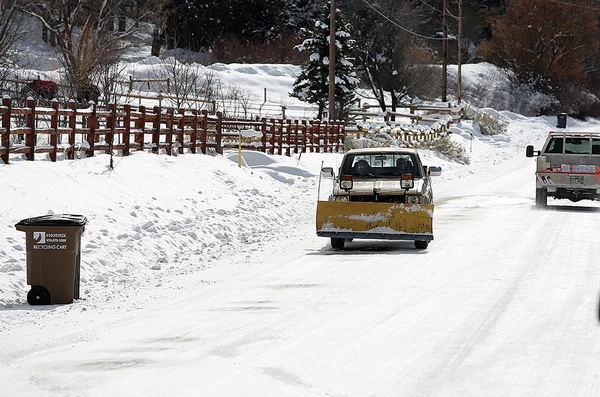
A plow truck runs along CR 250 following the most recent storm, which dropped almost a foot of snow. The recent run of wet snow and rain has resulted in plenty of potholes and washboards along La Plata County's roads./Photo by Jennaye Derge
Potholes litter the pavement, and washboard blankets the backroads of La Plata County. Between
the wet snow in late December and the rains of early January, the county’s roadways have taken a heavy beating.
About a week ago, when temperatures warmed, county crews hit the road and attempted to address some of the trouble spots. It’s a “worst-first” policy to tackle the biggest problems before the next storm hits, which it did by the weekend.
“Overall conditions are well below any satisfactory level we try to provide,” Doyle Villers, La Plata’s road maintenance supervisor, disclosed in a statement. “We know your roads are rough, and we are doing everything we can to schedule repairing them.”
During the most recent storm, almost a foot of snow fell on Durango, and even more in the higher elevations. Al- though it wasn’t as damaging as the wet snow and heavy rains of the holiday season, it certainly doesn’t give county officials much relief.
They’ve received a steady stream of calls and com- plaints, according to La Plata County’s public affairs officer Megan Graham. But without a break in the weather, there’s little they can do.
“We’re working as quickly and as safely as we can,” she said.
And, all this after a backlog of maintenance projects compelled county officials to come to voters for additional road and bridge funds – twice. In the past two election cycles, voters rejected the requests for an increase in property taxes to pay for a decade of road and bridge maintenance projects.
The county has already earmarked funds to cover plowing and basic maintenance this year, something they always plan for over the winter season. The real challenge, Graham said, is what to do when it comes time to make the long-term re- pairs, like damage to the road base or foundation.
It’s no secret La Plata County’s revenue stream has been going down for years. One of the major contributors is the decline in oil and gas revenues, largely due to plummeting natural gas prices.
According to the 2017 county budget, taxes on natural gas brought in $17.6 million in 2010. This year, it will be just $4.6 million. It’s a decline of almost 75 percent.
Another contributor to their budgetary predicament is a perfect storm of property values and tax equations.
The housing bubble may have burst in 2008, but the market didn’t hit bottom in La Plata County until 2015. With a two-year cycle for property taxes and assessed values, the real bottom didn’t hit the county until now.
To add insult to injury, the state’s property tax system
will throw another log on the fiscal fires next year in the form of something called the Gallagher Amendment.
Named after the state lawmaker who crafted the measure and brought it to the voters in the early 1980s, the amendment will ultimately reduce the assessed value of homes.
The Gallagher Amendment was intended to simplify the way assessors determine actual property value. In the resulting equations, though, when residential property values in Colorado go up faster than commercial proper- ties, their taxable value goes down in an effort to even things out.
“In other words, when home values grow faster than business values, homeowners pay proportionately less,” ac- cording to the state Treasury Department website.
These changes mean the assessed value of homes in La Plata County, a number that was already skimming the bot- tom, will be lower in 2018.
To put it in perspective, this year the county saw total revenue – including property taxes, sales taxes, everything – drop by $3.25 million from 2016. Next year, however, even though the county anticipates an increase in sales tax revenues, that amount will go down another $7 million.
“That’s when we’re going to have to ask those more difficult questions,” Graham said.
With total countywide revenues estimated at $68.5 million for 2017, that’s quite a chunk.
“Overarching all of it is the fact that La Plata County’s mill levy is the fourth lowest (in the state),” Graham added. The mill levy in La Plata County is just 8.5. As a com- parison, she pointed to the surrounding counties. Archuleta’s mill levy is 18.36, and San Juan is 19.88. Montezuma is the closest at 14.25.
It’s a perfect storm county officials can see coming.
“We’re not wasting time,” Graham said. “This is not some- thing where you can waste time.”
One of the first moves this year was to suspend a pro- gram in which residents can ask the county to add road- ways or sections of roadways to its network. The program was first suspended in 2010 because of budget constraints from the recession. It’s been suspended ever since – with an additional three-year extension passed unanimously by the Board of County Commissioners on Tuesday.
“Hopefully, at some point, we’ll see daylight,” Jim Davis, county director of public works, explained during Tuesday’s meeting.
The county has also been actively trimming county costs with a campaign called “Innovate La Plata!” The idea is to find ways to streamline administrative processes, reduce
waste and innovate any of the day-to-day functions of county government. It’s a two-pronged approach meant to both cut spending and make things easier for residents.
On the other side of the county’s budget coin is the money coming in.
During meetings this week, county officials discussed a possible use tax, an excise tax on marijuana, impact fees for new development and a host of other potential revenue sources.
However, there will come a time, likely during the 2018 budget talks, when the rubber will meet the road, so to speak – like which potholes get filled and which ones have to wait.