
Free herb for the people
Herb Hut Clinic uses power of plants to heal area's underserved populations
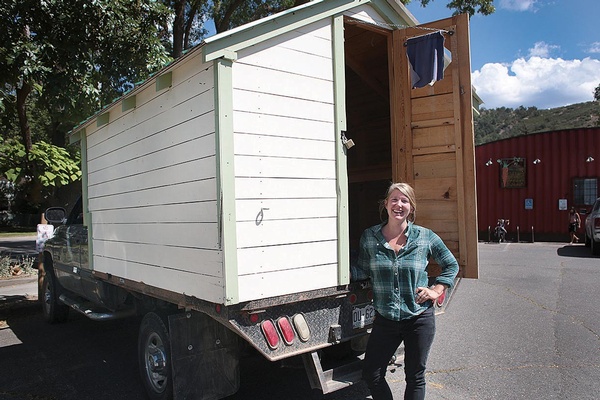
Kate Husted, owner of the Herb Hut Free Clinic, stands with the actual hut built by her lumberjack husband, who owns Lorax Forest Care. He fashioned the tiny home-camper hybrid mainly for surfing and climbing trips, and the easy-to-haul, log-hewn adventure mobile has since trans- formed seamlessly into this charming clinic-on-wheels./Photo by Jennaye Derge
There’s a tangled, tormented love story between humans and plants. A surprise bouquet from a suitor makes a young maiden blush, but every rose has its thorn. A field of wildflowers beckons grown men to frolic, while a bundle of poison ivy finds a child weeping in a tub of calamine lotion. People rejoice at the sight of spring’s first green after a long winter but will spend too-many dollars removing the disdainful dandelion from their perfect lawns.
But plants aren’t out to get us. In fact, they’re one of nature’s greatest gifts, providing us with a cornucopia of solutions to our most common and obscure ailments.
“No matter what culture you come from, one of your not-so-distant great grandmothers knew how to use the plants around her to keep her family healthy,” Kate Husted, owner of the Herb Hut Free Clinic, said.
After years of suffering chronic internal infections, Husted got fed up with taking rounds of antibiotics only for her symptoms to reappear weeks or months later. So she sought help from a naturopath, who suggested Husted
change her diet and start taking herbs. She hasn’t suffered from one of those infections since.
“That really convinced me of the power of plants,” says Husted. “Using plant medicine is part of being human, and that’s one of the reasons I see herbalism as the medicine of the people.”
Husted moved to Durango in 2010 after earning a degree in environmental studies and biology from the University of California - Santa Cruz. She began a three-year mentorship with local clinical herbalist Anna-Marija Helt and worked at Dancing Willow Herbs as an apprentice before getting promoted to medicine maker.
Instead of treating a headache with a pain pill, herbalists take into account each individual and the life circumstances that might have brought them to this point of pain. They’ll seek out the root of the complaint and then tailor remedies to fit the deepest issue.
“There is no one herb for any particular disease, and that’s what makes herbalism an art,” she said.
In August 2017, Husted launched the Herb Hut Free Clinic so she could help others become more self-reliant and less dependent on surgeries, pharmaceuticals and expensive disease care. The actual hut, formerly known as “the Love Shack,” was built by her lumberjack husband, who owns Lorax Forest Care. He fashioned the tiny home-camper hybrid mainly for surfing and climbing trips, and the easy-to-haul, log-hewn adventure mobile has since transformed seamlessly into this charming clinic-on-wheels.
Husted’s primary focus for the Herb Hut is to provide free consultations and herbs to underserved populations of Southwest Colorado, like the homeless, immigrants, elderly, disabled and people struggling with addiction. She partners with organizations that are already working with these demographics, hosting hour-long clinics at places like Manna Soup Kitchen, Pine River Shares and other nonprofits.
Each clinic serves about four people at a time. During a clinic, Husted listens to all facets of each client’s life: how much they’re sleeping, what they’re eating, stress levels, environmental factors, jobs, family, exercise routines. She then educates clients about their specific body and condition, moving beyond simply stifling symptoms toward creating wellness and balance.
“A lot of people only have experience with allopathic medicine and come in expecting a magic pill to make their symptoms go away,” says Husted. “Instead, they leave realizing that true healing is a journey and requires making changes.”
Each clinic costs $375. At a time when families and individuals across the nation are struggling to navigate a broken health-care system, Husted is able to keep the Herb Hut clinics free through grants, corporate sponsorships and individual donations.
The Herb Hut has 501c3 status under the San Juan Resource Conservation and Development Council.
“Over half of our donations come from everyday individuals like you,” says Husted.
With this model, Husted hosts clinics as funds are raised with no guarantee of the Herb Hut’s future. Wanting to make it more sustainable and reliable, her goal is to be able to schedule at least 92 clinics a year at regular intervals so she can consistently connect with clients to follow-up, track their progress, provide refills and develop long-term relationships – like how it should be.
“I like to think of myself as an ambassador to the plant world, working to heal the relationship between humans and flora,” says Husted.
According to Husted, the gateway drug to herbalism is eating that devilish marauder of our perfect lawns: dandelion leaves.
“Useful plants are everywhere – and are often those most undesirable weeds,” she says. “Choose ones that you know haven’t been sprayed, of course. The bitter flavor supports digestion and liver function, and good health starts with good digestion.”