
Getting crafty
Colorado brewers buck national trend by adapting to changing times
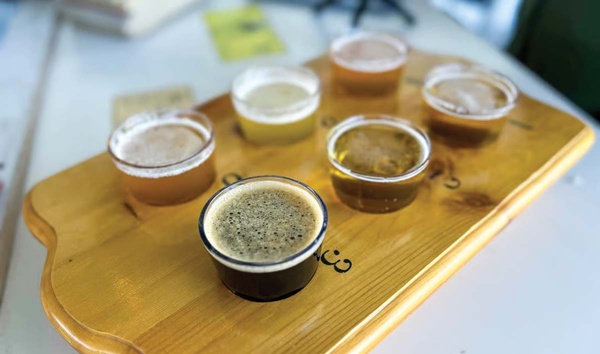
A flight of beer at the Colorado Farm Brewery in Alamosa on March 7. New data from the Boulder-based Brewer's Association shows Colorado craft brewers increased production by nearly 10% in 2025, outperforming a national industry slowdown where brewers saw a 5.7% decrease./ Photo by Hayley Sanchez/CPR News
Haylee May / Colorado Public Radio
- 05/28/2026
Colorado’s craft beer industry may finally be finding firmer footing after years of contraction. But experts say the recovery is a far cry from the boom days that once made the state an industry leader.
“What it looks like to run a successful brewery in 2026 is very different than what it was like in 2016 in terms of operational costs, of being strategic about distribution, of offering more experiences,” Matt Gacioch, staff economist at the Boulder-based Brewer’s Association, said last week.
New data from the national group shows Colorado craft brewers increased production by nearly 10% in 2025, outperforming a national industry slowdown where brewers overall saw a 5.7% decrease.
“A big piece of the volume can be attributed to some really explosive growth by Tivoli’s Outlaw brand, which is brewed in Colorado but is distributed throughout the country,” Gacioch said.
In Colorado, brewers large and small produced 75,369 more barrels last year than in 2024. The industry’s statewide economic impact also rose to an estimated $2.5 billion, up by roughly $28 million overall.
However, even as breweries like Tivoli produced more beer and boosted their statewide economic impact, the state still saw a net loss of 33 breweries.
Gacioch says that loss is comparable to losses suffered by the restaurant industry, which often sees closures as neighborhood demographics change. “A lot of these (closures) are in a hyper-local context. If the economics of operating in those particular neighborhoods is no longer where it was five to 10 years ago, those are a lot of the breweries that we’re seeing close,” he said.
Many of the breweries that closed in 2025 were smaller, neighborhood-focused operations facing rising rents, higher labor costs and thinner margins than they saw a decade ago.
For many brewers, survival now depends less on growth and more on reinvention.
“They’re bringing people in with something more than just the world-class beer. Maybe it’s a more built-out food menu or programming that appeals to certain types of consumers,” Gacioch said. “I think the breweries that have been able to weather the storm are the ones that are adapting, and that puts them in a better position financially.”
Part of that shift is a move toward an “onsite model,” where breweries rely less on distributing beer widely. Instead, they are focusing on drawing more customers into taprooms, places without food, and brewpubs, places with food.
“The taprooms and brewpubs have also had a strong year relative to other states in 2025. Colorado Brew pubs saw a 7% increase in production volume, and taprooms were essentially flat, so still five percentage points better than the national average,” Gacioch said. Those spaces increasingly double as community hubs, hosting trivia nights, live music, run clubs and family-friendly events, giving customers a reason to stay longer and spend more.
At the same time, larger or more established brands are better positioned to scale production, expand distribution and weather economic swings, a dynamic that’s slowly reshaping the industry.
“Colorado is definitely one of those pockets where there is more consolidation happening,” said Gacioch.
For example, last year Wilding Brands, a beverage group formed through mergers involving Denver Beer Co., Stem Ciders and Funkwerks, acquired Denver’s Great Divide Brewing, combining production and distribution operations under one umbrella.
“I would expect that what we’re seeing happen in Colorado will continue to ripple out, and we’ll see more of that over the couple years,” Gacioch said.
Younger drinkers are also consuming alcohol differently, often drinking less or opting for alternatives like non-alcoholic or cannabis-infused beverages.
“Some of the rates of drinking among Gen Z might have decreased. We’re still trying to figure out how much of that is impacted by the fact that many came into adulthood during the pandemic and didn’t have the same kind of social experiences outside of the home that many of the earlier generations had,” said Gacioch. “Gen Z is also mostly in their twenties right now, and they’re the generation that has some of the least buyer power.”
New financial pressures could also test the progress made by Colorado brewers last year and in early 2026.
Tariffs on aluminum, a key material for beer cans, continue to push up costs, with some brewers only beginning to feel the full impact as supply contracts expire.
“2026 is probably going to be the year where it starts being felt more acutely because many brewers have contracts into the future, and a lot of the tariff costs get built in when those contracts come up for renewal,” said Gacioch. “There’s more competition in the beverage alcohol space than ever before. To have the tariffs on top of it, it’s just one more factor that makes running a successful brewery that much harder.”
Even with the challenges, Colorado remains one of the country’s most influential craft beer states, home to a deeply rooted brewing culture and a strong base of independent producers.
“Colorado has, from the beginning of craft beer, been one of the hotspots, and I think for great reason, it fits really well into the lifestyle of Coloradans,” Gacioch said.
The industry may be more competitive than it once was, but it’s also becoming more focused and, in some cases, more resilient.
“I think what we’re seeing in craft beer consolidation — what we’re seeing in something like Outlaw, that is a really strong solo brand — I think these are some of the directions that we might see the craft industry move in future years,” he said. “I suppose in that regard, Colorado continues to be a leader in craft beer.”
For more from Colorado Public Radio, go to www.cpr.org. ■