
Grapes of wrath?
Local liquor stores take a hit with wine sales but remain optimistic
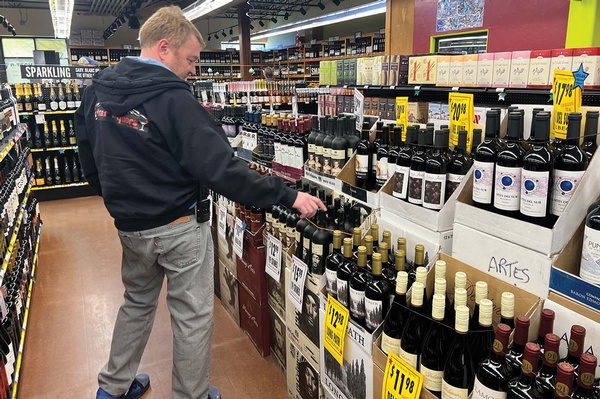
Mike Vermette, manager of Star Liquors, shows off but a small sampling of the store's wine selection. Since grocery stores started selling wine last March, Star's sales are down. To compete, the store has begun using yellow tags to highlight wines that are only available at Star./ Photo by Missy Votel
Nearly a year after Colorado voters narrowly agreed to allow folks to buy wine with their oat milk and avocados, local liquor stores aren’t quite dying on the vine. But they’re not exactly popping the cork, either.
“It’s had a really, really big impact,” Mark Raymond, manager of Wagon Wheel Liquors said. “And it doesn’t just affect liquor stores. It affects everyone in town.”
He was referring to Proposition 125. Passed in November 2022, it allows sales of wine in big box and grocery stores, which began stocking wine March 1. (Full-strength beer has been available in grocery stores since 2019.)
James Dempsey, who bought Wagon Wheel in August 2021, did not want to discuss specific percentages, but suffice to say his hit in wine sales is a double-digit drop in the barrel. Beer sales saw a more modest decrease while liquor sales remained about steady this year, he added.
On the other side of town, Mike Vermette, manager of Star Liquors, said since last March, total sales there are down 25% – the lion’s share of which he attributed to wine sales. Star has been hit particularly hard, he said, because 40% of its overall sales typically come from wine vs. only 20% from beer.
More telling than sales volume, Dempsey said, is the number of shoppers coming through his door. Now that people can buy a bottle of wine while fetching groceries, they’re less inclined to make that extra trip to the liquor store. According to Dempsey, customer traffic at his store is down about 10 % this year over last.
Star reports a similar trend, but Vermette notes that smaller stores that may not have as sophisticated tracking methods may be faring even worse.
“A lot don’t even know how badly they’re getting their butts kicked,” said Vermette.
And with winter tourism season coming, he said it may only get worse.
“January, February and March are big tourist months,” he said, adding that tourists may not have the allegiance to independent liquor stores that locals do. “A lot of them may think, ‘There’s wine and beer at the grocery store, great, I’ll buy it there.’”
Dempsey said it’s this local allegiance – along with his store’s location downtown – that has helped his store weather the Prop 125 hangover.
“If we didn’t have those regulars, I think we’d be in worse shape,” he said.
Wagon Wheel has 11 employees and Star about 13 – and both stores report not having to make any layoffs because of the downturn.
“It’s made things tighter,” said Dempsey. “I haven’t had to lay people off, but that’s by choice.”
However, one area where local liquor stores may be forced to make cutbacks is donations, such as for fund-raisers and nonprofits.
“A bigger impact that people don’t think about is philanthropy and giving back,” Vermette said. He said he expects there will be “significant adjustments” to what the store will be able to give away in the coming year, adding that paying his staff will be the biggest priority.
Dempsey echoed this sentiment, saying that in 2022, Wagon Wheel donated upwards of $50,000 in product. “A big part of why we bought this store is because we wanted to give back to the community,” said Dempsey, who owns the store with his partner, Christi Williams. “That’s something the grocery stores certainly are not doing.”
Trickling down
The Colorado Licensed Beverage Association, which represents the state’s small liquor retailers, estimates one-third of small liquor stores in Colorado will go out of business as a result of Prop 145. Although the expansion of full-strength beer sales didn’t necessarily diminish the number of liquor stores in Colorado, losing wine sales could push some over the edge.
“We have begun to see a lot of stores struggling,” Chris Fine, executive director of the CLBA, told Colorado Public Radio recently. He added that the extent of the impact depends a lot on where a store is located. Stores near supermarkets are having a difficult time no matter what part of the state they’re in, he said.
One local store that seems isolated from that trend is River Liquors, which is adjacent to Nature’s Oasis on the south end of town. River Liquors – which is owned by Jeff and Sherri Watson, who also own Nature’s Oasis – is in a unique situation in that Nature’s Oasis does not sell alcohol. Even so, Jeff Watson said River Liquors is still feeling the pinch – though not as severe as what other local mom and pops are feeling.
“It would be impossible to say it hasn’t affected us,” Watson said. “But I wouldn’t say it’s as much as what some other stores are seeing. We’re a little bit farther away out here and have a little bit more of a captivated audience.”
Aside from the effects on individual stores, liquor store owners also point out there is a larger price for the convenience of supermarket wine. For starters, there is the all-important multiplier effect, whereby money spent at locally owned stores goes farther in the local economy than money spent at a chain, which is often siphoned off elsewhere.
“Money spent at City Market doesn’t stay here,” said Wagon Wheel’s Raymond. “It goes to a big corporation.”
Watson also pointed out that the dream of increased sales, and thus increased tax revenues, from grocery store wine sales has yet to be realized. In fact, with grocery stores selling at lower prices, the exact opposite may be happening.
“You get the same consumption at lower prices, which lowers sales taxes,” he said. “It’s taking money out of city coffers, and we’re taking money out of Colorado – all so people don’t have to walk across the parking lot.”
No whining
Despite the downturn in liquor store wine sales, it is not all sour grapes. Liquor store owners say they’ve seen the change coming for some time now, and the competition has given them an opportunity to up their game. “No one should have been surprised by this,” said Vermette. “We knew it was a possibility for over a decade.”
He added that booze sales will probably be the next shoe to drop, with liquor likely being approved for sale in grocery stores in the next few years. With this in mind, he and other store owners say they have been working on that all-important post-pandemic buzzword: pivoting.
Such tactics include loyalty programs, delivery, apps, wine or bourbon of the month clubs, and case and happy hour discounts. Wagon Wheel also recently upgraded its delivery truck and underwent an extreme makeover of its 60-year-old store.
Smaller liquor stores also emphasize the “personal touch” – greeting customers when they walk in the door and offering product recommendations and expertise not available at a large grocery store. “We have combined more than 100 years of restaurant and industry experience,” Dempsey boasted of his staff.
In addition, many stores have shifted away from the “usual suspects” of mainstream wine – although they still offer them – to feature more unique, lesser-known but high quality labels.
“We’ve moved to becoming more of a ‘bottle shop’ and having some nicer wines,” Dempsey said. “We are trying to pivot to other wines that are similarly priced and better.”
At Star, they now feature “yellow tags,” which signify wines that are only available there. Fellow manager Tamara Vermette, wife of Mike, also noted that Star tries all of the wine it sells in order to provide better tasting notes and “to make sure they’re not poisonous.” (Don’t worry! She was kidding about the poison part, but not the sampling part.)
In fact, changing up offerings to smaller or lesser known wineries is one way small stores can compete with the purchase power of the corporate giants, which buy in massive quantities or use rebates to incentivize sellers.
Watson spoke of a brand of wine being sold at a certain big box store in town for $7 under what anyone else can sell it for.
“They’re selling it at prices that we can’t even buy it for,” he said.
Vermette echoed the concern, but was sober-eyed about the competition.
“We’re not victims here,” he said. “Everyone has the right to make money. We just want to be treated on a fair playing field.”
He said his hope is that once the buzz of grocery store wine wears off –much like the excitement of a new restaurant in town – folks will be back. “They’ll realize we’re still a better deal,” Vermette said.
Dempsey said he believes the low prices at the grocery stores are only to entice people. Once people change their buying habits, the prices will level out to be more in line with what liquor stores charge.
And, he prefers to look at the past year as a “reset” – much like what other businesses went through with the pandemic.
“I’m pretty confident we’ve hit the peak of the damage,” said Dempsey. “I think it’s going to go up from here. It’s been longer days, longer hours, but we’re just going to keep doing what we’re doing.” ?
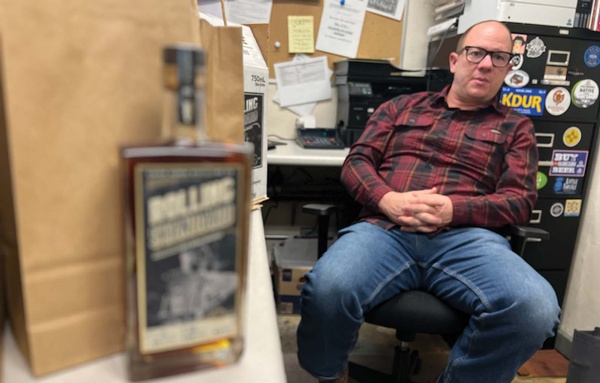
Wagon Wheel owner James Dempsey talks in his office last week. The bottle of whiskey in the foreground is part of the store's new "bourbon of the month" promotion./ Photo by Missy Votel