
Health Club
Direct primary medicine offers alternative to high-priced insurance
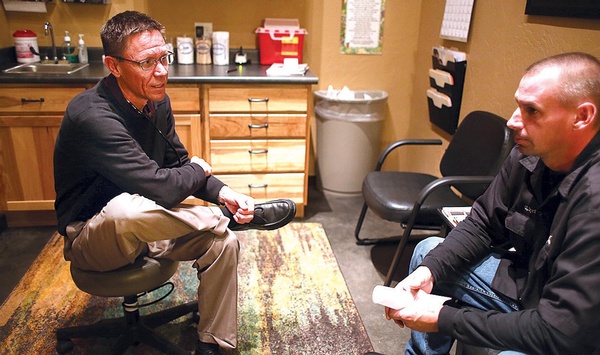
Dr. Dan Schaefer, left, talks with patient Chet Holmberg at the Whole Health Family Medicine Clinic in Rivergate recently. The clinic is taking a new, old-fashioned approach to health care: direct primary care, whereby patients buy a "membership" that covers routine visits, wholesale prescriptions and low-cost labs./Photo by Jennaye Derge
In Japan, golfers pay $65 a year in insurance to protect themselves on the course – not from getting whacked in the head, but in case they score a hole-in-one. That’s because unfair tradition requires the lucky chap to buy drinks for his comrades. The policy covers him for a party worth up to $3,000.
If only all insurance policies could be so simple – and sake-soaked.
Since this is the merry season of open enrollment (till Jan. 31) let’s focus on the most annoying insurance of them all: health. I know. So lame. But behold news of great joy: there’s an alternative to high-premium health insurance that’ll provide almost as much relief as finally taking the Christmas tree down.
In 1900, the average American spent $5 annually on health care ($100 in today’s dollars). Then came the dawn of modern medicine, featuring sleek medical schools, miraculous antibiotics and high-tech hospitals. Fast-forward a hundred years, and suddenly the most common reason for bankruptcy in the United States is an unexpected medical bill.
Since universal health care is still seen as socialist in America, we’ll roll right over bemoaning and straight into what the medical community is doing to rebuild the public’s trust in modern-day services. How about an analogy to kick this soiree off?
Car insurance as health insurance.
Car insurance plans are typically there for catastrophes, covering injuries and property damage in the horrible scenario of an accident. On the other hand, car insurance does not cover gas, oil changes, tire rotations, or windshield wiper replacements.
“If your car insurance covered that, it’d be really complicated,” Dr. Dan Schaefer, of Durango’s Whole Health Family Medicine Clinic, says.
In contrast, health insurance plans cover routine, preventive and emergency care, so of course premiums are going to be tremendous. I’m talking, YUGE.
“Health insurance has gone to the extreme,” says Dr. Dan, his preferred title (full disclosure, the car insurance analogy is Dr. Dan’s).
You see, says Dr. Dan, most people see their primary care physician for 80 to 90 percent of their medical needs. It’s that 10 to 20 percent of catastrophic care that’s really expensive and should be covered by insurance. If we separate the emergency stuff from the routine, suddenly health care becomes more affordable.
“People are smart,” says Dr. Dan. “They figure it out. Car accidents are covered by insurance, and so should appendicitis. Those things happen.”
OK. So we need insurance. But what if we just purchase a high-deductible plan for the worst-case scenarios and then had an innovative, alternative payment option for the regular stuff?
The latest-and-greatest of these options is called “direct primary care” (aka DPC), a medical service that provides comprehensive care for the individual, employee or entire family in exchange for a low monthly fee. Totally legal under the Affordable Care Act, DPC is still in the developing stages, considering that only two percent of the American Academy of Family Physicians’ 68,000 members offer it. But it’s making massive strides in that it’s no longer just for billionaires; the concierge-esque model of customized primary care is now available to the middle class.
DPC is actually more old-school than new-fangled; some would say it was the battle cry of Dr. Quinn Medicine Woman. This pioneer movement has made it back to the wild west of Durango.
“It combines modern knowledge and training with the old-fashioned approach to being a doctor,” says Dr. Dan. “We want people to rebuild their trust in the medical establishment.”
The national average cost for DPC is $80 per month. At Dr. Dan’s practice, which he runs with his wife, Karassa Yeomans Schaefer, PAC, and their staff of three, patients pay a fixed monthly fee of $10 per child (0 to 19 years old); $55 for 20- to 44-year-olds; $79 for 45- to 64-year-olds; and $99 for 65 years and older. There is also a corporate agreement option that costs $50 per employee per month.
Patients are allowed unlimited visits with no co-pay or co-insurance, plus a slew of other inclusions, like in-office lab work, prescriptions at wholesale prices, EKGs, wound repair, wart and lesion removal, biopsies, incisions and drainages, and ear irrigations. Since DPC is not a substitute for insurance, the model works with any and all forms of insurance, including Medicare and Medicaid.
“The simplicity really is the beauty,” says Dr. Dan.
But wait. There’s more. Instead of waiting 19 days to see a doc, DPC welcomes patients 24/7 ... with a consultation of not 7.7 minutes, like the average patient-doc facetime, but 30 or even 60 minutes.
When local Lacey Murphy’s husband lost his job in the oil fields this year, their family of four lost insurance, so they signed up for DPC with Whole Health.
“Monthly, we pay $130 for the whole family,” says Murphy. “We have a higher deductible plan with Medi-Share that costs $300. So the total is $430 a month for health care...for all of us.”
When Murphy’s 4-year-old fell and cut her face, Dr. Dan stitched it up at no extra cost. Later, Lacey was diagnosed with MRSA.
According to the Colorado Division of Insurance, the average health insurance premium for a family of four is $16,000 ($1,133 per month) or $5,860 for an individual ($488 per month). So what’s the catch with DPC skeptics ask? How do the docs keep it so cheap?
By eliminating the middle-man of the insurance company, DPC practices can cut up to 60 percent of overhead expenses and spend time with patients, rather than doing paperwork. In a traditional insurance-based primary care office, the costs of services are based on reimbursement from insurance companies, not individual patients, which distorts the pricing and increases the cost of health insurance. For example, a $4 strep test can cost upwards of $60.
Besides saving money for most people, the convenience of seeing the same doctor every time is a real win – not to mention skipping the bellyache of dealing with insurance companies about unexpected bills and other depressing surprises.
Speaking of depression, DPC is above all a proactive approach to health. It’s not designed to just treat disease but focuses instead on overall well-being. The idea is to provide better care up front so you’re less likely to develop expensive chronic illnesses down the road.
“We’ve been able to discontinue blood pressure and diabetes medications just by getting things under control through other mechanisms,” says Dr. Dan.
Dr. Kicki Searfus, of Mountain View Family HealthCare, is all about a holistic approach with her local DPC practice. She collaborates with a registered dietician and a psychologist, and also offers discounted gym memberships with her plans.
“These are the legs of the chair,” she says. “Health care, diet, behavior, psychology and fitness are all working together.”
While she also offers individual and family plans, Dr. Searfus specializes in employer-facilitated plans, something that’s become very appealing for small businesses, saving about 20 percent compared to usual health care costs. Heck, even Starbucks pays more for employee health insurance than it pays for coffee.
“It’s something a small business can offer as a benefit, but for a whole lot less,” says Dr. Searfus.
Local small business owners Paul and Jackie Beasley, of Tile & Light Art, find DPC the answer to providing medical benefits for their staff, a service the business couldn’t afford otherwise. They split the costs 50-50 with their 15 employees.
“Every little bit helps,” says Jackie.
With a price structure comparable to Whole Health, Mountain View has been around Durango since 2008, while Whole Health has been practicing since April 2016.
“We went to med school for specific reasons and it wasn’t to make a bunch of money or to do a bunch of paperwork,” says Dr. Dan. “We went to med school to prevent people from suffering, to be there when people need us, and to help people succeed with their health.”
Creative health care options like these two are popping up around the country. In North Carolina’s Union County, for instance, the local government was able to save $1.28 million in health care in 2015 by offering direct primary care as an option to employees. Though Union County is 21⁄2 times the size of La Plata County, the struggle is the same: a tight budget and endless demands on limited resources.
“I think it’s the best thing since sliced bread, personally,” says a local health insurance agent who requested to remain anonymous. For the healthy ones of us who find no present need of care, there’s
always the old adage of “an apple a day keeps the doctor away.”
“I say ‘a mile a day keeps the doctor away,’” laughs Dr. Dan, noting evidence that walking 20 minutes a day five days a week can prevent diabetes.
If apples or walking aren’t appealing to you, there’s always golfing with the guy in Japan that sinks the hole-in-one. Kanpai!