
Hotdish vigilantes
On why bad things (keep) happening to nice people
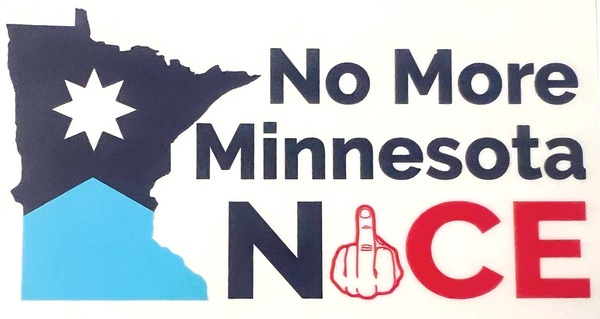
(Editor’s note: The last time I wrote about ICE, I got a nasty email telling me to “get off my bum” and stick to local news, even though I technically was writing about a local ICE protest. If you are in any way pro-ICE, you may want to turn the page, or the next several pages.)
My sister recently sent me a meme. In cross-stitched letters in a gilded frame it reads, “Nobody expected the revolution to begin in Minneapolis … except Prince.”
It was a rare moment of laughter in what has been a dark few weeks for my home state. For those who may not know – or have never heard me say “bag,” “out” or “sorry” – I was born and raised in Saint Paul, across the Mississippi River from Minneapolis. I guess this makes me as qualified as anyone to come up with some sort of explanation for why this out-of-the-way state of fewer than 6 million down-to-earth people is repeatedly the flashpoint for pivotal national tragedies.
I mean, why there, the land of hotdishes and “Minnesota nice”? Can’t they just be left alone? Aren’t the long, dark days of winter, where the sun hangs like a dim bulb in the gray sky, or the 65-plus years without a Super Bowl or Stanley Cup enough for one state to endure? (I still shed a tear now and then for the North Stars).
But the truth is, I really don’t know why it has become the current epicenter of Donald Trump’s ICE rage, other than Gov. Tim Walz once called Trump “weird.” This relatively tame assessment reportedly did not sit well with the Orange One (not to be confused with the Purple One.)
But for the record, Minnesota is not a particularly violent place. In fact, you’re more likely to get into a “Minnesota stand-off” at an intersection or grocery store – “oh no, you go,” “no, you go” – than any sort of physical altercation.
However, in addition to being the land of 10,000 lakes, it’s also the land of dichotomies. Along with all those beautiful lakes comes 100 billion mosquitoes (*a rough estimate.) It can be brutally cold in the winter and just as brutally hot and humid in the summer. It’s a land that has given us such artistic luminaries as Bob Dylan, The Replacements, Prince and F. Scott Fitzgerald, yet somehow also produced the My Pillow Guy and Jessie “The Body” Ventura. It is at once home to White Castle and the world-renowned Native American restaurant Owamni (the first place I knowingly ate bugs, a story for another day.)
There’s the pristine solitude of the Boundary Waters Canoe Area, and then there’s the Mall of America, the largest shopping mall in the United States, complete with indoor amusement park. And in the summer, it may be one of the greenest, lushest places on Earth, but good luck finding a green vegetable (and no, Jell-O doesn’t count, even if it has fruit cocktail floating around in it). Any kind of hot sauce is just as scarce – ranch dressing is as spicy as it gets.
And believe it or not, not everyone in Minnesota is named Sven and Ole and wears flannel Elmer Fudd hats. In fact, it is quite diverse, with nearly every diaspora represented, from southeast Asia to Latin America to western Africa.
Don’t get me wrong – it’s not perfect by any means. For starters, there’s all that snow, but it’s flat as a lefse. Buck Hill, the nearest “ski hill” to where I grew up, has a whopping 310 feet of vertical (which – along with the aforementioned lack of vegetable options – is the main reason I moved west.) And, like any metro area, the Twin Cities has its share of traffic, blight, inequities, scandals and controversies – the latest involving a proposed bike lane along St. Paul’s mansion-lined Summit Avenue that would require removal of some of the street’s historic trees.
But above all, Minnesota also happens to be one of the most welcoming places you’ll ever find. There is no “local’s police” eyeing you suspiciously and asking you how long you’ve lived there like some overly protective mountain towns. In fact, it’s quite the opposite. If you’re willing to move there, put in the hard work and make a life for yourself in that at-times inhospitable landscape – where many newcomers have never seen snow or ice, let alone a hockey stick – then go for it. Or rather, gofer it.
On a recent trip to the Twin Cities, I struck up a conversation with my Uber driver. He was from Somalia, and I remarked how moving to Minnesota must have been a shock at first. He said it was, but now, after 20 years, he did not mind the cold and loved living there. It was his home, he said.
Sure, there may be some idiosyncracies, like “duck duck goose” is called “duck, duck, gray duck” and “roof” is “ruff,” and you borrow, not lend, something to someone. Oh, and then there’s the strange obsession with food on a stick, loons, the Edmund Fitzgerald (OK, maybe that’s just me) and walleye as well as those quirky but enduring Minnesota pastimes of roller blading, hockey, curling and something called “booyah,” which I have yet to try. (Although, just between you and me, I will never understand the attraction of ice fishing. #Sorrynotsorry.)
Eventually, after some time, you start to tolerate the cold – your blood grows thicker, I swear – and you come to appreciate the state’s subtle, understated, natural beauty. (Pretty much the exact opposite of Kristi Gnome’s – er, silly me – Noem’s, face.)
In fact, there are very few things Minnesotans won’t stand for, including but not limited to: whining about the cold; anyone holding an empty beer at your house; and anyone who doesn’t adhere to the “nice” code.
It is this last one that is particularly pertinent right now. See, as nice as Minnesotans are, they reserve a special sort of un-nice – which coincidentally has the word “ICE” right in it – for, say, masked, heavily armed, wannabe gestapo who are sowing terror and chaos in their streets. There is a proud culture of independence and self-determination among these folks who have not just managed to eke out an existence up there, but thrive. The downtown skyway system is a direct testament to this. And when you challenge this quiet resolve, the response is as sharp, biting and persistent as the bitter January air.
“After Renee Good was murdered, it unlocked a rage inside me I didn’t know I had,” said a high school friend who literally is the poster girl for Minnesota nice. “I couldn’t keep in the tears. It was maddening.”
My friend and her daughter had been protesting against ICE regularly. They also had been donating to help immigrants who were literally trapped inside their houses with blankets over their windows, out of fear of being spotted by ICE. (“Anne Frank,” anyone?)
“They’re just so cruel, their actions are brutal,” said my septuagenarian aunt – a grandmother of 10 who recently beat cancer and took part in the Jan. 23 march in downtown Minneapolis in -10-degree weather.
(For the record, none of these “radical” hotdish vigilantes were paid to protest and went on their own volition. Weird, huh?)
And maybe therein lies the answer to the Minnesota riddle. It’s not that bad things happen there, it’s how people there respond to bad things: by standing up, helping out and speaking up. The day after Alex Pretti was gunned down in a Minneapolis street by federal agents, Gov. Tim Walz called out the Minnesota Guard, not to assault peaceful protestors with tear gas or flash bangs or to tackle them to the ground and call them names or racial slurs. But to keep the peace and hand out doughnuts and hot chocolate (with marshmallows, I presume). Because that’s what Minnesota does. See, it’s all about decency and helping out, whether it be shoveling your neighbor’s walk, bringing them groceries or blowing a whistle when one of those menacing black SUVs rolls down your street.
In other words, normal, civilized, neighborly behavior that calls out right from wrong. Very, very wrong. And unless I’m going crazy, there’s nothing revolutionary about that. Or at least there shouldn't be.