
Last one in...
After decades of discussion and debate, the "No Trespassing" sign at Lake Nighthorse might be coming down.
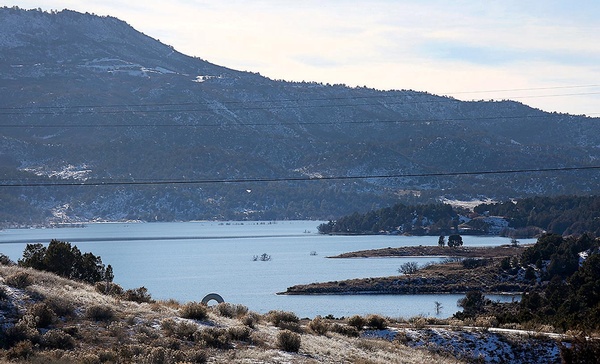
It's possible the gates to Lake Nighthorse could open next summer. Following the release of a final Environmental Assessment by the Bureau of Reclamation on Dec. 19, there's only a handful of necessary steps. The bureau needs to complete a Cultural Resource Management Plan with 25 stakeholder tribes and a 25-year lease agreement with Durango. Meanwhile, the city needs to annex the property so it will have jurisdiction to manage the lake and surrounding area./Photo by Jennaye Derge
After decades and decades of discussion and debate, the “No Trespassing” sign on the gates to Lake Nighthorse just might be coming down.
With the release of a final Environmental Assessment by the Bureau of Reclamation on Dec. 19, both federal and city officials who’ve been working on the project for years have whittled the to-do list down to less than a handful of items.
It means, although no one is willing to give an exact date, it is possible Lake Nighthorse could open next summer.
“Hopefully, in the near future, recreation will be available,” said Justyn Liff, public affairs specialist for the Bureau of Reclamation’s Western Colorado Area Office. “We’re excited about that possibility.”
For many stakeholders and area residents, it’s been about delay after delay – not step by step.
It all really started in 1968 when the federal government and tribal leaders wrestled over water rights, eventually coming together to create the Animas-La Plata Project and its governing body in the 1980s.
It took a few more decades to agree on the idea of a dam and reservoir at Ridges Basin, an area just southwest of Durango, which was later named after Ignacio Sen. Ben Nighthorse-Campbell, an instrumental figure in helping the parties come to an agreement.
Lake Nighthorse began filling up in 2009 and everyone’s attention turned to recreation. The idea of enjoying trails, campsites, fishing, boating and swimming seemed within reach after the lake filled up in 2011.
However, the gates didn’t open the following year, or the one after that, or the one after that.
Instead, the property sat unused with the chains on the gates and the “No Trespassing” sign slowly rusting at its border. Frustration in the community over the delays even gave rise to an Occupy Nighthorse movement a couple years ago.
After five long years, however, things might be changing. Federal and city officials have only a handful of things left to do.
That work includes a Cultural Resource Management Plan, being negotiated by the Bureau of Reclamation and 25 stakeholder tribes; a lease agreement between Reclamation and Durango, which spans 25 years; and, an annexation process so the city can have jurisdiction to manage and patrol the lake and surrounding area.
First up is to finalize the management plan for dealing with and protecting the area’s cultural resources.
The Bureau of Reclamation also considers the lease agreement with the city a high priority.
What might be the most complicated of these administrative tasks, though, is the annexation process, which according to Durango’s Parks and Recreation Director Cathy Metz, is similar to other open spaces the city has annexed in the past, like Oxbow and Horse Gulch.
She called it an extensive public process, ultimately decided by a vote of the Durango City Council.
“Quite a bit of work still needs to be done,” she said. “I think there’ll be a lot of community dialogue on Lake Nighthorse.” She added that all the attention that comes with the process might actually help move it along.
Once those three administrative tasks are complete, there’s one more thing – construction. A little work still needs to be done to the decontamination station, which would prevent the introduction and spread of any invasive species into the lake.
There’s also some improvements needed for the lake’s access road and boat ramp. Of course, none of those projects can move forward until things warm up in the spring.
In the meantime, however, Reclamation and city officials are planning to move forward with the Cultural Resource Management Plan, 25-year lease and annexation process.
The Bureau of Reclamation is calling the plan, referred to as the proposed action in the final Environmental Assessment, “a small-scale, staged approach.”
The small-scale part is the limited activities and footprint those activities would make on the area’s 5,500 acres. The staged approach is about the possibility of expanding both the activities and footprint in the future.
Under the final plan, once Lake Nighthorse finally opens, paddle sports, like kayaking, canoeing, rowing and stand-up paddle boarding, as well as swimming, scuba diving, fishing and boating will all be allowed.
Both motorized and non-motorized boats have the green light as well, although only from mid-May through mid-November.
Liff and city officials said wind-surfing and sailing are “well-suited for Lake Nighthorse,” but they need to work out some details first, like a designated launching area.
As for the footprint, the facilities and access to the surrounding area is minimal. Specifically, plans call for restrooms, an overflow parking area, a courtesy dock for the existing boat ramp and a trail connecting the two. That’s it.
The lake would be open for day-use only with access limited to the eastern side,
where the boat ramp and parking are located, with a 25-foot buffer around the entire lakeshore. Swimming, fishing and other activities are allowed from the shoreline.
Everything is subject to seasonal or other types of closures.
All of these specifics were part of the draft Environmental Assessment, released early last year. Hundreds of people sent in comments, all of which Reclamation reviewed before completing the final EA.
Liff said although officials did receive some specific comments from organizations like Trails 2000, the La Plata County Board of Commissioners and Colorado Parks and Wildlife, most were “votes.”
The top topic for commenters was boating – supporting or opposing motorized, non-motorized, or seasonal closures. The second most popular subject was trails.
Over the years, talk of a trail system around the lake has been a hot topic.
In their comment on the draft EA, Trails 2000 requested a multi-use trail on the north side of County Road 210 be included in the initial phase, something that was part of an earlier recreation plan developed in 2011. The group even offered to assist with planning, construction and maintenance of the trails.
However, a specific trail system is not in the initial planning. It is something that can be developed later, following more study.
The plan specifically refers to the development of “a natural surface trail connecting Lake Nighthorse to the Animas River Trail, a looped natural surface trail system on the east side of the reservoir, (and) link-ages with other trails outside the project area.”
Other things that could come after further review are campgrounds, a swim beach, picnic area, breakwater structures at the boat ramp and more.
However, any future development not included “would be subject to additional environmental review and approval by Reclamation,” according to the final EA.