
Meet the new boss
For chief Afzal, it's all about getting police out of cars and onto the streets
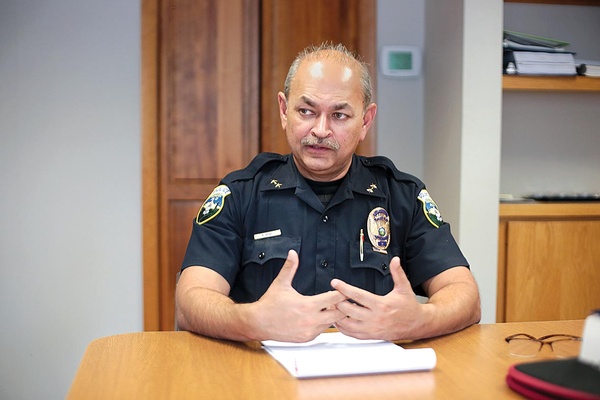
New Durango Police Chief Kamran Afzal, who moved here by way of the Washington, D.C., area, discusses his philosophy last week at the Durango Police Department. "We are not policing anyone in the job of law enforcement; we're here to serve others, to be better today than yesterday and better again tomorrow," Afzal said./ Photo by Jennaye Derge
There’s a new lawman in town, so you better watch where you spit, who you dis and just how you get home after barhopping. He’s here to clean up Durango, make it safe for unescorted women to walk the boards, for kids to roll their hoops and gentlemen to conduct commerce. He’s not related to anyone in these parts, has no friends hereabouts, owes no favors. He comes from the far east, where there’s bad guys aplenty and manners and civil discourse are taught, demanded and enforced. He’s easy to like if you don’t force a meeting; he casts a big shadow you don’t want to fall under. But he’s known to help a guy who’s down, rescue a treed cat and drive a kid home who lifted a Tootsie Roll for his father to bridle. We’re lucky to have him, and you better believe it.
Kamran Afzal is Durango’s new chief of police, replacing Jim Spratlen, who retired in September 2016. Afzal, 50, comes from Arlington County Police Department in Virginia, on the other side of the Potomac from Washington, D.C. While there, he worked his way up the ranks in a 471-man department to retire as captain after 24 years. But his story started long before that.
In 1982, at the age of 15, Afzal came with his mother to the United States to live with an uncle and cut path for his father and siblings to immigrate during the next five years. After graduating from George Mason University, Afzal planned on going into banking but temporarily fell into a deputy job on the U.S. Capitol Police force in Washington, D.C. It was in this high-profile job that he realized how he might best contribute to his family and his new country. Afzal was hired on as deputy with the Arlington County police in 1993, made sergeant in ’98, lieutenant in 2002 and captain in 2005. In that time, Afzal said he developed an approach to law enforcement that is now being embraced by police agencies across the country.
“We are not policing anyone in the job of law enforcement; we’re here to serve others, to be better today than yesterday and better again tomorrow,” Afzal said.
In Arlington, Afzal worked continually on developing a mission statement and strategic plan for the department that was written by and put into place by all the officers. “If a plan for improvement in enforcing laws and developing relationships with citizens comes from me alone or with top brass, it goes nowhere with the men on the street,” he said. “But if the men who have day-to-day contact with the community study, analyze and write a strategic plan, they then have buy-in.”
Afzal is a strong believer that we are all here to serve others. “We have a social contract with each other,’‘ he said. “Society has an obligation to ask ‘What can we do to help others?’ I talked about this all the time within my department, now these guys here in Durango can get sick of hearing me – ‘What can we do; how can we do it better?’”
This simple observation was suggested to Afzal by authors Jim Kouzes and Barry Posner in their 1987 book Leadership Challenge, which made a lasting impression on the the future chief. According to the book, the five practices of exemplary leadership that make “extraordinary things happen” are to: model the way; inspire a shared vision; challenge the process; enable others to act; and encourage the heart.
With that aspirational meme, Afzal has a near-perfect laboratory here in Durango. He is certain that criminal behavior must first be dissuaded by identifying the locus of the activity and either preventing it or arresting perpetrators swiftly
and surely. With 58 officers patrolling 10 square miles with 18,000 people, one would think –and it feels as if–Durango is well protected and has a resultant low level of crime. However, as it happens, it’s wrong to think of Durango as crime free. And Afzal hopes to soon get his arms around the full picture of our seemingly carefree burg.
Using analytics that Afzal will update and put his brand on, the Durango Police Department historically responds to an average of 35,000 calls annually. Not all calls are for crimes, of course, but Durango ranks 35th for crimes out of 152 Colorado municipalities of any size and 76th in violent crime among 346 towns of similar size nationwide. According to the FBI’s Uniform Crime Report, in 2015 Durango had 45 crimes of violence; 639 property crimes; various assaults on police officers; more than 100 cases of family violence; 500 disorderly conduct calls; 450 criminal mischief calls; not to mention the myriad calls for traffic violations, drunken driving, accidents, dog bites, trespassing, and alcohol and drug overdose.
In other words, law enforcement is not a pretty job, and it’s getting less glamorous every day under the scrutiny of public oversight in the form of pects and bystanders with smartphones. Tectonic changes are occurring in law enforcement, corrections, and the judiciary and community supervision of offenders. And it is long overdue, according to students of criminal justice.
“The biggest setback in law enforcement was when beat officers were taken off the streets and put in cars,” Afzal proclaimed. “The connection between need and help was broken. Eyes were taken off the streets, friendships and mutual respect were eliminated when patrols were switched to officers in cars.”
As a result of this disconnect, Afzal is working on partnerships and mentoring programs with schools, the homeless, business owners and neighborhoods. Community policing is the standard of excellence in 2017, and evidence-based practices show that the bottom-up model creates trust and cooperation, safer streets and less crime.
“People – the public and police officers – want to be valued and will work smart and hard to get that recognition,” says Afzal.
With a police chief who has dedicated his career to making extraordinary things happen by enabling others in his command to act with integrity and heart, Durango may just be on the cutting edge of yet another quality-of-life standard.
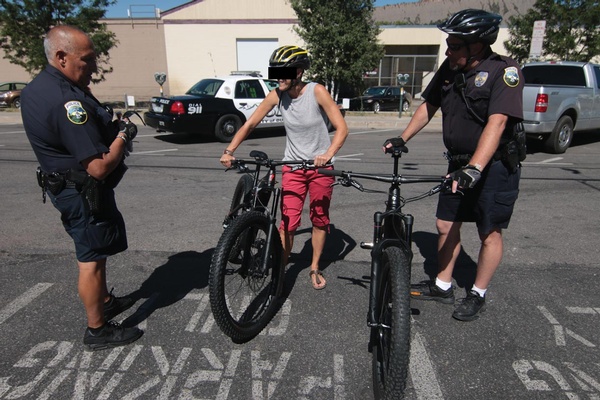
Durango Police stop to have a friendly chat with a local law-abiding citizen. If you think you've seen more police out pounding the pavement, you'd be right. Under new Chief Afzal, the goal is to get police out of cars and out making connections with the community./ Photo by Jennaye Derge