
Quick and Dirty
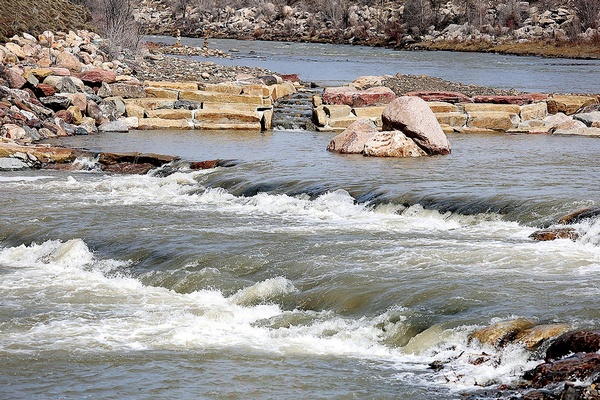
The Animas River will strike a little less fear in boaters this season, with work under way to tame Corner Pocket and Ponderosa./ Photo by Jennaye Derge
WW park to get a little less munchy
Local boaters will soon be able to lessen their high water death grip through the Whitewater Park. That is if all goes as planned when the City of Durango conducts its latest round of in-stream park maintenance, which is scheduled to start today, Feb. 23. The latest itineration of the park, which contains grouted features, was completed in 2014 after a lengthy community process.
According to Durango Parks and Recreation Director Cathy Metz, the work is being conducted for safety reasons, namely to take some of the bite out of two features – Corner Pocket and Ponderosa – which proved challenging at high flows, flipping numerous commercial and private rafts.
“The conversation in the community after high water in 2014 was that these features were too powerful,” she said. “We’re working on dropping the elevations of Ponderosa and Corner Pocket so they’re not as powerful. There will still be a wave, and hopefully still a feature boaters will enjoy.”
Specifically, crews will be reworking the river right wing of Corner Pocket as well as the wings of Ponderosa to make the features less constrictive. In addition, a rock from Ponderosa that washed downstream will be put back in place; voids in the Smelter boulder wall on river left will be filled in; and Clock Tower will be re-tooled as well.
Metz said the work was scheduled to take place in the winter of 2015-16, but the city was unable to work out a schedule with a contractor. This time around, Whinnery Construction, based out of Lake City, will be doing the work. It will be overseen jointly by staff from the Whitewater Park’s original design firm, S2O, and John Brennan, Durango Whitewater coach and member of the Animas River Task Force.
Work is slated to be done by mid-March before run-off begins. Until then, Metz asks boaters to avoid the park all-together. “Boating through during construction is not something we recommend,” she said, adding that heavy equipment, coffer dams and other hazards could be encountered.
She also said steps are being taken to minimize stirring up sediment. “We know it’s prime fly fishing time, so we’re trying to minimize disturbance in water quality,” she said.
The history of Durango’s new $1.1 million Whitewater Park has been a long, and somewhat contentious, one. The city acquired recreational in-channel diversion water rights of 1,400 cfs for the park in 2007. However, as mandated by law, the RICDs must include permanent structures to direct the flow – in Durango’s case, grout was used to help cement the rocks in place. Then, due to recessionary budget constraints, construction of the park was postponed until 2013-14.
The Smelter area also underwent work last fall to change the route of the drop and dig out the city’s water intake, which had become filled with sediment.
Metz said the city is hopeful this will be the last round of work in the river for a long while. “Our intent is to complete the work and let ’er go and let the river do what it’s going to do,” she said. We want it to be a good recreational experience, and we want to get it right.”
For more info., call 375-7321 or email at rec@durangogov.org
Death toll mounts in beetle epidemic
A new report verifies what anyone who’s been over Wolf Creek Pass recently has already observed: Colorado’s forests are in bad shape. According to “Fire and Water,” the Colorado State Forest Service’s 2016 report on the health of Colorado’s forests, there are a staggering 834 million standing dead trees in the state’s forests. The number represents and almost 30 percent increase in dead trees in the last seven years, amounting to nearly one in every 14 standing trees. The trend is most noticeable in spruce-fir and lodgepole pine forests impacted by bark beetles. But the beetle is not the only enemy. Catastrophic fires are much more likely among dead trees, such as the intense wildfires last summer near Beaver Creek that burned through beetle-kill timber northwest of Walden.
“When so many trees die and large wildfires follow, our forests quickly turn from a carbon sink into a carbon source,” Mike Lester, State Forester and Director of the CSFS, said. “Beyond the implications for our atmosphere, forests in poor health have implications for our water supplies, public safety, wildlife and recreation opportunities.” The 2016 report was presented Feb. 15 at the Joint Agriculture and Natural Resources Committee Hearing in Denver. This year’s report focuses “on how wildfires and unhealthy forests impact human populations, water supplies and forested environments.
Other important findings from the report include:
- Almost 3.4 million acres have been affected with some degree
of tree mortality due to the decades-long pine beetle epidemic. The ongoing spruce beetle epidemic has impacted 1.7 million acres.
- Approximately 80 percent of the state’s population relies on forested watersheds for municipal water supplies.
- Risks ranging from severe wildfires and insect infestations to long-term droughts are likely to be amplified in the future, as climate models predict statewide warming between 2.5 F and 6.5 F by 2050.
“With increasing changes in our forests, now is the time for determining how we will manage for projected future conditions,” said Lester. He says the CSFS is taking steps to address these threats such as management focused on watershed protection and wildfire risk reduction; providing seedlings for restoration; wood utilization and marketing; and insect and disease detection and response.
Much of CSFS work is done through partnerships with other agencies, including the U.S. Forest Service. The agency also assists with helping communities become better fire-adapted, including Community Wildfire Protection Plans (CWPPs), Firewise Communities and the online Colorado Wildfire Risk Assessment Portal.
Information for the reports is derived from an aerial forest health survey by the CSFS and the Forest Service, as well as field inspections, contact with landowners and special surveys.
Copies of the 2016 report are available at www.csfs.colostate.edu.
Area residents win mitigation awards
Speaking of wildfire mitigation, two Southwest Colorado residents have been recognized for their efforts to help stem wildfire risk in their communities. FireWise of Southwest Colorado announced earlier this month that Dolores resident Rebecca Samulski, FireWise Assistant Director, and Jim Tencza, neighborhood ambassador for Timberdale Ranch, north of Bayfield, were both recipients of the national Wildfire Mitigation Award.
Established in 2014, the national Wildfire Mitigation Awards go to individuals and organizations that display innovation and leadership in wildfire preparedness. Of the 14 national awardees, three were from Colorado. The award is sponsored by the National Association of State Foresters, International Association of Fire Chiefs, National Fire Protection Association and U.S. Forest Service.
“These outstanding individuals are truly embracing the concept of creating fire-adapted communities,” Pam Wilson, Executive Director for FireWise of Southwest Colorado, said.
In 2015, Samulski started the Dolores Watershed and Resilient Forest Collaborative to reduce the risk of wildfires at McPhee Reservoir. Tencza was honored for spearheading a community wildfire protection plan, coordinating defensible space projects and instigating cross-boundary treatment between private and public lands.
Awards will be presented at the IAFC Wildland-Urban Interface Conference (WUI) in Reno on March 22, and FireWise of Southwest Colorado will honor the local recipients at its March meeting.