
Quick and Dirty
• Montoya, Unger, Landis for LPEA • MSI: Animas meets standards
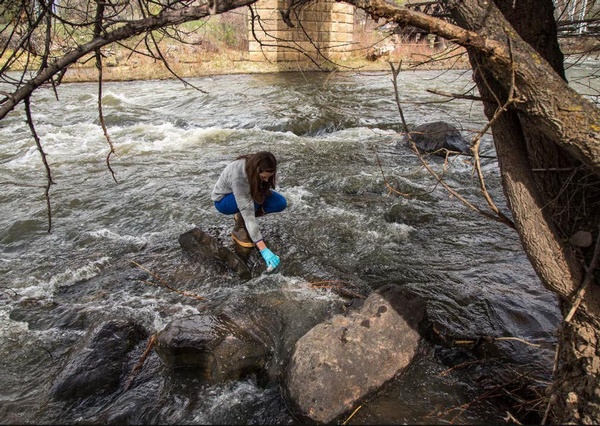
A member of MSI takes a sample in 2016./Courtesy photo
Montoya, Unger, Landis for LPEA
A longtime incumbent retained his seat on the La Plata Electric Association Board of Directors while two new, greener faces will be joining the ranks.
Results of the election were announced at the co-op’s Annual Meeting on Sat., May 13, at the Sky Ute Casino & Resort in Ignacio.
Incumbent Davin Montoya retained his seat representing District 2, with new directors Rachel Landis, director of FLC’s Environmental Center, and Guinn Unger, a former NASA engineer and software developer, were elected to represent Districts 3 and 4, respectively. Both campaigned on a progressive platform of more renewables and a move away from coal.
LPEA board elections are held annually for one of the three seats in each of the coop’s four districts (in District 1, Archuleta County, incumbent Bob Lynch ran unopposed). Out of the 24,610 ballots mailed, 7,001 were cast for a 28 percent return – the highest participation in several years.
Approximately 8,650 members in District 2 (south and west La Plata County) voted, giving Montoya 1,374 votes, compared to 1,068 for challenger Kim Martin.
In District 3 (City of Durango), with approximately 8,070 members, 1,484 members cast votes for new candidate Landis over the 891 earned by new candidate R. Michael Bell. District 3 incumbent Jeff Berman did not seek re-election.
Of the approximately 7,890 members in District 4 (north and east La Plata County), challenger Unger received 1,181 votes, unseating incumbent Joe Wheeling, who received 999 votes.
An estimated 430 co-op members attended LPEA’s Annual Meeting. Balloting and tallying was overseen by the La Plata County Clerk’s office.
“As a rural electric cooperative, LPEA exists to serve its members. Everyone has an economic interest and voice in LPEA’s future,” CEO Mike Dreyspring said. “We thank those who cast their votes and took time to participate in the cooperative process.”
The new officers were officially sworn in at the board’s regular meeting Wed., May 17.
MSI: Animas meets standards
Water quality of the Animas River in Durango posed no serious health risks to humans, livestock or crops in 2016, although if you’re a fish or other water-going creature, it could be a different story. This according to water-quality results announced by the Mountain Studies Institute this week. The local nonprofit research center conducted its own monitoring of the river at Rotary Park from February – November last year, evaluating for metal concentrations in the wake of the Gold King Mine spill.
According to MSI aquatic ecologist Scott Roberts, the 2016 results were encouraging. “Based on water quality benchmarks developed by the Colorado Department of Health and the Environment and the Environmental Protection Agency, we have no indication of any threat to human health or agricultural use from Animas River water in Durango,” Roberts said. “And it does not appear that metal concentrations in 2016 were any higher than those documented in previous years from 2002-14.”
He noted that they did detect elevated metal concentrations during storm events when turbidity and discharge rose but those levels were not high enough to pose a threat to human health or agriculture.
However, the data did raise concerns for aquatic life in that stretch of river, particularly due to elevated levels of iron and aluminum. In heavy concentrations, these can inhibit fish breeding and decrease oxygen availability, among other things.
MSI has prepared a “flip-book” style guide of its monitoring results, a weekly snapshot of the river itself, water-quality data and summaries on its website: www.mountainstudies.org/AnimasRiver. Roberts noted the results are from only one monitoring location and not representative of the entire watershed.
The nonprofit plans to continue the Rotary Park monitoring program in 2017, and results will be made available via the website and social media. “Our goal is to get water-quality results to the public as quickly as possible,” said Roberts.
The monitoring program is part of a partnership between MSI and the City of Durango to provide an independent assessment of river quality from May – August, when river recreation is at its highest.
In addition to MSI’s monitoring, several other agencies are monitoring water quality of the Animas River including the EPA, CDPHE, San Juan Basin Public Health, Southern Ute Indian Tribe and the United States Geological Survey.