
Quick 'n' Dirty
Reining in flock; LPEA makes Tri-State split official; and land closures remain until April 30
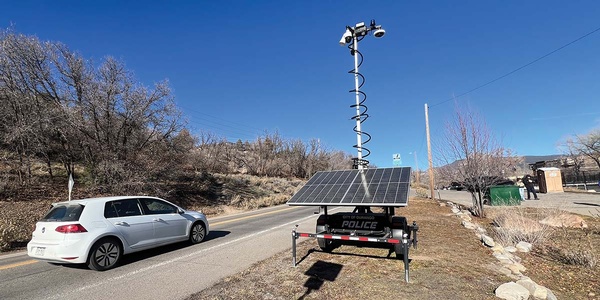
One of the City of Durango's Flock cameras, along Roosa Avenue. A proposed law would tighten rules around who can access Flock footage and how long it is retained. /Telegraph file photo
Law would rein in Flock
Durango could be tightening the rules around its Flock camera system. This Fri., April 3, City Councilor Shirley Gonzales, along with civil rights and advocacy organizations, will announce the proposed “Protect Our Privacy Ordinance,” which would set limits and safeguards around the controversial license-later reader cameras around town.
“This is common-sense regulation that would provide important safeguards for our community while allowing our police department to continue to use the Flock Safety system,” Councilor Gonzales said in a news release.
If passed, the ordinance would create judicial warrant requirements for any agency wanting to access data captured by the cameras. It would also limit the baseline retention of footage to 72 hours and create a community oversight board that would ensure the provisions are being followed. The ordinance includes exceptions for “exigent circumstances” and a process for parties to request specific data be preserved for a limited period.
The ordinance was developed by community advocates, with support from the ACLU of Colorado, Colorado Immigrants’ Rights Coalition (CIRC) and Compañeros: Four Corners Immigrant Resource Center.
“If passed, this ordinance would create critical protections that would protect the civil liberties of everyone in Durango. This is a crucial regulation needed to ensure that law enforcement and government agencies cannot abuse this developing technology,” Anaya Robinson, of the ACLU of Colorado, said.
To debrief the community on the proposed ordinance, Gonzalez, along with the ordinance’s supporters will hold a press conference from 12 noon – 1 p.m., Fri., April 3, at the Windom Room at the Durango Community Recreation Center.
Enrique A. Orozco-Perez, Co-Director of Compañeros, said the ordinance as an important step in protecting the constitutional rights and civil liberties of everyone who lives in and travels through Durango.
“For immigrant communities in particular, unchecked surveillance systems create real fear and risk,” Orozco-Perez said. “Making strong protections, such as judicial warrant requirements, strict limits on data retention and community oversight, safeguards against misuse of personal data. We are deeply grateful to community members, advocates and organizations who worked to develop this important legislation.”
Tri-State split official
La Plata Electric Association announced that its long-awaited breakup with Tri-State Generation and Transmission became official Wed., April 1. The local co-op has now joined the Southwest Power Pool Regional Transmission Organization.
With this transition, LPEA said it expects to achieve an additional 20% reduction in greenhouse gas emissions while delivering lower wholesale power costs, greater reliability and increased local control for its members. This transition marks a new chapter for LPEA, according to CEO Hansen, one focused on local control, innovation and long-term value.
“This is a defining moment for our cooperative,” Hansen said in a news release. “We’ve built a power supply portfolio that is more flexible, more local, more resilient and more affordable while staying grounded in our mission to serve members.”
The transition follows a multi-year effort by LPEA’s Board of Directors to sever ties with its longstanding provider. On March 25, 2024, directors voted to exit the co-op’s contract with Tri-State. LPEA was the fifth largest of Tri-State’s 42 members, responsible for 5.7% of the total demand over a three-year period. Although at the time LPEA declined to disclose a buy-out price, Tri-State, in a statement after the LPEA decision, said the estimated value of LPEA’s contract termination was $209.7 million.
Through its new power supply strategy and participation in the Southwest Power Pool, LPEA said it expects to realize more than a 10% reduction in wholesale power costs. It is hoped that these savings allow LPEA to hold base rates stable for 2026, even as broader power supply costs across the region have increased.
“This is exactly why we made the decision to leave,” Board President Nicole Pitcher said. “I was proud to be part of that Board vote, and we’re already seeing it pay off for our members with lower costs, stable rates and a cleaner, locally controlled power supply.”
In its exit, LPEA joins a growing number of electric cooperatives that have transitioned away from Tri-State in recent years including: Kit Carson Electric Cooperative (NM), which departed in 2016; Delta-Montrose Electric Association (departed in 2020); and United Power (CO) (departed in 2024.)
By joining SPP, LPEA said it will gain access to a broader, multi-state market and transmission network, thus enhancing reliability, efficiency and flexibility. It will also help the co-op maintain local control over rates and resource decisions. This was one of its main points of contention with Tri-State, which historically has been heavily invested in coal.
“This move gives us access to tools and flexibility we simply didn’t have before,” Hansen said. “It strengthens reliability today and positions us for the future.”
Looking ahead, Hansen said members can expect continued investment in local energy resources, expanded programs to manage energy use and costs, and a system designed to adapt to the region’s evolving needs.
“We are building the future grid for Southwest Colorado,” Hansen said. “And we’re doing it in a way that puts our members first.”
To help members better understand the transition, LPEA will host a “CommunityPowerX” forum on from 6-7:30 p.m., Thurs., April 23, at the Durango Arts Center. The public event will bring together regional energy leaders to discuss the future of the grid, new energy resources and what members can expect moving forward.
Seating is limited and participants are required to reserve a spot in advance at lpea.coop. A $5 reservation fee will be donated to the LPEA Round Up Foundation.
You shall not pass
Colorado Parks and Wildlife reminds local trail users that seasonal closures on specific areas managed by CPW, the Bureau of Land Management and the City of Durango are in effect through April 30, despite the warm winter.
Each year, several areas around Durango are closed from Dec. 1 - April 30 to provide winter habitat for mule deer and elk. In addition, early spring is a period of heightened stress on the animals, and disturbance from people or dogs can cause them to expend critical reserves.
This year, all partners agreed that extending the full closure period is the best approach. While the 2025-26 winter was hot and dry, the lack of snow alone does not signal that deer and elk have moved on to higher ground, according to CPW District Wildlife Manager Luke Clancy.
“Deer especially do not migrate based on conditions,” said Clancy. “The months of February, March and April have the highest winter mortality due to poor body conditions and poor forage availability.”
The BLM and City of Durango also announced their original closures dates will remain, despite warm, dry conditions.
Closures include:
• Bodo and Perins Peak State Wildlife Areas
• Smelter Mountain Trail is open for foot access only from 10 a.m.-2 p.m. Dogs are prohibited
• Big Canyon, Sale Barn and Three Springs trailheads in Grandview
• Upper loops of Animas City Mountain and Twin Buttes (closed until May 1)
Those found in violation of CPW closures are subject to a $139.50 fine. For updated conditions and closures, visit durangotrails.org.