
Quick 'n' Dirty
Help for the Demon Bridge, Highway 550 N closure, and fire mitigation falls off
Highway 550N closed June 2 for chip-seal
In addition to work on the Animas River Trail, travelers heading north on Highway 550 will also experience delays next week.
Four-day chip seal operations will be taking place between Molas and Red Mountain Pass June 1-4, with a full closure of the highway from Molas Pass to Silverton on Mon., June 1, from 7 a.m. - 2 p.m. After this, the road will transition to one-way alternating traffic for the next three days, and motorists should expect up to 15-minute delays.
Working hours will be 6:30 a.m. - 5 p.m., Monday-Thursday and there will be a speed reduction of 40 MPH through the work zone.
Bridge replacement, ART upgrades begin
A section of the Animas River Trail notorious for many a late-night bike crash among other calamities will be getting a facelift starting next week.
Starting Mon., June 1, the City of Durango will be begin work on the trail behind Durango High School, between Rank and Memorial parks. Upgrades include replacing the trail’s failing asphalt surface with a new 10-foot-wide concrete path and adding new lighting and landscape features. Improvements will also be made to the spur trail connecting the ART to Rio Vista Circle.
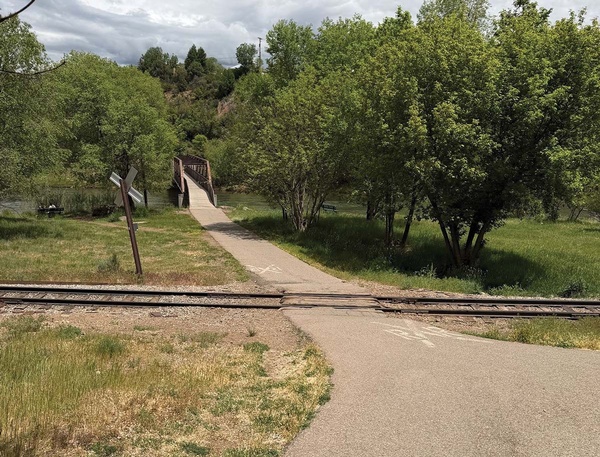
Additionally, the Durango-Silverton Narrow Gauge Railroad will be replacing the tracks on the east side of Demon Bridge on Tues., June 2, from 9 a.m. - 5 p.m.
The project, which is being overseen by the city’s Parks and Recreation Department, will eventually include replacing the Demon Bridge. The new bridge will be wider than the current one, with smoother abutments, and the height will meet waterway freeboard requirements (we’re not exactly sure what this means but assume it has something to do with raft and SUP clearance).
The project is funded through the voter-approved 2015 half-cent sales tax and is expected to continue into 2027.
Temporary detours will be necessary during portions of the construction, and routes may shift periodically depending on construction activities. Trailer users should note that some detours may involve longer travel times. For construction and detour updates, go to the City’s Engage Page at: engage.durangoco.gov/ animas-river-trail-improvements
USFS fire mitigation decreased in 2025
A new analysis by the Center for Western Priorities finds that the U.S. Forest Service treated roughly 35% fewer acres for hazardous fuels in 2025 than in 2024, a sharp decline that may leave communities across the West more exposed to the risk of catastrophic wildfire.
Hazardous fuels treatments – including prescribed burns, mechanical thinning and brush clearing – are known to significantly moderate the intensity and severity of wildfires by reducing the amount of vegetation available. According to CWP’s analysis of publicly available USFS data, the Forest Service treated approximately 2.6 million acres for hazardous fuels in calendar year 2025, compared with roughly 4.1 million acres in 2024.
CWP Executive Director Aaron Weiss said the decrease does not bode well for fire-prone communities heading into the fire season. “Agriculture Secretary Brooke Rollins and Undersecretary Michael Boren had two critical responsibilities heading into fire season: take care of America's forests, and help build fire-resilient communities,” Weiss said in a statement. “Instead, they cut treatment acres by more than a third in a single year, leaving fuel on the ground from Montana to Florida heading into a drought-fueled fire season.”
Making things worse, Weiss said, Interior Secretary Doug Burgum has gutted the firefighting workforce and ordered fire crews back to a failed full-suppression policy. “The policy is what got us into this mess. Doubling down on it, while the Forest Service falls a million and a half acres behind on the prevention work that keeps communities safe, is a recipe for disaster this year,” he said.
While it is too early to make definitive statements about fuel treatments in 2026, early data suggest that 2026 is also tracking far behind the historical average.
The analysis found severe declines in many of the states at greatest wildfire risk. Montana, which faces persistent high wildfire risk, treated just 87,845 acres in 2025 – down 63% from 2024. Oregon, which led the nation in acres treated in 2024, completed hazardous fuels work on 228,411 acres in 2025, down 47% from the year before. And in California, which has experienced devastating wildfire seasons in recent years, 205,358 acres were treated in 2025, down 40% from 2024.
The CWP, in partnership with Redstone GIS Consulting, analyzed publicly available data from the USFS’s Natural Resource Manager Forest Activity Tracking System.
– Missy Votel