
Quick 'n' Dirty
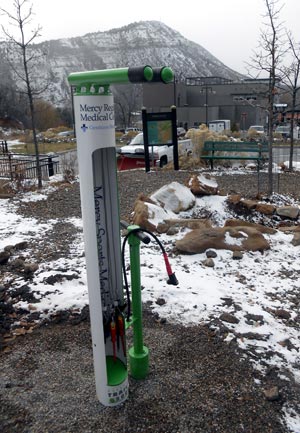
T2000, Mercy here to pump you up
Squishy tires, a wiggly seat post or squeaky brakes no longer need to derail your bike ride.
Last week, Trails 2000 announced the addition of a community bike repair statin at the Horse Gulch Trailhead. The one-stop shop features all the tools necessary to perform basic bike repairs and maintenance, from changing a flat to adjusting brakes and derailleurs.
“The new repair station is a fantastic addition to the trailhead and to the overall functional bicycle infrastructure of Durango,” Mary Monroe Brown, executive director of Trails 2000, said in a news release. “As a destination bike town, it is essential that our community meet the needs of both local and visiting riders.”
The station was funded by Mercy Regional Medical Center, which also proposed the idea. “Mercy’s longstanding partnership with Trails 2000 is one way we promote health and wellness,” Mercy Spokesman David Bruzzese said. “The trail system is such a great resource for outdoor exercise, and we hope this is a convenient resource for mountain bikers who enjoy the Horse Gulch trails.”
Among the station’s many features are an integrated bike pump as well as arms that allow users to hang their bikes while making adjustments and repairs. Tools include Phillips and flat head screw-drivers, various Allen and box wrenches, and tire levers.
The project was made possible through support of the City of Durango, which provided the concrete pad and helped install the repair station. “This was a true community effort,” Monroe Brown said.
Durango is home to more than 300 miles of trails within 30 minutes of downtown. The city was previously awarded a Gold Level Bicycle Friendly Community designation from the League of American Bicyclists.
EPA ups the ante for hardrock mining
The hardrock mining industry may have to start picking up the bill for its messes under a proposed rule from the Environmental Protection Agency. Announced Dec. 1, the new regulations would require hardrock mining facilities to demonstrate financial ability to clean up releases of hazardous substances.
The new proposal was the result of a court order stemming from a 2008 lawsuit against the EPA. It will fall under the Superfund Act (aka Comprehensive Environmental Response, Compensation and Liability Act or CERCLA.)
Since the 1980s, the EPA says it has spent considerable resources cleaning up contamination from hardrock mines. The most recent analysis, from 2010-14, shows the EPA spent nearly $1.1 billion on response and cleanup actions from hardrock mining and mineral-processing sites.
“Far too often, the American people bear the costs of expensive environmental cleanups stemming from hardrock mining and mineral processing,” Mathy Stanislaus, assistant administrator for the EPA’s Office of Land and Emergency Management, said in a news release. “This proposed rule, once finalized, would move the financial burden from taxpayers, and ensure that industry assumes responsibility for these cleanups.”
In crafting the proposal, the EPA consulted with stakeholders, including small businesses, industry groups, environmental groups, and state and tribal governments.
The proposed rule will apply to approximately 221 facilities nationwide that extract and process metals, such as copper, gold, iron and uranium, or nonmetallic, nonfuel minerals, such as asbestos, sulfur and phosphate rock. It will not apply to coal mines, former operations, or hardrock operations that extract commodities such as granite, marble or lime. The proposed rule will allow entities to use insurance, guarantees, surety bonds or letters of credit to demonstrate financial responsibility.
These proposed requirements complement existing financial responsibility requirements. Facilities that apply environmentally protective practices – including those required by other state or local regulations – may be able to reduce the amount of money required under the proposed rule.
The hardrock mining proposal will be available for public comment for 60 days following its publication in the Federal Register. A pre-publication version of the rule can be viewed at: www.epa.gov/superfund/superfund-financial-responsibility.
Learning to eat healthy on a budget
Does the family grocery budget not stretch as far as it once did? This Friday, local low-income families can learn how to make ends meet and offer the kids something healthy to eat. The “interactive and educational” shopping tour takes place Dec. 16 from 3-7 p.m. at Farmers Fresh Market, in Ignacio. The event is presented by Share Our Strength’s Cooking Matters.
The tour, led by Cooking Matters staff and volunteers, will educate shoppers on the finer points of comparing unit prices, reading food labels, identifying whole grains, and buying fruits and vegetables on a budget. After the tour, participants will be able to apply what they learn to buying ingredients for a healthy meal for a family of four with a $10 gift card. The event is free and open to the public.
“Our national study, ‘It’s Dinnertime,’ shows 85 percent of low-income families want to make healthy meals, but only about half are able to do so on a regular basis,” Erin Jolley, local program manager for Share Our Strength’s Cooking Matters, said. “The cost of groceries is a big concern for many shoppers, but healthy eating doesn’t have to break the bank.”
As part of the national “No Kid Hungry” campaign working to end childhood hunger in America, Cooking Matters works to teach low-income families the skills to stretch their food budgets while also eating healthy. The organization holds cooking courses and grocery store tours across Colorado. To learn more, go to: co.cookingmatters.org.