Ramping up
La Plata Mountains coalition fears 'fast-tracking' of Metallic Minerals operation
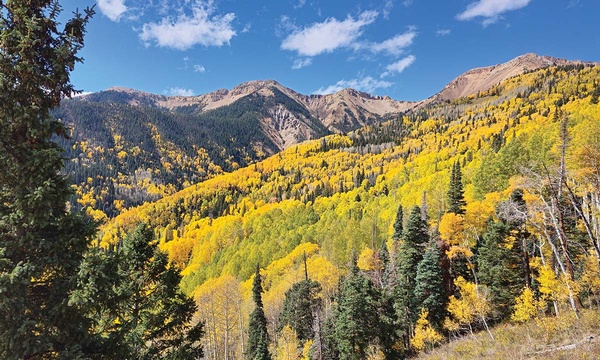
What is known as the Allard Reserve, on the western slope of La Plata Canyon near Bedrock Creek, where Metallic Minerals is conducting exploratory drilling. The La Plata Mountains and Public Lands Coalition recently formed over opposition to further mining activities in the La Platas and fears Trump's recent announcement to "fast-track" extractive operations on public lands will mean a return to large-scale mining sooner than later./ Courtesy photo
As the prospect of large-scale mining in the La Plata Mountains grows, so has local grassroots opposition to it.
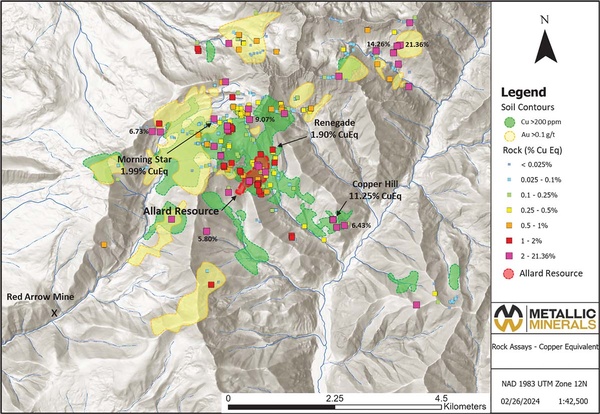
Since 2020, Metallic Minerals, a Canadian company, has been conducting exploratory drilling in the La Platas with the intent of later selling the claim to a larger mining operation. The test drilling, mostly for copper although other metals have since been added to the list, has taken place in an area known as the Allard Reserve, a 19-square-mile swath straddling the western ridge of La Plata Canyon across from the La Plata City campground.
In 2024, Metallic Minerals held town hall meetings in Breen, Mancos and Cortez on drilling activities. Broad opposition during those meetings has since coalesced into a formal alliance of more than 250 members, calling themselves the La Plata Mountains and Public Lands Coalition.
“I attended all of those meetings, and, predominantly, people were concerned and against the mining operation. There was definitely a huge uproar,” coalition administrator Dan King said. “We believe there is a better place to do this mining extraction than the La Platas.”
As a result, the loosely formed coalition held town halls of its own in Durango and Mancos in late 2024 and early 2025. The goal was to sound the alarm over the impacts industrial mining could bring to the nearby mountain range. “We continued to build our numbers and spread the word. We went from about 40 or 50 people to a list of more than 250,” King said.
King said 2025 was a slow year for the coalition as well as Metallic Minerals, as both were waiting to see what direction the Trump administration would go. However, after Trump announced last July that he would be fast-tracking resource extraction projects under his “Big Beautiful Bill,” the coalition knew it was time to get moving.
“In December 2025, we decided we really needed to ramp up our efforts,” said King.
The group now includes citizens as well as experts and activists in several areas including mining, water and hydrology, permitting and regulations, geology, and stakeholders and users, according to King.
“Not only are we standing firm and in absolute opposition to the project, but if we can’t stop it, we want to be collaborators with the operation, making sure that permits and good science are followed, and that the natural environment is impacted as little as possible.”
In order to introduce the group – as well as the myriad issues facing the La Platas and public lands in general – to the public, the coalition is hosting a free event this Sat., Feb. 14, from 9-11 a.m. at the Durango Public Library. Purposefully planned for Valentine’s Day, it will not only include a panel discussion but serve as a celebration of public lands and a thank you to the 3,000-plus public lands employees who were fired by the Trump administration one year ago.
“We'll be talking about our public lands, not only in the La Platas, but the greater San Juans. We'll be sharing our love for them and stories,” said King. “And we’ll be talking about their longevity, especially in light of the fact that they're not being managed as they have in the past. The threats to them in 2026 could be worse than what we saw in 2025.”
The panel will feature several local lands experts and advocates, including: Heidi Steltzer, former FLC Biology and Geosciences professor-turned-theologian; John Raider, public lands director for the San Juan Citizens Alliance (also a sponsor of the event); Chara Raglan, member of Great Old Broads for Wilderness and Bonita Peak Citizens Advisory Group; Anthony Culpepper, associate director with Mountain Studies Institute (which has been conducting water quality sampling at the Metallic Minerals site); and Metallic Mineral’s local Community Engagement Officer Bryan Eisenbraun.
“Bryan's been great,” said King. “He's been very helpful with answering questions. He's led some tours for our group up into the range. He'll be there and able to speak to public lands and what it means to their operation.”
On the fast track
Metallic Minerals describes itself as a “growth stage company” focused on development of copper, silver, gold, platinum, palladium, lead, zinc and rare earth materials. It acts as a precursor to actual mining operations, determining if mining is feasible, if and what a potential return on investment would look like and then selling the claim to a larger mining company. In this case, they are funded by Newmont Corporation, touted as the world's largest gold mining corporation. Based in Denver, it owns mines in the United States, Canada, Mexico, South America, Australia and Ghana.
In addition to the extraction-friendly political climate, in 2025, Metallic Minerals sold a large amount of shares, raising about $8 million, King said. “From what we're seeing, 2026 is going to be a big year for them. There's talk of them resubmitting a new plan now with the feds fast-tracking these processes without doing much of an environmental analysis. We have big concerns about that.”
In a Jan. 26 story on Access Newswire, Metallic Minerals announced it had increased its “mineral resource estimate” at the Allard deposit by 23% since the previous estimate in 2023, adding platinum, palladium and gold to the existing copper and silver deposits. The 2026 estimate now totals 181.4 million metric tons of recoverable metals.
“The updated and expanded resource estimate at the Allard deposit is an important milestone for the company and further validates La Plata as a large, multi-metal, district-scale system,” Metallic Minerals CEO Greg Johnson said in a press release. “The 23% increase in the resource tonnage, supported by recent drilling, confirms the continuity and robustness of the deposit.”
He added that beyond the Allard area, the broader La Plata district remains “significantly underexplored.”
“We believe Metallic is well positioned to unlock additional value for shareholders,” Johnson wrote. He said that “key next steps” include metallurgical tests, and “advancing permitting and execution … focused on resource expansion."
For King and his group, it’s what comes after the exploratory drilling that is most troublesome. “Metallic Minerals, in their exploratory phase, could do a pretty good job of probably keeping things in check,” said King. “But if they can show a big enough return on investment and sell the large claim to a company like Newmont – they're one of the main investors for Metallic Minerals already – who has a terrible track record, that's a big concern for us.”
In fact, there are a multitude of concerns, King said, starting with the gamut of environmental impacts to watersheds, landscapes and wildlife as well as increased traffic, dust and noise. “The La Plata River still holds cutthroat trout, believe it or not, and that’s probably due to the large beaver complexes,” said King. “Ask any wildlife biologist about the impacts on everything from migratory birds to other species that are already impacted from overdevelopment and habitat loss, not to mention climate change, and it's just adding insult to injury.”
King also spoke of limited water availability – although Metallic Minerals currently uses between 250-500 gallons a day, a full-scale mine could swallow nearly 250,000 gallons a day. In addition, the La Platas are the ancestral homelands to the Southern Ute and Ute Mountain Ute tribes, who own water rights on the La Plata River. There will also be impacts to residents on both the Durango and Mancos sides of the range, particularly those who make their living off the land. “There's people who own great tracts of land who are concerned about impacts to their livelihoods and their families, their properties, their water rights and their grazing rights,” he said.
More and more likely
It’s been more than 100 years since La Plata Canyon saw its most lucrative mining boom, which took place from the late 1800s to early 1900s. Around the 1940s, however, most mines folded, and there has been no major commercial operation since. Metallic Minerals, however, thinks new technology could revive the region’s mining history, reopening the scars of which can be seen to this day.
Just when or if that will be is anybody’s guess. King said members of the coalition have varying opinions, but all agree it’s more probable now than ever. “If you ask Tom Miller, who lives right at the base of Copper Hill, or Ryan Brown, who owns thousands of acres on the Mancos River, they'd say it really seems more and more likely,” he said. “If you would have asked me five years ago, I would have said it was a long shot, but … things have really changed in the last 24 months. There's a lot of reason to believe they could rush this through. If they can show their return on investment and sell the claim, then that's all they have to do.”
However, most agree a rebirth of mining in the La Platas would still be years off due to planning and regulations. The proposed project lies on 90% Forest Service lands, which means any mine would likely be subject to an environmental impact statement (depending on presidential administration) as well as approvals from Montezuma and La Plata counties, tribes, and the Colorado Department of Reclamation, Mining and Safety. Most of these processes would include multiple opportunities for public input.
Nevertheless, King said the common refrain that mining is off in the distant future rings hollow. “We often hear from Metallic Minerals that this is a long-term effort; it's 25 years down the line. Most people won't even be here,” he said. “And that's a huge slap in the face to grandparents whose kids are growing up here as we speak.”
And in the meantime, he said, the group will continue to oppose the mine, hold regular gatherings and make sure rules are followed to a T.
“The coalition is geared up, and we're going to be doing outings and active surveillance in the range. We're going to put people on the mountain, whether they're hiking or biking or hunting or fishing or watching what the Metallic Minerals group is doing,” he said. “And we've never been stronger, we're excited.”
For more information on the La Plata Project or the La Plata Mountains and Public Lands Coalition, visit:
• La Plata Mountains Facebook Page
• La Plata Mining Info Page - laplatamininginfo.com
• Metallic Minerals La Plata Project Page - metallic-minerals.com/projects/laplata/ property-overview/