
Ready to roll
Aqueduct trails come to Mancos; inaugural Durango-Farmignton tour this fall
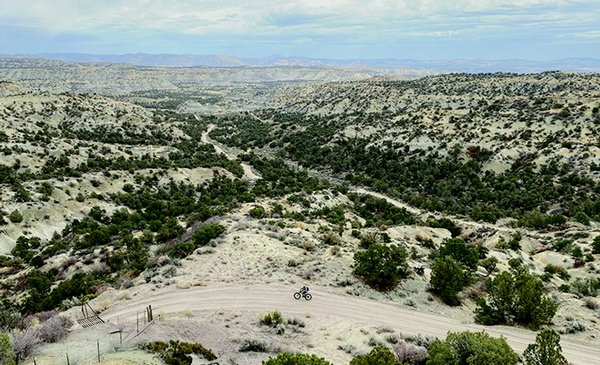
A tiny speck of a rider in the huge vistas of the Durango-Farmington Cycling Tour.
While area trails rested under a not-quite-deep-enough blanket of snow over the winter, new trails were being born for local public lands. The Mancos Trails Group announced last week that there soon will be two additions to the Montezuma County trail landscape: the Chicken Creek Trails and the Aqueduct Trail System.
While details on the Chicken Creek trails will be forthcoming, trail advocates in the M.C. are ready to roll on building the Aqueduct, with the first of what will likely be many build days slated for this Saturday.
Located 2 miles northwest of Mancos, the Aqueduct’s planned 11.7 mile system of singletrack will be open to nonmotorized users plus ebikes. The vision is that eventually, when the Paths to Mesa Verde project connecting Mancos to Mesa Verde National Park is done, riders will be able to access the Aqueduct using just trails and County Road 39.
This Sat., May 15, 9 a.m., the Mancos Trails Group will hold an orientation followed by a work day at the Aqueduct. Trail work will be dependent on trail alignment approval in advance of the work day and having sufficient crew leaders. If there is no trailwork that day, volunteers will instead hike part of the trail system.
Folks interested in coming out and swinging a Pulaski for a few hours can RSVP to: mancostrailsgroup@gmail.com. Space is limited.
And speaking of riding, this fall will usher in a new regional biking event: the Durango-Farmington Cycling Tour. Taking place Oct. 23, the ride is being organized by longtime cyclist and former “Chip Peddler,” Neil Hannum.
The 50-plus ride will start at Santa Rita Park in Durango and end at San Juan College, in Farmington. The “half-road, half-dirt” route follows mostly scenic backroads and BLM singletrack including La Posta Road, HWY 550 and San Juan CR 2300 before descending into Farmington via what Hannum calls the “Big Apple” in a nod to the iconic Road Apple trails.
In addition to local scenery, the route also takes in local history. Not only does it follow parts of the old Spanish Trail, it also takes in the Aztec arches and the once-flourishing Spanish settlement of La Posta, Colo.
For more info. on the tour, email Hannum at:neilhannum@gmail.com