
Redefining the business of art
Colorado's new A Corp model helps creatives retain control while attracting investment
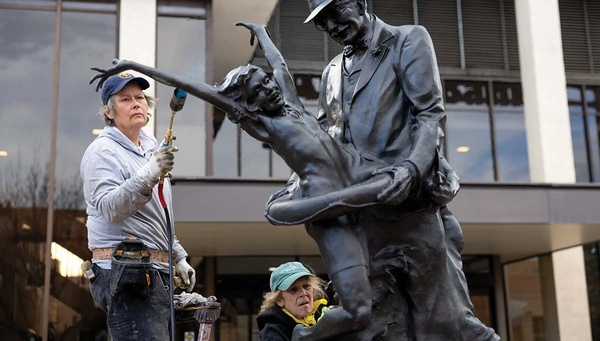
Jo DeDecker, left, and Nancy Miller-Hadley, of Sculpture Services of Colorado, work on "For the Making of Men," a bronze sculpture, by William Moyers, in March 2024 in Grand Junction. Jared Polis recently signed a bill giving Colorado artists creative control with "A Corps," or artist companies, a subset of limited liability corporations that keep creative control of companies in the hands of the artists./ Photo by Hugh Carey, The Colorado Sun
Gov. Jared Polis on Tuesday signed a bill that creates a new business structure designed to support artists and creatives.
Senate Bill 133 creates Colorado Artist Companies, or A Corps, a new subset of limited liability corporations that guides artists through the complexities of setting up a business while ensuring they retain creative control over their work. This can include everything from songs, paintings and poems, to less obvious output, like creative coursework.
“We’re so often forging our own path in the creative sector, and it’s really exciting to see the Colorado state government really codify something that’s for artists,” said Meredith Badler, deputy director of the Colorado Business Committee for the Arts, which helped shepherd the bill through the Legislature. “It really recognizes their unique needs and their unique benefits.”
Colorado is the first state to enact this new business structure, though other states like California are busy crafting versions while keeping an eye on its legislative success in Colorado.
Yancey Strickler, co-founder of the crowdfunding platform Kickstarter, who came up with the idea of an A Corp, said there are at least six other states lining up similar bills. Badler said she’s been fielding calls from arts advocacy groups in California, Vermont and New Jersey.
So what is an A Corp?
When it comes to federal law and taxes, A Corps will be subject to all of the same rules as an LLC. But a few defining characteristics set it apart:
• Controlling shares. Artists must control 51% of voting shares at all times, guaranteeing them creative control.
• Separation of governance. A separation between the economic rights and governance or creative control. In other words, investors can buy shares of the company that grant economic benefits, like revenue or royalties, without having voting shares in the company (thus the artist retains creative control).
• A Corp shares. The A Corp share can be based on capital contributions or artistic contributions, as a way for artists to build equity in their companies whilecontinuing to create the work the company is founded on.
• Artistic mission. Every A Corp has to define an artistic mission as part of its governance.
• IP protection. Potentially the most impactful characteristic of the structure. Put simply, artistic work licensed to the A Corp can never be transferred to nonartist investors or third parties. So if the company dissolves or is sold, the intellectual property rights automatically revert back to the artist owner.
Continue reading here