
Rescue me
Fire department tax question tops ballot
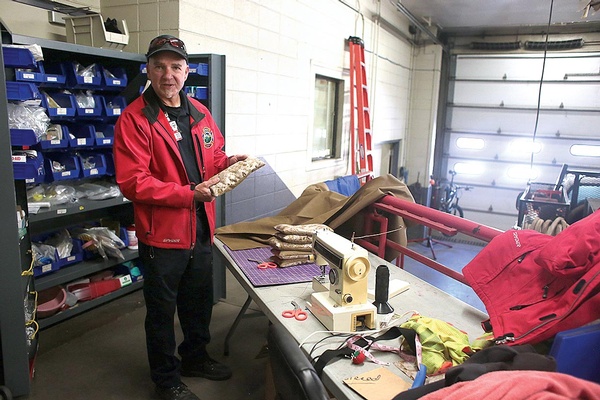
Scot Davis, community education coordinator for Durango Fire and Rescue, stands be- fore the sewing work station where firefighters and first responders repair their work attire because the department cannot afford new uniforms./ Photo by Jennaye Derge
The ones who usually answer the call for help are looking for a little themselves this November. With declining revenues and ever-increasing expenses, Durango Fire and Rescue has few options – either ask residents for a property tax increase or risk cutting into essential services.
So, the department is asking voters to approve a property tax increase of 2.5 mills. For someone with a home worth $400,000, it’s an increase of $72 per year. For commercial property worth $1 million, the increase would be $725.
“Nobody – including me – wants to pay more taxes,” Fire Chief Hal Doughty said.
But it’s what he feels the department has to do. For the past several years, Durango Fire and Rescue has been tightening its belts and trimming the budget everywhere it can. At this point, Doughty explained, if they keep tightening, they’ll cut themselves in half.
The department has also been tapping into savings intended for capital projects like equipment and upgrades.
“Each year for the last four years, we’ve had to take money out of our savings,” he said. “Eventually we’re not going to be able to do that anymore.”
The department’s austerity measures are a result of getting squeezed on both sides. While its revenue stream is decreasing, its expenses are increasing.
Part of the revenue decline is because of the Gallagher Amendment, a state law that kicks in when residential property values outpace commercial properties. It automatically drops the rate used to calculate residential property values – which is where most of Durango Fire and Rescue’s revenue comes from.
The other issue is that the department can’t simply raise its prices. In fact, its rates are often nonnegotiable. For example, Medicaid pays the department just 17 cents for every dollar of service it provides. Medicare pays only 48 cents.
There is also little the department can do when it comes to expenses. It will always answer an emergency call and send first responders to the scene. The problem is, it’s getting more and more calls every year.
Just five years ago, Durango Fire and Rescue answered a total of 3,985 calls. Last year, it responded to 5,080. As of Oct. 1 this year – with three months left to go – it has already topped 2016 numbers by 300.
Station 2, which services downtown Durango, answers the bulk of emergency calls in La Plata County. But when multiple calls come in, it needs to turn to other stations that are farther away to respond. This means first responders might be farther away and take longer to arrive on a scene.
Doughty said this situation wasn’t so common in the past. Today, it’s happening every month – and, sometimes, even weekly. “The reality is the more calls we have, the chances are the closest resources aren’t going to be available,” he said.
What’s needed are more responders in the areas with higher call volumes. Since, the department is already tapped out on the belt-tightening and can’t charge more for services, the only option to pay for additional staff is a mill levy increase – something that hasn’t actually happened in decades.
The last time the district’s mill levy went up – by 0.5 mills – was in 1997 when the Animas Fire Protection District voted to raise it to pay for ambulance services. Over the past 20 years, the district has consolidated its governance from three boards to just one, expanded ambulance and EMS services throughout the district, and added 54 full-time response staff.
All without raising taxes.
But, their ability to make the most of what they have has reached its limit.
“If I think about my child ... there is no amount of money I wouldn’t pay just to get help there a little quicker. That’s what we’re talking about here,” Doughty said.
The challenge for Doughty has been explaining the situation without sounding ominous. But, as he headed out into the community to talk to residents and answer questions about the proposed tax increase, he said people have been understanding and receptive.
“I’m exceptionally pleased with the response I’ve been getting from the community,” he said.
The next presentation for Doughty happens tonight at Durango City Hall. The La Plata County League of Women Voters is hosting a forum at 5:30 p.m. for the 9-R School Board candidates and Fire and Rescue tax increase.
The fire chief will have a presentation followed by a Q&A session. There won’t be a debate because these isn’t any organized opposition, according to the League of Women Voters.
Doughty said he has heard some misconceptions, though, about what the funds would be used for – like a new downtown fire station.
With the department landing in the news this past summer over the need for a new station downtown, Doughty said he’s heard from some residents who think the tax increase would fund construction.
Although the department doesn’t deny needing a new downtown station – the current one along the river was intended to be a temporary home in 1983 – the revenues from a tax increase would go toward equipment, capital projects and staff, including an additional 24 full-time first responders to tackle the increasing call volume.
“This is not about the downtown fire station, this is about operation needs,”
Doughty explained. There’s no decision yet on a location for the new station, although three finalists were presented this summer. Those discussions
have been put on hold until after the vote. And the much-needed station is not dependent on the outcome of the vote. Whether the tax is approved or not, the department still plans to move ahead with choosing a location and starting construction.
Ballots went out this week for the Nov. 7 election and should arrive in mailboxes by the weekend. Depending on where voters live, they’ll actually see a different question on their ballots.
Outside Durango city limits, the district is paid directly by property taxes. Within the city limits, the department is paid by the City of Durango. The city has a contract with the department to provide services and gets its funds from property taxes.
Fire and medical services provided are the same inside and outside city lines, and the amount residents pay is the same as well. Although the questions are worded a little different, a “yes” vote in either case means a “yes” to the mill levy increase. However, both voters living within the city and outside, in the district’s boundaries, must approve the increase for it to pass.
“We’re asking for the community’s help and support,” Doughty said.
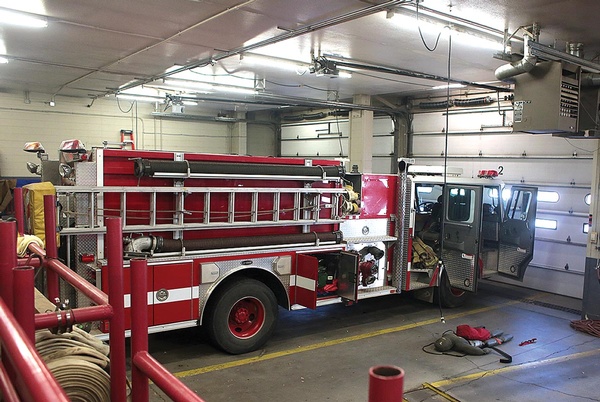
Revenues from Durango Fire and Rescue's proposed property tax increase would go toward equipment, capital projects and staff, including an additional 24 full- time first responders to tackle the increasing call volume./Photo by Jennaye Derge