
Rule Breakers
Locals put up a fight as Washington prepares to overturn methane rule
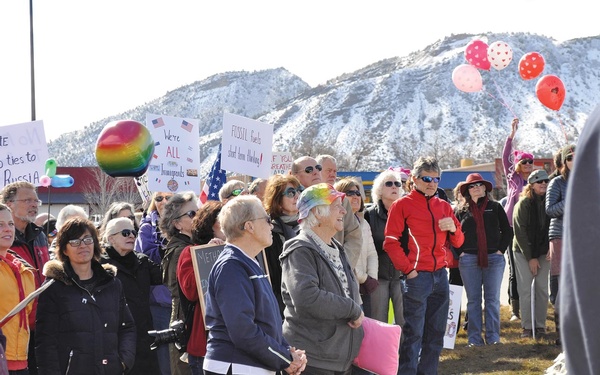
With a vote to overturn the BLM's new methane rule likely coming soon, protesters gathered outside Colorado Sen. Cory Gardner's Durango office Tuesday morning asking him to keep it in place./Photo by Tracy Chamberlin
With the release of one very colorful image, beamed down from space almost three years ago, both an awareness and a debate, one still being fought on the ground today, began.
In 2014, the National Aeronautics and Space Administration confirmed the existence of several methane “hot spots” across the nation. In turns out the hottest of all hovers directly over the Four Corners.
With more than 20,000 oil and gas wells in the area, the existence of methane, the prime component of natural gas, didn’t come as a total surprise. The real shocker was the high concentration. The Four Corners stood out in the space agency’s image like a glaring red flag.
Following the announcement, Colorado put together a first-of-its-kind methane rule for oil and gas companies operating in the state.
The regulations were crafted with two main goals in mind. First, by reducing leaks and improving capture techniques, operators could cut methane emissions, which made up 11 percent of all man-made green-house gases in the U.S. in 2014, the same year NASA’s image came out. Second, the captured natural gas could be sold, something that would put money in the pockets of oil and gas companies, as well as the state, with windfalls expected to be in the millions.
The Colorado methane rule was not challenged in court and has largely been considered a success by its supporters. But, when the Bureau of Land Management created its own methane rule last year, the conversation changed.
The BLM rule was modeled after the Colorado rule, but certainly has some differences. The biggest is the fact that it would apply to all BLM-managed public and tribal lands, including those across the stateline, in New Mexico.
Many environmentalists, especially those in the Four Corners, hailed the new federal rule because although they appreciated Colorado’s, it could not address the entire region. After all, methane can easily cross borders, but a state regulation cannot.
Debate over the BLM’s rule was contentious at times and many local advocates voiced their support. La Plata County Commissioner Gwen Lachelt testified before Congress on behalf of the rule, and the Board of Commissioners approved an official letter of support with a 2-1 vote.
By the end of last year, the BLM’s methane rule was approved and on the books.
Immediately following its approval, the Western Energy Alliance and Independent Petroleum Association of America filed suit. The two organizations, which support and advocate for thousands of oil and gas companies across the United States, not only believe the rule would cost $1.26 billion with little to show in emissions reduction, they say it isn’t actually BLM business.
It’s the states and the EPA that have authority over methane, specifically given under the Clean Air Act.
Around the same time the debate was headed to the courts, the results of the November election meant changes were coming to Washington, and the current leadership in Congress has echoed the points made by the Western Energy Alliance: It’s not the BLM’s place to regulate methane and it only serves to double the regulatory burden on energy producers.
With that, Congress began the process of using a rare measure called the Congressional Review Act, which gives them the ability to overturn rules approved by federal agencies.
“We call it taking a sledgehammer to it, not a scalpel,” Emily Bowie, energy and climate campaign organizer for the San Juan Citizens Alliance, explained.
Under the act, the BLM rule would not just be scrapped, it would mean only Congress could approve such a rule in the future.
“They’re saying they don’t want to regulate methane in this way ever, and that’s the part that’s scary,” she added.
U.S. Rep. Scott Tipton, R-Cortez, actually co-sponsored the legislation in the House, where it has since passed. It also made it through Senate committees and is likely to hit the Senate floor in the coming week.
With a full vote imminent, concerned residents in Durango and the Four Corners have stepped up their game. They’re reaching out to Colorado’s Sens. Michael Bennet and Cory Gardner, asking them to vote against the measure. These residents feel it’s key to addressing that glaring red flag – the Four Corners’ methane hot spot.
The latest effort was a balloon rally held Tuesday outside Gardner’s Durango office. Promoted by Indivisible Durango, a local advocacy group, the rally was meant to show Gardner and others how the methane hovers over the region like a cloud of invisible balloons.
As the rally began, the crowd was told it couldn’t congregate at the building in Bodo Park and was forced to the median between the parking area and frontage road. Several drivers honked in support as they passed.
According to organizers, more than 100 people showed up to express concerns and ask Gardner not to tow the party line. While the crowd cheered outside, local experts met inside with Gardner’s Durango representative, Ann McCoy Harold.
Bowie, who attended the meeting, said it went well.
Gardner’s representative asked questions and said he recognized the Colorado rule cannot fully address the methane hot spot. “That was something,” Bowie said.
The meeting was a good show of faith, according to Bowie, but the vote will speak for itself. “That will be the true test,” she added. “(We’ll see) if our words fall on deaf ears.”