
Show me the money
Packed ballot includes minimum wage increase, local and state tax questions
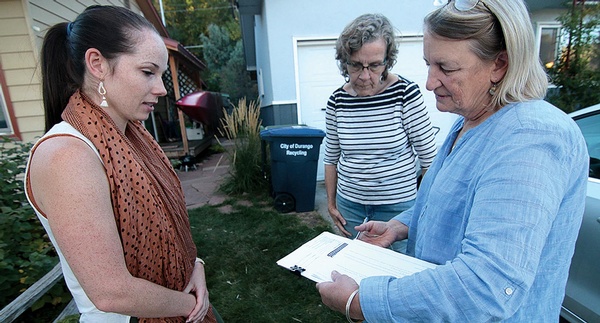
Mowita Niemyjski-Rondeau, left, speaks with Nan Uhl and Maureen Maliszewski from the Thrive! Living Wage Coalition on Tuesday evening as part of a door-to-door effort to inform residents about Amendment 70, which would increase the minimum wage to $12 by 2020. Maliszewski said so far they've had strong support from residents./Photo by Jennaye Derge
Related story: Locals First: Three taxes for La Plata County voters
This year’s ballot is no small matter. The biggest piece of evidence is the bigger-than-usual Blue Book voters likely needed to pry out of their mailboxes – and it just covers the state issues.
Voters in La Plata County are looking at a ballot with six Colorado constitutional amendments, three state propositions, two county tax measures, one school tax measure, and 10 races for political office, including the La Plata County Board of Commissioners, Colorado House, U.S. Congress and, of course, president of the United States.
There’s also the question of whether or not to keep 13 judges on the state Supreme Court, Court of Appeals and District Courts. It’s a question voters don’t always pay attention to – at least, not until they’re actually (God forbid) standing in front of the judge in question.
In total, it comes down to 35 decisions a voter needs to make. That’s a lot to ponder, especially when ballots begin landing in local mailboxes in just three weeks.
Some of the questions and candidate races are well-known and well-funded with yard signs, volunteers going door-to-door and ads. Others are a little more obscure.
One that’s not trending on Twitter or topping the front page is Amendment T, which asks voters to remove language from the Colorado Constitution that allows for an exception to slavery or involuntary servitude. Currently, it is allowed as a punishment for crime.
The one point of debate concerns prison work and community service.
The fear is this subtle change might open the door to challenges against those practices. On the flipside, 25 states without those phrases in their constitution have prison work and community service programs, according to state officials.
It’s really seen as a symbolic move – an effort to put more distance between the 21st century and a time when people could be property.
Together Colorado, a multi-faith and nonpartisan community organizing group, has come out in support of the amendment. So far, no one has come out in opposition to it.
For many, Amendment T is an easy decision. However, it’s only one on a long, long ballot.
Over the next several weeks the Telegraph will address (almost) all the amendments, propositions, ballot issues and candidates leading up to the latter half of October when locals will find the ballot sitting in the mailbox.
This week, it’s all about the Benjamins – changes to the minimum wage in
Colorado, taxes associated with government-owned property and increases on the cigarette tax.
Amendment 70: State minimum wage
Minimum wage has been a hot topic in the political world.
Some think the minimum wage should be raised to a living level. Suggestions have ranged from $10-$15 an hour. Others have argued wages should be up to employers, and sudden sharp increases could hurt the very workers it’s meant to help.
This debate came to Colorado when Rep. Dominick Moreno, D-Commerce City, introduced two bills during last year’s legislative sessionOne was an increase in the state’s minimum wage, and the other would have allowed communities to have their own minimums.
Under current law, municipalities like Durango or La Plata County are prohibited from having a minimum wage specific to their communities. Only the federal government and the state can determine those rates.
The thing is a living wage for a household in Cortez might not cover the costs of living in Durango.
According to the 2015 Southwest Colorado Index, a report put out by the Region 9 Economic Development District of Southwest Colorado, the hourly rate needed for one adult to make ends meet in Durango is $13.44. In Cortez, they would need $10.42.
Either way, those rates are higher than the current rate of $8.31.
The last time the minimum wage was on the mind of Colorado voters was 2006, when it was increased to $6.85 with room to be adjusted up or down, depending on inflation, brinigng it to $8.31.
The ability to fluctuate is one of the potential problems with Amendment 70, according to its opponents. It does not allow for the rate to go down, only up.
Coalitions have been formed on both sides – supporting the measure is the Colorado Families for a Fair Wage and opposing it is Keep Colorado Working.
The measure would raise the minimum wage to $12 an hour by 2020, starting with a rate increase of $9.30 on Jan. 1, 2017, and going up 90 cents each year until reaching the $12 mark in 2020.
It’s considered a first step to offering workers fair and livable wages, according to its proponents like La Plata County Thrive! Living Wage Coalition, a local group advocating livable wages in Southwest Colorado.
The nonprofit group is also helping to organize door-to-door canvasing efforts in support of Amendment 70.
“This campaign is just one part of what we see as a larger statewide effort,” Maureen Maliszewski, director for La Plata County Thrive! Living Wage Coalition, said Monday.
The second step, Maliszewski said, might be to repeal the law prohibiting towns, cities and counties from making their own decisions on minimum wage.
For now, though, the focus for Maliszewski is taking the first step.
For more from both sides go to www.coloradofamiliesforafairwage.org, www.thrivelaplata.org or www.keepcoloradoworking.com
Amendment U:
Exempt certain possessory interests from property taxes
Although possessory interests might not be the most exciting phrase of the election, it’s something that will affect La Plata County.
The idea is to eliminate property taxes for individuals or businesses falling under a certain limit when it comes to the amount of money they make using government-owned property.
For example, someone who owns and operates a snack bar on National Park Service lands would pay possessory interests because they profit from the use of property that’s government owned and exempt from property taxes.
The amendment was proposed to exempt those making $6,000 or less because the amount of tax collected is often less than what it costs to file the paperwork.
“That’s true of a lot of things we do,” La Plata County Assessor Craig Larson said.
He estimates the exemption could affect more than 200 accounts in La Plata.
Amendment 72:
Increase cigarette & tobacco tax
The cost for lighting up in Colorado could get much higher if Amendment 72 is approved. The tax would be an extra $1.75 on every pack of cigarettes and a 22 percent increase on the manufacturer’s list price for other tobacco products.
The exception to the rule is e-cigarettes, which wouldn’t see any increases.
Campaigns have sprung up on both sides of the issue. No one is debating whether or not cigarettes are harmful, or even if increasing the price for a pack would force someone to quit.
The biggest point of debate is what will happen to the $315.7 million in additional tax revenue expected to come in the first year alone.
The amendment specifies the money to be used for tobacco-related education programs, research and prevention. It also leaves a chunk of the funds open to other health-related issues, homelessness prevention for veterans and more. The problem for opponents of the measure is, what if those programs aren’t working?
There’s no remedy for correcting the constitutional amendment, except another constitutional amendment.
For more info, go to: Healthy Kids, Healthy Colorado, www.healthyco2016.com; No on Amendment 72/No Blank Checks in the Constitution, www.noonamendment72.com.