
Stalling out
What to make of LPEA's claim of Tri-State being 'sneaky and underhanded?'
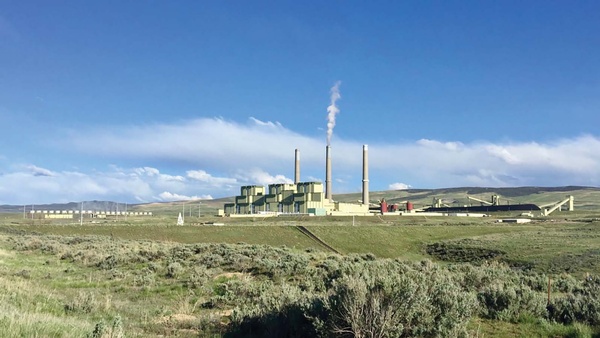
The Craig Station coal-burning power plant in northwest Colorado in 2020. Tri-State recently announced plans to close the unit it owns early in 2028, two years earlier than expected. The wholesale energy provider recently announced plans to transition to greener energy sources, but it may come too little too late for some of its members./Courtesy photo
A lawsuit filed by La Plata Electric Association on Nov. 10, 2023, accuses Tri-State Generation and Transmission, its wholesale supplier, of being “sneaky and underhanded.” The suit is part of a far broader story that involves electrical customers across much of rural and semi-rural Colorado. In question is the business viability of Tri-State, the second largest electrical utility in Colorado. Taking it one step further, what are the consequences if Tri-State should go belly up?
It has happened before. Durango-based La Plata Electric became a member of Tri-State in the early 1990s after its prior wholesale supplier, Ute Electric, went bankrupt. It had built coal plants at Craig in the late ’70s and early ’80s in expectation of a huge demand for oil-shale extraction in northwest Colorado – that never happened.
Today, LPEA serves about 48,000 meters in primarily La Plata and Archuleta counties. In size, it’s on par with Holy Cross Energy. The electrical demand it has represents about 5% of all of Tri-State, which has 42 members spread across Colorado and three adjoining states.
LPEA says Tri-State’s conduct has resulted in higher electricity rates than it would have paid had it been allowed a timely withdrawal in compliance with its contract. It first asked for an exit fee in July 2019. It still has no answer.
Three times in the 29-page filing, LPEA accuses Tri-State of dragging its feet in ways that were, well, “sneaky and underhanded.”
Despite recently filing a resource plan, Tri-State remains in deep financial distress. Clouds of debt hang over it. Plans to retire a coal plant in Arizona and possibly accelerate retirement of one in Colorado depend upon federal aid through the Inflation Reduction Act. It hopes to secure $970 million.
The overriding question is why Tri-State has been so determined to keep members of the “family” in the family. LPEA, in its lawsuit, argues that this goes against the cooperative principles upon which Tri-State was founded.
Those already out the door
Most of the drama cited in the lawsuit have been previously reported.
In 2016, New Mexico’s Kit Carson Electric got its freedom from Tri-State to innovate by its own rules after agreeing to pay Tri-State $37 million. I suspect a great many cooperatives had expected Kit Carson to stumble and fall. Instead, it has soared. It made its final payment last June.
Delta-Montrose Electric Association was next, departing in 2020. It had wrangled with Tri-State for several years before getting out of its contract that extended to 2040. That contract required Delta-Montrose to secure 95% of its power from Tri-State. It paid $62 million to leave the 42 remaining members. As Kit Carson had done previously, Delta-Montrose hooked up with Guzman Energy, which promised to help the co-op develop more of its own electricity. The first significant project, a solar farm on Garnett Mesa, near Delta, is under way.
Three more members have now given notice they intend to leave. The most imminent is United Power, which intends to be gone May 1.
LPEA and others have wanted to enter into partial contracts, in the case of LPEA, allowing it to generate 50% of its own electricity. That option is now off the shelf.
Why hasn’t LPEA gotten an exit number from Tri-State for either a full or partial exit? In 2020, Colorado members of Tri-State were close to getting an answer. A judge for the Colorado Utilities Commission heard testimony for about a week before issuing a recommended formula to the PUC. The formula was not much more complicated than drawing a straight line between what Kit Carson and Delta-Montrose had paid, then adjusting it for the size of the co-op.
Before the PUC could take up the matter, though, Tri-State managed to shift the decision-making nexus from the PUC in downtown Denver to the Federal Energy Regulatory Commission, or FERC, in Washington, D.C., 1,656 miles away.
How did Tri-State engineer this? The story is generally known, but the lawsuit by LPEA discloses that the research for how to achieve this began in 2017 in an operation called Blue Sky II. It was before the chief executives now at Tri-State and the two dissident co-ops had arrived.
According to the LPEA lawsuit, for much of its existence, Tri-State successfully avoided both federal and state regulations. Tri-State historically was exempt from FERC jurisdiction because it was wholly owned by exempt rural electric co-ops. “Faced with regulation by the Colorado PUC in the last decade, Tri-State embarked on a secret plan to obtain federal regulation by FERC in order to preempt Colorado regulations,” reads the lawsuit.
Beginning in August 2017, says the lawsuit, Tri-State paid lawyers to evaluate ways to obtain FERC jurisdiction and displace states’ regulations over potential withdrawals from Tri-State. “Tri-State initiated a secret project, code-named ‘Blue Sky II,’ which was designed to explore ways for Tri-State to become FERC jurisdictional,” reads the lawsuit.
Tri-State, this lawsuit says, kept this strategy secret from members until June 2019. But to make it work, Tri-State needed to create a new membership class. It needed to add at least one member that was not an electric cooperative or utility. Instead, it added three: a greenhouse near Fort Lupton that uses gas from Tri-State; a company that sold natural gas to Tri-State; and a company near Craig that rents land from Colowyo Coal Co., a subsidiary of Tri-State.
With this, Tri-State secured overview by FERC.
Next, LPEA and other co-ops worked with Tri-State to achieve a partial-requirements contract. After all, if Tri-State is hamstrung by its increasingly archaic 20th century technology for power generation, it has a very important 21st century asset: transmission. Instead of being required to get 95% of their power from Tri-State, what if they could get less, 50% in the case of La Plata, or a third, as in the case of San Miguel Power?
LPEA even went out and secured deals from partners building solar and other technology in southwestern Colorado.
Out of options
LPEA assumed that Tri-State would provide an exit fee proportionate to the partial-requirements contracts. It has not, and those deals with independent power producers have lapsed.
LPEA accuses Tri-State of employing delay tactics and – echoing the complaints of United Power – accuses Tri-State of being not inclined to have conversations. The way these two cooperatives have described Tri-State, it’s Tri-State’s way. The highway is not an option.
And hence the lawsuits – first by United Power and now LPEA.
Out of options and without any active dialogue to modify its power supply, LPEA says it “was left with the single option of filing this lawsuit to vindicate its rights.”
I suppose I should reach out to Tri-State, to see what sort of statement they want to make. A he-said, she-said piece. That is the formula purported to achieve fairness. Sometimes it actually works.
But honestly, I’ve paid my dues on this drama. Watched the LPEA directors in 2021 approve the partial-requirements agreement. Been to Tri-State board meetings. Been to the annual “we’re-doing-great” meetings of a few coo-ps. Had many, many conversations on the sidelines.
The question I have not asked Tri-State is why has it dragged its feet? The easy answer, one I’ve published before without kickback, is that it wants to stall the exit of members while it gets its house in order. Kit Carson and then Delta-Montrose is one thing. But if all the bigger ones leave, what is left? Well, the smaller, more rural cooperatives. It leaves Tri-State a much smaller operation, one likely at greater risk of failure.
Under its previous manager, Tri-State was tepid in embracing changes. Duane Highley was hired as chief executive in 2019 with the explicit mission of steering Tri-State into the energy transition. By January 2020, he had announced the closure of the coal plants in Craig.
That transition was hard – and it’s still far from done.
But it’s the easiest of the work that needs to be done. Tri-State more fundamentally needs to reform its business model. It needs to figure out how to become a better partner in innovation with its members.
To be fair, all utilities are very different from what they were 15 to 20 years ago. Tri-State is no exception. Today, it has exhibits about energy efficiency at its annual meetings. It is a sponsor of the Beneficial Electrification League. “Resilience” was the theme of its annual meeting in April 2023.
But the gravity must shift even more.
Highley and the board of directors at Tri-State have their work cut out for them. In a recent memo to its members about the Tri-State energy resource plan, the Colorado Solar Energy Industry Association said if Tri-State secures its Inflation Reduction Act funding, it could pay down debt on its stranded assets, which is good for its ratepayers and the Colorado energy market as a whole “to have a solvent and functioning Tri-State making an energy transition.”
That begs the question, what if Tri-State is not solvent? What if somebody else picks up the pieces from a Tri-State bankruptcy? Will they be better – or much worse?
I’ve only touched on the FERC proceedings on exit fees. A judge there issued a recommendation in September 2022 that is little different from what the PUC recommended in 2020. A decision from the FERC commissioners is expected any day now. But the formula for partial requirements is only beginning. It’s still a couple of years away.
Maybe a final metaphor would be clarifying. In a marriage, in a family, there needs to be communication. For whatever reason, the conversation between Tri-State and its larger members was obviously lacking.
The question this lawsuit begs is whether this marriage can be salvaged, whether this family can stay together? I don’t know the answer. ?
Allen Best tracks Colorado’s energy and water transitions at BigPivots.com