
Stirring the pot
As Colorado settles into legal life, feds' marijuana battle sparks up
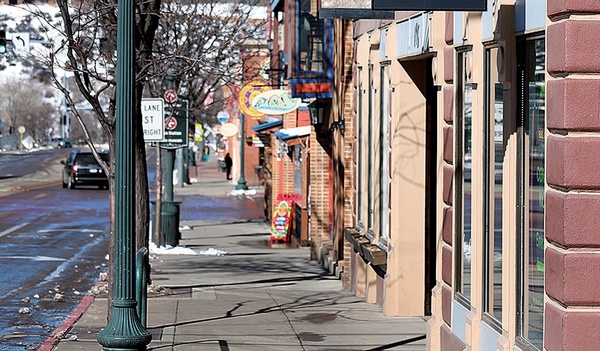
When the City Council first wrote regulations for marijuana businesses, it used language that would not allow multiple shops on the same street segment. The goal was to prevent saturation downtown. In order to rewrite the city's ordinance to address some unintended consequences, city officials are now adding buffers around existing businesses and language to prevent marijuana shops on the same city block./Photo by Jennaye Derge
In Southwest Colorado, the debate is about the finer points of legality – like how Durango can avoid creating a “Green Mile,” while at the same time protecting local businesses who’ve invested so much in the budding marijuana industry.
For La Plata County, it’s also about subtle change. County commissioners are streamlining regulations to make things more efficient and easier for marijuana businesses to operate, just like any other business.
Even the state is working on minor adjustments to marijuana law. Four years after voters approved Amendment 64, which legalized recreational marijuana in Colorado, the arguments are about allowing hemp to be used as livestock feed, creating licenses for cannabis clubs and even home delivery. No one’s talking about repealing
the law.
At the national level, however, the feds are still stuck on legalization itself, as officials have recently made public
comments calling into question the country’s great green experiment.
Nationwide is on who’s side?
At a recent meeting of attorneys general, newly confirmed U.S. Attorney General Jeff Sessions, who is now the chief law enforcement officer in the country, said the United States doesn’t need to be legalizing pot. “I’m dubious about marijuana,” he added (no pun intended). He reiterated his belief in state’s rights, then attempted to connect marijuana to crime and opioid addiction.
Whether there’s any bite behind his bark is anyone’s guess, but these talking points from a new White House administration are making leaders in the marijuana industry nervous.
Last year, the Drug Enforcement Agency was forced to reconsider marijuana’s spot on the list of Schedule I drugs, alongside the likes of heroin and cocaine. In the end, though, they left the list untouched, and marijuana is still illegal under federal law.
It’s legal, however, in more than half the country. At this point, 28 states have legalized medical marijuana and eight allow for recreational use – including the feds’ home turf of Washington, D.C.
Also, in just the past few weeks, U.S. Rep. Jared Polis, D-Boulder, created a new group in the nation’s capital – the Cannabis Caucus. With two Democrats and two Republicans on board, it seems Colorado’s green revolution has its own booster club among the bureaucrats.
State of mind
Just like in D.C., marijuana might be one subject where Democrats and Republicans can find common ground in Colorado.
The legislature is split. Democrats control the House and Republicans the senate, and battles have already begun. But, there are several marijuana measures that just might make it through the muck and mire of party politics.
Currently, lawmakers are looking at 17 different marijuana-related bills – including ones to allow for cannabis clubs, home delivery of marijuana, a study on using hemp as livestock feed, and another allowing medical marijuana to be prescribed for stress disorders, like PTSD or Post Traumatic Stress Disorder.
All of these legislative issues are tweaks to what many consider a successful experiment. Other states, like California, which legalized recreational marijuana last November, are even looking to Colorado as the model for how to govern this new industry – an industry that’s adding millions to state coffers.
In 2016, marijuana sales in Colorado hit $1.3 billion – that’s “B” for billion. Tax revenues from those sales topped $160 million. It turns out, though, it might not be enough.
The state is currently grappling with some constitutional loopholes, ones which will automatically reduce Colorado’s property tax rate in the coming year. It’s called the Gallagher Amendment, and it’s going to shrink both state and local budgets dramatically.
With this reality on the horizon, Colorado Governor John Hickenlooper is looking at a sales tax increase on recreational marijuana – and he’s not the only one. La Plata County is considering a marijuana tax of its own.
Locals first
With budget shortfalls already in play and more expected in the future, La Plata County officials are brain-storming ways to increase revenues and lower expenses. One way is to increase the excise tax on marijuana.
County staff were asked recently to put together some general information on a possible five percent excise tax on marijuana cultivation facilities. It’s something other communities, like Ouray, are doing to recoup funds spent on regulation, according to county officials.
Any tax increase, whether it’s at the state or local level, however, must be approved by voters. So, nothing’s going to happen in the immediate future.
Money isn’t the only marijuana issue in La Plata County, either. County officials are also looking at ways to streamline governance.
In the beginning of legal pot, La Plata County – like many Colorado communities – erred on the side of stricter regulation. But, it turns out, those rules have prohibited marijuana businesses from even being able to move office furniture from one side of the room to another. Business owners voiced their concerns and offered solutions at recent County Commission meetings. In response, county officials are tweaking regulatory language and procedures with plans to approve final changes in the weeks ahead.
The City of Durango is also making some changes – although unexpectedly. “This whole thing started when the 10th Street dispensary came, and we had complaints from property owners,” City Councilor Dean Brookie explained during a meeting last week.
With another marijuana business less than a block away, they were concerned about saturation along Main Avenue. In response, the Durango City Council enacted an emergency moratorium on marijuana business licenses in the Central Business District, on North Main Avenue, in the College Drive and 8th Street area, and along Highway 160 West; and, began discussing how to tweak the city’s ordinance to prevent a repeat.
When the City Council first wrote regulations for marijuana businesses, it used language that would not allow shops on the same street segment. The goal was to prevent saturation downtown.
In order to rewrite the city’s ordinance to address some unintended consequences, city officials started talking about buffers around existing businesses. Not only were marijuana businesses split on support of buffers at the council’s meeting last week, so were city officials.
Those opposed to the idea were concerned with how a buffer could limit potential shop locations, rallying instead behind the idea of a cap on marijuana business licenses.
Originally, the City Council was against caps. It wanted to allow the market to decide how many shops Durango could support. But, local shop owners explained the reality that buffers around existing businesses, combined with those already required around schools, parks and treatment centers, leaves very little space available within city limits.
If an existing business were to lose its lease, for example, it could end up with nowhere to go.
“I hadn’t been in favor of caps prior to hearing from the industry,” explained Durango Mayor Christina Rinderle.
Now, she wants to talk about it.
Following last week’s council meeting, Rinderle and others have asked to start discussions with local business owners on the possibility of capping the number of marijuana business licenses the city will allow.
Along with those talks, they plan to add language to the Land Use and Development Code to require a 250-foot buffer around existing businesses with an additional requirement in the Central Business District to limit marijuana shops to one per city block.
The first reading of the new ordinance is scheduled for next week with its effective date likely to happen April 5, just one day after the moratorium expires

In the beginning of legal pot, La Plata County – like many Colorado communities – erred on the side of stricter regulations. But, it turns out, those rules have prohibited marijuana businesses from even being able to move office furniture from one side of the room to another. In an effort to address these unintended consequences, county officials are rewriting regulations./File photo