
Strength in numbers
School district asks voters for property tax increase to fill shortfalls
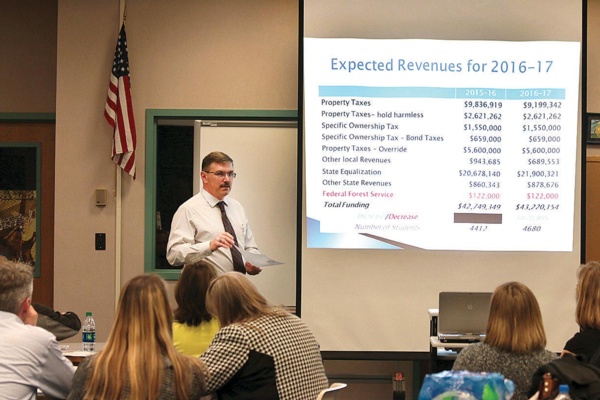
Earlier this year, 9-R School Superintendent Dan Snowberger hosted several meetings to address the "negative factor" in Colorado school funding and the gap it created. The district also asked what path to sustainability residents would likely support. In the end, the school board chose to bring a property tax increase of 1.2 mills to voters this November./File photo
The difference between what K-12 schools in Colorado are supposed to get from the state, and what they are actually getting is rapidly creeping up on $1 billion.
It’s a deficit in school funding that grew out of budget shortfalls following the Great Recession, but has continued to this day. With $4.8 million missing from the 9-R District’s budget for just the 2016-17 school year, the district has decided to turn to voters for help.
“This is the only way we can gain local control,” 9-R spokeswoman Julie Popp said.
It all began in 2000 when Colorado voters added Amendment 23 to the state constitution, requiring an increase in education budgets by a specific amount each year.
This was no problem during the economic boom of the early and mid-2000s, but when the housing bubble went bust and the recession hit in the latter part of the decade, it was a whole lot harder to keep up the pace.
In 2010, state legislators looking for a way to make cuts reinterpreted Amendment 23 and created the “negative factor.”
The Colorado Legislative Council Staff, a nonpartisan research arm of the state’s General Assembly, defines the negative factor as “a provision in state law that reduces the amount of total program funding and state aid provided to K-12 school districts.”
The addition of the negative factor to the school funding equation created a gap between how much the state had to give school districts and how much those districts were required to increase their budgets under Amendment 23.
During the lean times, it helped to balance an underfunded budget – something legislators are also required to do. However, over the years the gap has grown wider and wider.
According to the legislative council, the negative factor gap was $130 million in its first year and, just as Amendment 23 intended, continues to grow every year. It hit $855 million statewide for the 2015-16 school year and will be even greater for 2016-17. Officials from 9-R estimate the district has lost about $32 million since 2010, including $4.8 million this year alone.
Efforts to address the gap have been ongoing since the Legislature first adopted the negative factor.
At the state level, groups sprung up like Great Education Colorado, a nonpartisan education advocacy group formed in 2010. Great Education has turned to lawmakers, citizens and the courts for help.
Most recently, they tried to bring a ballot initiative to voters this November, called the Colorado Priorities campaign, which would have allowed the state to keep excess tax revenues to use for specific education and infrastructure projects rather than return those funds to taxpayers, something that is required under the Colorado Taxpayer’s Bill of Rights.
Last month, however, with limited campaign funding and an already-packed state ballot, the group
decided to pull back.
Great Education also supported two suits brought before the courts by a coalition of advocacy groups, school districts and parents. Both cases ultimately made it to the Colorado Supreme Court, where both failed.
At the local level, educators turned directly to the voters.
First, in 2010, a ballot initiative called 3A was passed to help fill the gap. The problem today, though, is the ballot language was written so those gap-filler funds could only be used for three things: retaining quality staff, keeping small class sizes and technology. According to district officials, there are other needs piling up fast.
Over the years, the 9-R School District has tapped into reserves, made cuts and frozen salaries.
Last year, the district cut 24 positions and kept salaries stagnant this year. It may have stopped the constant bleeding, according to Popp, but it hasn’t solved the problem.
Earlier this year, 9-R School Superintendent Dan Snowberger hosted several meetings to address the negative factor and the funding gap it created. The district also asked what path to sustainability residents would likely support.
In the end, the school board chose to bring a property tax increase of 1.2 mills to voters this November. The tax would bring in an additional $17 million for 9-R in its first year, costing the owner of a $500,000 home $3.75 a month. There is no sunset to the tax.
The funds would be distributed across the district on a per pupil basis, including to the area’s two charter schools.
“I think it’s something all of the districts throughout the state need,” Popp said. “This is the only way we can gain local control.”
The real trick for the district is deciding on the ballot language. It needs to be specific enough for voters to approve, but broad enough so the district doesn’t end up in the same limited boat as the 2010 version.
Naomi Azulai, chairperson for the Vote Yes on 3A campaign, called “Stronger Schools, Stronger Community,” said the district would like to have the option to use the tax revenues for a variety of school programs.
Such programs include hands-on vocational classes that prepare students for the workforce, as well as ones that help students who are college-bound.
Supporters would also like to avoid the kind of salary freezes the district is dealing with this year and, instead, offer professional training to teachers and administrators.
The language, though, might not be the biggest hurdle. It might just be the competition.
The 9-R School District isn’t the only group asking voters for money this November. Two other local tax questions are scheduled for the ballot: La Plata County’s road and bridge tax, and another tax that would be used to build a new airport terminal.
Popp said the district doesn’t consider the other measures competition, and all three are really interconnected.
“We can’t send kids to school if we have crumbling roads and bridges,” she explained.
The school board did consider waiting for another election cycle but, Popp said, it only meant more cuts to staff and programs.
“The time is now,” she added.
Using an anonymous donation of $25,000, the Stronger Schools, Stronger Community campaign will be buying promotional materials such as posters and yard signs, and is looking to hire a campaign manager.
Supporters of the campaign have been meeting at the Powerhouse Science Center every Thursday from 5:30-7 p.m., and plan to continue those meetings through Election Day – with one exception. On Thurs., Sept. 8, they’ll host a Campaign Kick-Off Party at 5:30 p.m. at Buckley Park.
Azulai said anyone who wants to join in the effort or just find out more is welcome to attend.
“This is a community issue, not just a school district issue,” she added. “This affects everybody in the community.”
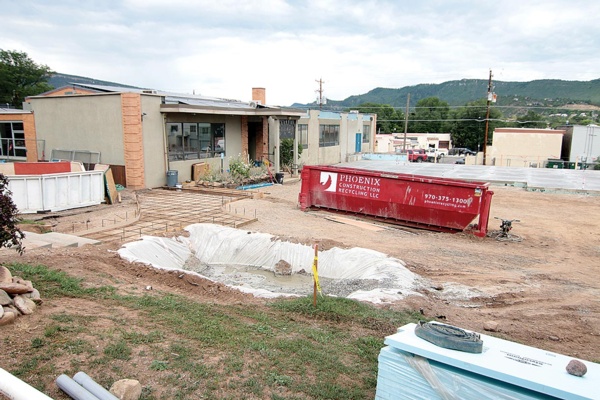
The 9-R School District is working on the exact ballot language. It needs to be specific enough for voters to approve, but broad enough to offer flexibility. They plan to disperse the funds on a per pupil basis across the district, including to the area's two charter schools. Mountain Middle School, above, for example, would be able to use the tax revenues for campus construction projects./ Photo by Jennaye Derge