
Taking a stand
Culture, ancient prophesies and modern politics collide at Standing Rock
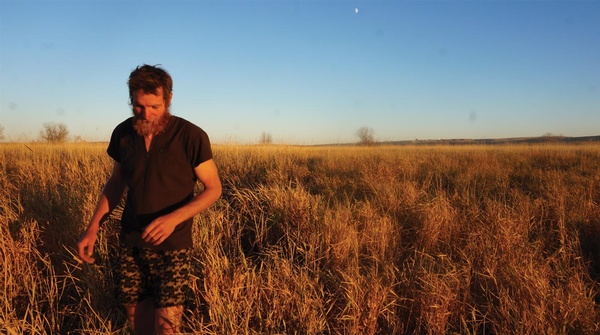
A Durango protestor, who goes by the name Muskrat, at the Standing Rock main camp, Oceti Sakowin./ Photo by Katie Holmdahl
I wake up from the roaring whispers of the dried yellow grass outside my tent. The black tarp whipping back and forth sounds like sails when you tack laboriously upwind. That brings me full force upright, hitting my head on the frost covered netting above me – I am in North Dakota, just north of the Standing Rock Reservation. Last night I fell asleep to the sound of yipping coyotes, and now I hear a girl calling for her cat, Franklin. “Have you seen my cat?” she asks, over and over again. I close my eyes and try to remember that correlation is not the same as causation, and her cat is probably fine and dandy, and not composting in the countryside as the girl moves on down the camp, calling.
The colors here are magnificent. A burnt-gold foundation, with sunsets that striate the sky into layers reminiscent of the Pagosa Springs-made chip dips I used to get at Nature’s Oasis. We are surrounded by hills, and the floodplain I have made camp in is a 40-foot drop from the road. The hills behind it stretch another 40 feet after that. We’ve been asked to stay off the hill closest to the bridge to our north, where two burned-out National Guard trucks are melted onto the bridge rails, creating a permanent road block. Behind them are a couple dozen vehicles belonging to the police, National Guard and DAPL (Dakota Access Pipeline) private security. This is where they stand until about 5 p.m. each day, until most of them drive up the hill across the river and out of sight. The hill on our side is a burial ground, and as part of the newcomer orientation, we are asked to respect those buried there and stick to the road if we are heading to the bridge. Still, there are new trails in the grass, leading up to the top.
I float between projects such as helping people assemble stoves, stovepipes and roofs; turning compost; and carrying dish- water for one of the many kitchens in camp. It reminds me of the first weeks of college, and similarly, it’s easy to join endlessly, without a thought of rest. People are working hard, and the stresses shine through. Constant meetings, building, winterizing ... there is a whole community that needs help, from the ceremonial sweat lodges to the healers and the mental wellness tents here. And there always seems to be a helping hand reaching out, whether to offer another sleeping bag, food, a hug or a listening ear.
The first person I am introduced to at the main camp, known as Oceti Sakowin, is a Durangotang called Muskrat. He finds me projects to help with and is also happy to join me for swimming in the Cannonball River. I later learn that the elders are asking for people to dress modestly, so I set aside a skirt and shirt that covers my shoulders for future dips. We are guests here, and I intend to respect their rules. What others do to wash up, I am not so sure... there is a rumor of a solo shower somewhere, and if you get to the Prairie Knights Casino down the road, there’s a marina where people take showers.
When I got here, I hadn’t planned beyond my landing in Bismarck. But my plane happened to land in perfect time for me to catch a ride with the Standing Rock Shuttle down to camp. It was just $5 for the hour ride, and it will take me right back to the airport on my way home, too.
I have been here for almost a week now, trying to get a grasp on the camp, the movement and why people are here. I flew in on Nov. 8 and spent the evening with new friends around a camp fire. We sat on the benches from an old van that a mother- daughter team brought up from South Dakota, the floor of the van temporarily holding a queen size bed. The mother is a high-powered attorney in California, but works part time on the Pine Ridge Reservation at low or no cost. Just walking through camp, you’re invited in to sit, sing, play, work, talk or relate through a wild mix of people, housing, transportation and languages. Everybody seems to be picking up some Lakota, which creates a feeling of unity. “Mni Wiconi,” which is Lakota for “Water is Life,” is the rallying cry. Occasionally, someone yells “Mni Wiconi!” and from all around, it is returned in multiples.
According to Lakota prophesy, there will be a time when a black snake must be stopped, or Mother Earth will be destroyed. The pipeline is called the black snake, and that seems to be the predominant reason most have come – this is the time to resist, this is when we have the power to come together for indigenous rights, for environmental rights and for the rights of people over profit. There isn’t a person I’ve met who suggests that the pipeline should be rerouted farther downstream, but instead, a belief that we can leave the destructive ways of our recent past behind us.
The camp is full of alternative sources of energy; I lend a hand one evening building a rocket mass heater in the big dome. It will use one fifth of the wood of a traditional wood stove, and is piped through an adobe bench, which will hold and emit heat for a long period of time. There are random trolleys with solar panels where we can charge our electronics, which is well needed, as even new batteries go flat on a daily basis. Various theories flourish about this, some tied to the planes, helicopters and drones that are our constant companions, day and night.
This has been the best place to be for the election mayhem I landed on Election Day. We listened to reports carried by unknown friends out of the quarter moon semi-darkness, where people and horses moved slowly around us. It’s part dream-scape, this mixing of new and old, traditional and inventive, solar panels and horseback riders. Though cold-weather camping is its own rough reality, I feel protected from the outside world. I’ve been free of infotainment, focusing instead on what positive change is possible. We organize around what to do when we leave, carrying the momentum and intention with us.
The day I am set to rejoin the outside world, there is a caravan of activists heading out to protest violence against indigenous women: twice as likely to be assaulted as other American women, less than half as likely to have their assault investigated. Indigenous protestors are more often met with violence, too, which is why I have come as an ally and a witness. These have been the realities. The environmental and racial discrimination brought us here to stand in solidarity and create a new future.
As the time comes to leave, I hope I will remain able to listen for the sound of the roaring wind and whispering grass, and carry it with me into the world.
Katie Holmdahl graduated from FLC in 2005, with degrees in environmental biology and English communications. After masters studies in film directing, she now strives to balance permaculture design, innovation, activism and courting venture capital for a program that might just save the world.
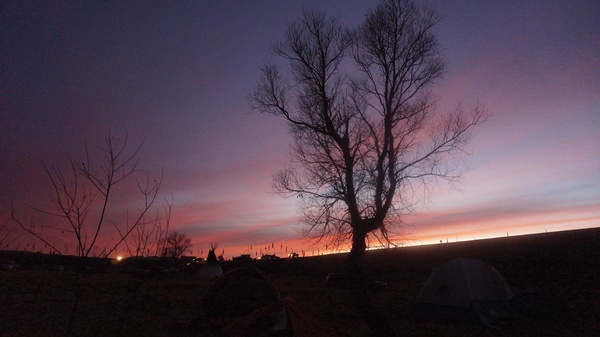
The sun sets over Oceti Sakowin. Things at the main camp for Dakota Pipeline protestors were not so serene late last Sunday, as tear gas, freezing water and rubber bullets were used to disperse a crowd of 400 protesters, according to NBC News./Photo by Katie Holmdahl