
Testing the waters
EPA puts out community plan as Silverton settles into Superfund status

On Aug. 5, 2015, an EPA contractor accidentally triggered a spill at the Gold King Mine outside Silverton, sending more than 3 million gallons of toxic mine wastewater down Cement Creek and into the Animas River (pictured above)./Photo by Jennaye Derge
It’s the first summer season since the Bonita Peak Mining District found its place on the National Priorities List last September, which also means it’s the first tourist season for Silverton since becoming a Super-fund site.
It turns out, though, visitors aren’t really all that interested.
Michelle Hamilton, interim administrator for the Town of Silverton, said they’ve had a few inquiries from tourists, but the real concerns come from the area’s permanent residents.
One of those top concerns is having a say in what’s happening in their town.
“I think the community would like to have greater involvement in the decision-making process,” she said.
According to EPA officials, it’s common for local communities to want to be involved in the process. It’s the reason they put out what’s called a Community Involvement Plan, or CIP.
The plan is like a roadmap. It describes what role federal and state agencies in the area will have, from the Colorado Department of Health and Environment to the U.S. Forest Service. It also explains how the EPA plans to communicate with local stakeholders, including tribal leaders, elected officials and residents. The federal agency released a draft version of the plan already and will accept comments on it until Mon., July 17.
Whether or not the EPA ends up allowing for the kind of community involvement locals are looking for, they still plan to stay in the game.
Trout Unlimited, the Animas River Stakeholders Group and other organizations are planning monthly classes on the Bonita Peak Mining District, abandoned mines and other related issues.
The first of those classes will focus on the history of mining and its effect on the health of the Animas River and its tributaries.
Another class will be about local efforts to pass what’s called Good Samaritan legislation, laws intended to close legal loopholes and regulatory roadblocks created under the Clean Water Act that have prevented concerned residents – or good Samaritans – from tackling the cleanup of abandoned mines.
For decades, the stakeholders group has been attempting to deal with the waste seeping from abandoned mines around Silverton. With legal and financial limitations, however, there was only so much they could do.
Many had hoped the EPA would be able to bring in the kind of resources and funding needed to make a difference.
In their first 10 months on the job, however, it seems the federal agency is playing catch-up.
According to EPA Remedial Project Manager Rebecca Thomas, the biggest challenge for the EPA has just been understanding the Bonita Peak Mining District. The area’s hydrogeology – or the science behind the structure, processes and history of the area’s water, both underground and on the surface – is just as complex as the myriad of mine workings in the district’s 48 specific sites.
“We continue to learn a lot about the impacts of historic mining activities on the Animas River and its tributaries,” Thomas explained in an email.
Since they first got together in 1994, the Animas River Stakeholders Group has identified hundreds of mines and categorized the top polluters.
According to the group, there are 160 draining mines in the Upper Animas water-shed, 33 of which account for 90 percent of the metal load in the waterways.
The worst of those 33 mines are located in the Gladstone area and include the Mogul, Red and Bonita, American Tunnel, and Gold King mines.
“A vast amount of metal-loading does come from around Gladstone,” Peter Butler, co-coordinator for the Animas River Stake-holders Group, said. “Some of the other 48 sites (included in Bonita Peak) are pretty small in comparison.”
Butler and Ty Churchwell, San Juan Mountains Coordinator for Trout Unlimited, a national nonprofit dedicated to conserving and protecting the state’s coldwater fisheries and watersheds, think that if the EPA wants to make real headway when it comes to mine waste, those top offenders need to be addressed.
The EPA, however, just isn’t ready to tackle them. They’re still collecting data and crunching the numbers.
“The site is very complex and requires thoughtful and comprehensive characterization and evaluation of alternatives,” Thomas said. “While we consider how to address the top-polluting mines, we have also identified some early response actions to improve water quality in the district.”
But, some local stakeholders are concerned about the EPA spending their limited funding on those “early response actions.”
The 2018 budget proposal put out by the Trump administration cuts the Superfund line item by 25 percent. If those cuts go into effect next year, there might not be enough to address the top polluters.
Those proposed cuts prompted local leaders to head to Washington, D.C. Churchwell, along with Durango City Councilor Dean Brookie, La Plata County Commissioner Brad Blake and San Juan County Commissioner Scott Fetchenhier, made their way to the capital for meetings with EPA officials.
They wanted to meet with the top dog himself, EPA Administrator Scott Pruitt, but he was out of town at the time. Instead, they met with the EPA’s top brass, including those in charge of mine cleanup across the nation.
“You could not have asked for a better group of surrogates,” Churchwell said.
They also met with the Colorado delegation in Congress, including Rep. Scott Tipton, R-Cortez, and Sens. Cory Gardner, R-Colo., and Michael Bennet, D-Colo.
Churchwell said they got assurances at all levels that the Bonita Peak Mining District is a priority.
“We got a good response from every-body,” he added. “In that sense, it was mission accomplished.”
Keep up with the latest news and updates on the Bonita Peak Mining District at https://cumulis.epa.gov
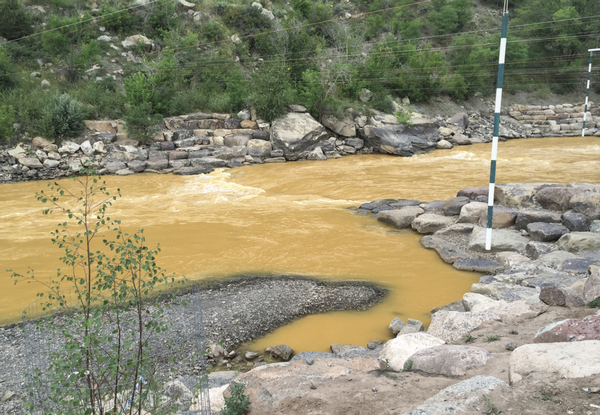
The orange waters of the Animas swept through Durango (Whitewater Park at Santa Rita pictured above) and downstream to New Mexico, eventually ending up at Lake Powell in Utah./Photo by Missy Votel