
The price is right
Group-buy program for EVs hits Durango, along with much-needed infrastructure
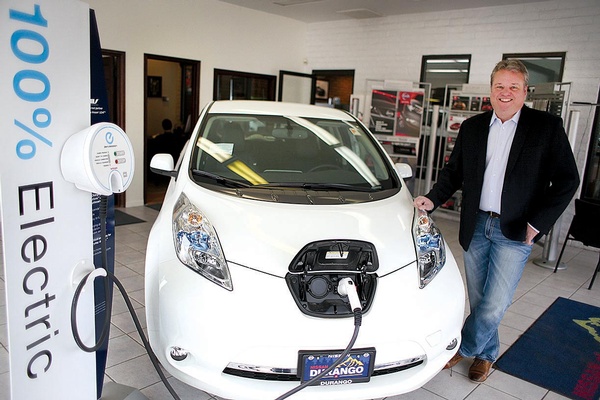
Nissan of Durango owner Chris Cashdollar stands with the company's all-electric vehicle, the Leaf. He said most people looking to purchase the Leaf intend to use it as a second car. Through purchasing programs across the country, Nissan is pushing the electric car and touting its low-carbon footprint./Photo by Jennaye Derge
As electric cars transition from technological wonders to everyday vehicles, there’s bound to be some growing pains.
It was the same when cars first hit the road more than a century ago, and gas stations slowly sprung up until there was a service station on every corner. Today, it’s happening with electric charging stations. In order to promote the transition, particularly in Southwest Colorado, a local non-profit is working with state agencies and local businesses to increase the number of charging opportunities in Durango and lower the price of an electric vehicle by more than $20,000.
“It’s not just about buying a car at a cheap price ... it’s about developing the whole culture around electric vehicles,” Laurie Dickson, executive director for 4CORE, explained.
However, there are several reasons why it’s been more challenging to go electric in the region.
It’s electric!To find charging stations all over the country and in the Four Corners, visit www.plug share.com The Nissan Leaf - Manufactured in Tennessee (batteries also built in the U.S.) - Can travel about 107 miles on one charge - Cost: $30,000-$39,000 (before any discounts or tax credits) - 30 kilowatt lithium-ion battery |
For one, the infrastructure is in its infancy. There is one spot to charge up downtown – at the Transit Center on 8th Street, where the current cost is $1.80 per hour. However, there are no charging stations along Second, with weather and terrain the way it is, driving in Southwest Colorado often requires four-wheel-drive. Electric vehicles, however, do not come equipped with the feature.
Finally, commutes tend to be longer in rural areas. Combine the challenge of where to charge up with battery life limitations, and the result is hesitation about going electric.
Through collaboration with area businesses, though, Dickson and other energy efficiency advocates are hoping to change all that.
She worked with representatives at La Plata Electric Association and Mercy Regional Medical Center to apply for state grants to help with the cost of building charging stations along the 160/550 corridor, and with the Nissan automobile company to lower the cost of electric cars at the Durango dealership.
The three programs Dickson used to make it all happen are Refuel, Charge Ahead, and the Workplace Charging Challenge.
Refuel, a program promoted and developed by the Colorado Energy Office, is an information goldmine when it comes to electric vehicles – or any alternative fuel vehicles.
From fuel calculations to details on the latest models, the website can answer just about any question consumers in might ask, including ones about money.
Along with the specific numbers on fuel savings, the site also explains some of the available tax credits. The state currently offers a $5,000 tax credit for the purchase of an electric vehicle, and the federal government offers a $7,500 tax credit.
The other way to make electric vehicles more affordable is the group buy program. Basically, it began as a way to bring down the price of electric vehicles by buying in bulk.
It’s something that’s been sweeping the nation as of late, hitting urban areas like Salt Lake and several Front Range communities, including Fort Collins and Boulder.
Dickson’s been working with representatives from Nissan to lower the cost of the Nissan Leaf by $10,000. It means when the program begins, which is likely to happen in May, anyone can head into Nissan of Durango and see the sticker price of the Leaf drop by $10,000.
Combine that number with the $12,500 in federal and state tax credits, and all of a sudden a car costing around $35,000 is now around $15,000.
“Not only will you be getting a screaming deal, you’ll be saving $900-$1,000 a year in fuel,” Dickson added.
Of course, the devil is in the details. And when it comes to tax credits and automobile purchases, there are many. So, the first thing anyone interested in taking advantage of the program should do, Dickson said, is contact 4CORE.
Dickson’s not only heading up the group buy program, which will only be around for a limited time, she can also help navigate the tax credit maze.
Along with the cost of the cars, Dickson is finding ways to improve the infrastructure. This is where the Workplace Charging Challenge comes in. It’s a state program created to promote the use of electric vehicles by helping businesses install charging stations through grants, like the Charge Ahead grant. Colorado doesn’t cover the entire bill, but matching funds – in some cases up to 80 percent – can help make it happen.
LPEA and Mercy have both applied for the Charge Ahead grant. The electric coop is looking to build three stations at its headquarters in Bodo Park, and those stations would be free for anyone to use.
Mercy has applied to put in two charging stations. They would be built at the new Hospice Center, currently under construction at Three Springs. Those stations would also be free of charge.
According to Dickson, Purgatory Resort has also applied for the grant, which means the commute for many area residents could become electric.
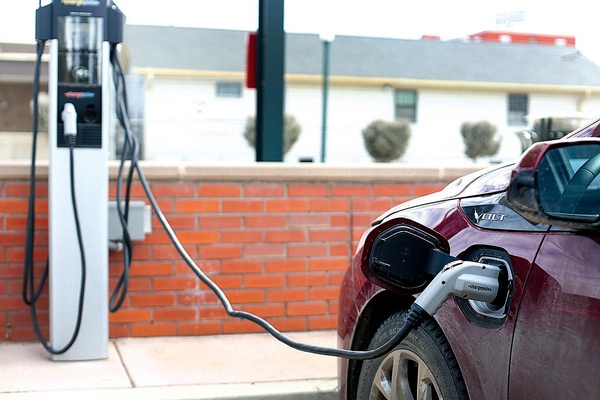
With electric vehicles in their infancy, there's few spots to charge up in town. One is at the Transit Center (left) where the cost is $1.80 per hour. Plans are to change that, with free stations slated for LPEA and Mercy./ Photo by Jennaye Derge