
The spillover
Finding a silver lining on the Gold King anniversary
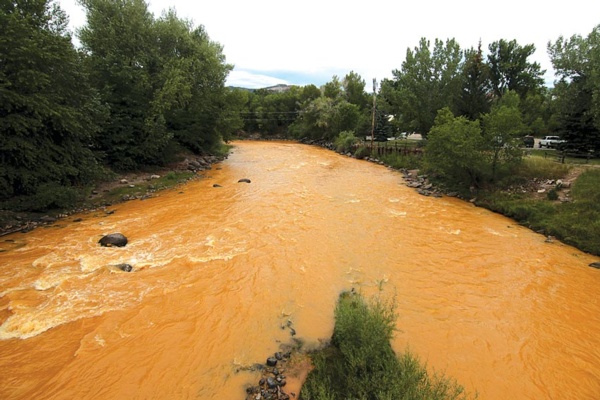
A sight forever burned in our memories: the Animas River on Aug. 6, 2015./ Photo by Jennaye Derge
One year later and it may seem as though little has changed.
Residents are still waiting to be reimbursed for losses. Abandoned mines in the mountains north of Durango still seep waste into the watershed as helpful legislation oozes its way through Congress.
A Superfund listing, supported by a majority of the community, is bogged down in federal bureaucracy; and, everyone is willing to point the finger yet no one is taking the blame.
But, underneath it all, is a silver lining.
“The silver lining is, it brings a whole lot of attention to a much-needed problem – and not just on the Animas,” said Ty Churchwell, San Juan Mountains Coordinator for Trout Unlimited. “Congress is finally paying attention.”
On Aug. 5, 2015, contractors with the Environmental Protection Agency took a backhoe to the abandoned Gold King Mine outside Silverton, inadvertently unleashing millions of gallons of toxic mine wastewater into Cement Creek, a tributary of the Animas River.
The neon-orange sludge slowly made its way to Durango, New Mexico, across Navajo tribal lands and, eventually, into Lake Powell.
Not only was the Tang-colored water enough for locals to take notice, it caught the world’s eye. Suddenly, everyone was aware of a problem communities across the West have been attempting to tackle for years – what to do with all the abandoned mines.
For decades, local organizations like the Animas River Stakeholders Group have tried to tackle the problem with some, if little, success. The biggest barrier has always been federal legislation.
Under the Clean Water Act and other laws, anyone who attempts to clean up an abandoned mine becomes legally responsible for that site in perpetuity – meaning any Good Samaritan would be libel for that mine and any of its contaminants for all time.
Over the past several years, Colorado’s congressional representatives from both sides of the aisle have introduced legislation, commonly referred to as Good Samaritan bills, hoping to address the legal loopholes. Today, those bills are still alive and moving forward. In part, because of the national attention brought about by the spill.
Along with Good Samaritan legislation, lawmakers from the Centennial State are working on other bills related to the Gold King Mine spill, including ones to help locals recover losses incurred when the orange acid waste put an end to what is often a busy time of year on the river.
From rafters to anglers, local companies filed the proper paperwork with the EPA and other federal agencies in an effort to recoup those losses. So far, they are still waiting.
Then there’s the blame game.
It’s been revealed there is a criminal investigation currently under way with the EPA’s Office of Inspector General. And, they’re not the first agency to examine what happened. So far, the EPA and the U.S. Department of Reclamation have issued reports, with the EPA concluding in one that the state of Colorado bears some responsibility.
These reports are all likely to be used in several cases making their way through the courts, including suits filed by the State of New Mexico against Colorado, the EPA, their contractor and the Gold King Mine owners, Sunnyside Corp.
“We too often focus on the negative,” Churchwell said. “While the EPA needs to be held accountable, the community should concentrate on moving forward and being a part of the process.”
That process is the Superfund listing.
Becoming a Superfund site is something Silverton and San Juan County deliberated for years. Once the orange sludge made national news, though, work began in earnest to make it happen.
At this point, many local and surrounding municipalities have thrown their support behind what is now being called the Bonita Peak Mining District Superfund, encompassing 48 abandoned mines in the area.
Before the official approval, a public comment period was opened thru June 13. Now, the agency is required to respond to the comments, of which there are 50. The EPA expects to complete the process by the fall.
Currently, the EPA is continuing with water, soil and rock sampling at the Gold King Mine. It also plans to keep an on-site treatment facility running through November. Also in November, the federal agency has scheduled a series of public informational meetings across the Southwest.
As for the Animas, it’s flowing along much the same as it always has. Local organizations, like Mountain Studies Institute and San Juan Basin Health Department, have been monitoring metal concentrations and aquatic life, and the data shows levels similar to those in the past. (For more on that, turn to “Quick ’n’ Dirty,” p.10.)
For almost a century, waste has been seeping out from abandoned mines. After the orange plume floated through town one year ago, one thing that has changed is a belief that things just might change.
To keep up with the latest news and updates from the EPA and the Superfund listing, visit www.epa.gov/superfund/bonita-peak or the San Juan Clean Water Coalition’s wearetheanimas.com.