The ups and downs
School tax, minimum wage get thumbs up; airport, roads and bridges a thumbs down

Aimee Martin, left, enjoys an Election Night selfie with La Plata County Commissioner Gwen Lachelt, who won her reelection campaign. Lachelt's colleague on the board Julie Westendorff also won her bid to keep her seat on the commission. The two watched results come in at the La Plata County Dems Watch Party at the Powerhouse Science Center on Tuesday night./ Photo by Jennaye Derge
As everyone wrestles with what happened Tues- day night on a national level, the decisions voters made in La Plata County and across Colorado will make a difference in wallets and at the doctor’s office come Jan. 1.
With several local tax measures on the ballot, only the schools came out on top. It’s a result that could start a brand new conversation at the county level.
As for the state ballot issues, five of the nine amendments and propositions celebrated a victory Tuesday night.
Most incumbents were successful in their bids. All 15 judges on the local ballot were retained; Rep. Scott R. Tip- ton, R-Cortez, kept his seat in the U.S. House; and Joyce Rankin still has hers on the State Board of Education.
Sen. Michael Bennet, D-Colo., also won his bid for reelection, fending off challenger Daryl Glenn with 52 percent of the vote statewide.
A seat with the University of Colorado Regents, the governing board for the state’s higher education system, had been vacated, and Democrat Alice Madden ended up with the victory in that race.
The only incumbent to be unseated in the Southwest was Rep. J. Paul Brown, R-Ignacio, who lost to Democratic challenger Barbara McLachlan 51 to 49 percent.
Speaking to the Telegraph on Wednesday morning, McLachlan congratulated Brown on a good race. “I think we all worked hard for this,” she added.
McLachlan said she was pleased to win, but doesn’t think her victory is a mandate. “Almost half the people did not vote for me,” she said. “I need to be a great listener now.”
Another tight race was for the La Plata County Board of Commissioners – District 2. The incumbent, Democrat Gwen Lachelt, won the race against Republican challenger Lyle McKnight by just 580 votes as of Wednesday morning.
“I knew it would be close,” Lachelt said.
It’s not as tight as her victory in 2012, which she won by just 174 votes, but it’s tighter than the other com- missioner race, which was in District 3.
Incumbent and fellow Democrat Julie Westendorff retained her seat over Republican challenger Kayla Patterson, 54 percent to 46 percent.
Both commissioners spoke of the challenges facing the county in the coming years, and said they are glad to have the experience of serving previously as they face those challenges.
With oil and revenues down, La Plata County is left with an increasingly smaller pot to pull from.
“This is not just a next year or a 2018 discussion,” Lachelt said. “This is a 30-year discussion on how we
fund county government.”
One way to fund some of the projects, like road and
bridge maintenance or a new airport, was to go to vot- ers with a property tax increase. But both measures were voted down on Tuesday.
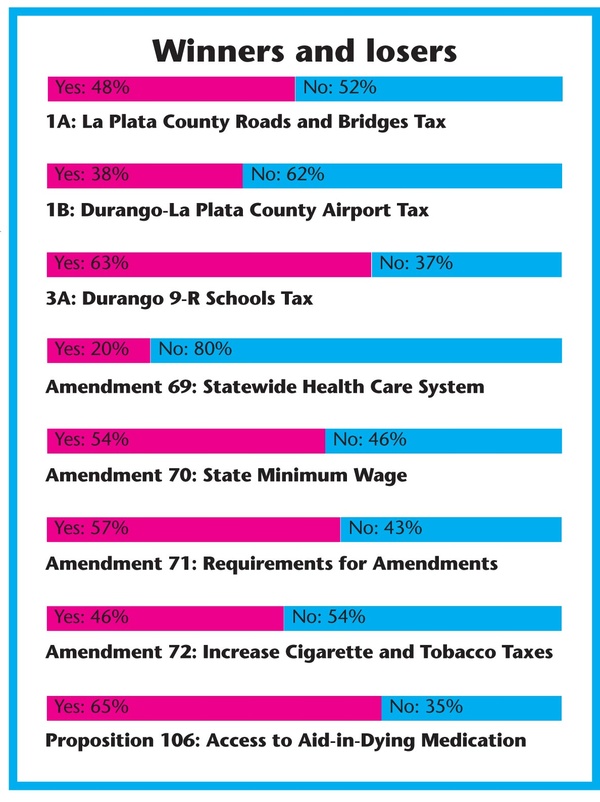
The road and bridge tax, Ballot Issue 1A, failed 52 percent to 48 percent, while the airport tax, Issue 1B, suffered a bigger loss with 62 percent of La Plata County voters saying “no.”
Westendorff and Lachelt were uncertain if having several tax measures on the ballot hurt the chances of getting these taxes passed.
The property tax increases for Durango 9-R School District, Ballot Issue 3A, and the Bayfield School District, Ballot Issue 3B, both passed.
“This county always supports education,” McLachlan said. “I’m very happy about both of those issues.”
Along with the Durango 9-R property tax, which will bring in an extra $1.7 million in 2017, voters in the Bayfield school district passed a property tax that will pay for a new elementary school for grades 3-5, as well as renovation of the current elementary school, serving grades K-2.
Westendorff voted against placing the airport on this November’s ballot. She expressed concern that there wasn’t enough time to educate voters.
Moving forward, Westendorff said she’s not sure what the best strategy is. Another vote for the airport can’t come in April – it can only come during a general election.
As it sits, the current airport is not adequate, she said.
An environmental assessment is currently under way on the airport, and that will continue as the county considers its options. It will also look at how to address the county’s need for road and bridge maintenance and improvement.
“We’ve certainly heard twice now, property tax is not what people are willing to pay for roads and bridges ... and for the airport,” Westendorff said.
Revenues from either the roads and bridges or the air- port tax were not assumed in the 2017 budget, so the county doesn’t need to make any immediate adjustments. What they do need to do, according to Lachelt, is start a new conversation about how to fund county government in the future. “We’ve got to come together as a community and talk about this,” she added.
Statewide measures
Voters in the Centennial State had no less than nine constitutional amendments and propositions on this year’s ballot, choosing to support five of them.
Amendment T, which would have taken out language in the state constitution allowing for slavery or involuntary servitude as a form of criminal punishment, and Amendment U, which would have exempted certain possessory interests from property taxes, failed to pass.
La Plata County voters approved Amendment T by an almost 10-point margin, but that trend didn’t hold across the state, with a narrow loss at 49 percent to 51 percent.
Another measure where La Plata County voters were not on trend with the rest of the state was increasing the cigarette tax by $1.75 a pack. The measure passed in La Plata 59 percent to 41 percent, but failed statewide 46 percent to 54 percent.
One spot where the county was on trend with the rest of Colorado was Amendment 69, which would have created the statewide health care system ColoradoCare.
It was defeated by a wide margin in La Plata, 74 percent to 26 percent, and across the state, 80 percent to 20 percent. McLachlan said although the measure failed, she was happy the conversation about health care had started.
“There’s a lot of things wrong with the system,” she said. “... at least we’re talking about it.”
Another health care related issue did pass on Tuesday – Proposition 106: Access to medical aid-in-dying medication.
The measure allows for someone with a terminal illness and a diagnosis of six months or less to live, the right to get a prescription for aid-in-dying medication. The issue, commonly referred to as assisted suicide, passed in La Plata County 74 percent to 26 percent.
Statewide the mar- gin was slightly smaller at 65 percent to 35 percent.
It was a measure McLachlan supported and is very happy that it passed. She had a good friend who passed in hospice care. “All he wanted to do was go quickly, and he couldn’t,” she said.
Propositions, like medical aid-in-dying, might be more common in future elections since one of the other measures passing was Amendment 71, which makes it more difficult to amend the Colorado Constitution. It passed 57 percent to 43 percent in both the state and in La Plata County.
This means, in the future, constitutional amendments will require a higher percentage of petition signatures over- all and at least two percent from each state senate district to make the ballot.
Another “Yes” for a majority of voters was Amendment 70, raising the minimum wage in Colorado to $12 an hour by 2020.
Voters will begin to feel the impact of this vote on Jan. 1, 2017, when the state’s minimum wage goes from $8.31 to $9.30 an hour. After that, it will go up an additional 90 cents per hour each year until reaching the $12 mark in 2020.
Maureen Maliszewski, director for La Plata County Thrive! Living Wage Coalition, said Wednesday morning she was just starting to plan an appreciation party for the 40-plus volunteers who helped get the word out ahead of Election Day. “I think that made a difference,” she added.
The measure passed overwhelmingly in La Plata County with almost 62 per- cent of the vote. Statewide, it passed with 54 percent approval. Thrive, a local group advocating liv- able wages in Southwest Colorado, is a part of a larger coalition of Coloradoans who support a living wage.
The next step, according to Maliszewski, is to tackle a state law prohibiting municipalities, like Durango or La Plata County, from choosing their own minimum wage.
The cost of living varies, dramatically in some cases, from city-to-city and town-to-town. What is enough to live on in Cortez might not be enough in Durango, so many, like Maliszewski, believe local communities should be able to make their own choices.
“I think that’s the next big challenge,” she said.
The final two measures on the state ballot were Proposition 107 and 108, both of which passed in La Plata and statewide.
These two came about after a tumultuous primary sea- son, when the potential problems with a caucus system were out in the open – literally – as some party members could not fit inside meeting places.
Colorado will now have primary elections with mail-in ballots, and unaffiliated voters will also have a say.