
Tougher on trash
As human-bear conflicts rise, new state law targets 'knowingly' allowing attractants
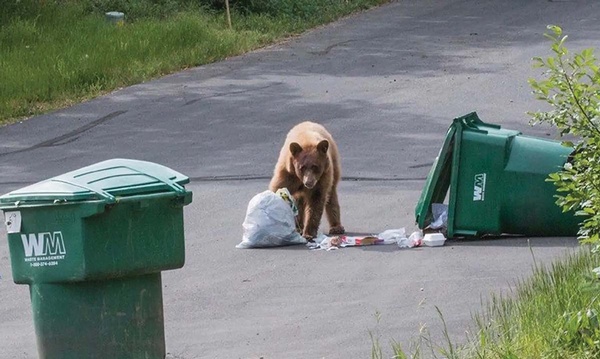
A bear digs through trash in La Plata County. Under a new law passed last week, residents who are negligent in leaving unsecured bear attractants like trash can be subject to an immediate fine, even if a bear has not accessed it./ Photo courtesy Bear Smart Durango
The penalties for failure to secure trash and other bear attractants just got more teeth. On May 28, Gov. Jared Polis signed HB26-1342, aka the Negligently Luring Bears bill, which lowers the threshold and also stiffens penalties for luring bears. Previously, Colorado Parks and Wildlife was required to issue a warning on the first offense and could only issue warnings or fines for "intentionally" luring a bear. However, under the new law, officers may now pass “go,” issuing fines on the first offense. Additionally, the burden of proof has been lowered from “intentionally” luring bears to "knowingly" allowing attractants – like unsecured trash or bird feeders – to be accessible.
The law also allows officers to issue fines even if no human-bear conflict occurs, as long as there is a reasonable probability of luring a bear. And all law enforcement, not just CPW officers, have discretion to enforce the law.
First offenders who knowingly place food or edible waste in a way that lures bears can face up to a $200 fine; second offenses up to a $1,000 fine and a misdemeanor charge; and third or subsequent offenses carry up to a $5,000 fine (previously $2,000) and a misdemeanor.
“Dangerous human-bear interactions are rising in our state, and we’re doing more to keep Coloradans, visitors and the bear population safe,” bill co-sponsor Rep. Katie Stewart, D-Durango, said. “Last year, the vast majority of bear reports were related to trash or food waste. Bears are attracted to human food, which means this is a people problem, and it’s our responsibility to keep food undetectable to bears so we can limit human-bear interactions.”
Bryan Peterson, director of Bear Smart Durango, said Bear Smart proposed the legislation and worked with Stewart and other legislators to draft it, as part of the broader Colorado Bear Coalition.
“Having to prove intent in feeding bears seemed to really hamper CPW,” Peterson said in an email. “This should be a valuable tool for CPW, considering that around 50% of bear calls to them are trash-related.”
According to CPW, there has been a 15% increase in reported human-bear conflicts over the last six years. CPW received 5,022 bear reports in 2024 and 5,229 in 2025, with the majority involving bears trying to access human food sources. Last year, 57% of reported sightings were linked to edible trash; 18% to livestock, chickens and beehives; and 16% to bird seed, pet food, barbeque grills, coolers and refrigerators. Of the 5,299 reports CPW received in 2025, nearly half resulted in property damage to a shed, garage, home, vehicle or fence.
The results of these human-bear interactions are also costly for the bears and taxpayers. In 2024, CPW relocated 68 black bears and euthanized another 98, because of incidents with humans. That same year, CPW spent nearly 6,000 hours of staff time responding to human-bear conflicts and nearly $800,000 in supplies, grants and salaries related to human-bear conflicts.
In the City of Durango, if a bear accesses a non-resistant container, residents are required to lease/buy a city-approved, wildlife-resistant trash container, which also includes a one-time delivery fee. La Plata County also requires residents to secure trash, and Bear Smart offers $100 rebates to county residents who buy bear-resistant cans.
For more on the rebate and ways to limit human-bear conflicts (which we should all know by now), visit: bearsmartdurango.org.