
Up in smoke
City, county mull increases in retail, wholesale marijuana taxes
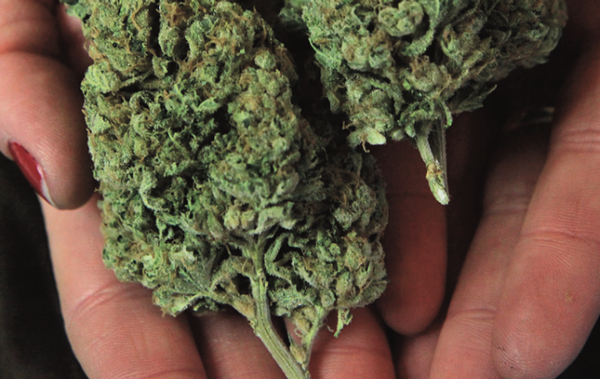
Legal pot consumers could start feeling a pinch at the register. In addition to the state's 15 percent special tax, the city and county are also considering adding their own special tax to help meet budget shortfalls. Pot is currently taxed at about 20 percent./ File photo
As the City of Durango and La Plata County grapple with shrinking budgets, both are looking to retail marijuana for a quick hit. But local dispensary owners say when it comes to taxes, they’ve had their fill. “We’re the most heavily taxed industry in the country ... the world,” Owner of Durango Organics Jonny Radding said Tuesday.
Radding, whose dispensary was the first to open in Durango in September 2014, was reacting to news that the city and county are considering a potential ballot question this fall to add a special tax to local retail marijuana sales. This would be in addition to the 15 percent special sales tax on recreational pot currently levied by the state as well as the standard 2.9 percent City sales tax and 2 percent County sales tax on all goods that already applies to legal pot.
La Plata County Commissioners will be discussing the topic, with public comment, from 5:30-7 p.m. Thurs., July 20, in the County Administration Building, 1101 E. 2nd Ave. Likewise, the City Council will hold a public hearing on the proposed tax at its Tues., Aug. 1, meeting starting at 6:30 at 949 E. Second Ave.
“Retail marijuana is currently taxed at 20 percent, which already provides a significant amount of revenue,” said Radding. In addition, dispensaries pay a federal tax rate of about 70 percent since, under federal tax code, they are not recognized and cannot write off expenses, like employees.
More taxes will threaten the economic viability and job opportunities marijuana has brought to the community, he said. He estimates the local pot industry employs about 500 people, not including ancillary businesses that also benefit. Others argue raising taxes will only drive pot back underground, which will result in even more lost revenues.
Radding said between 300-400 people opposed to the new taxes, including local dispensary owners, have written letters opposing the measure. “We’re trying to fight it before it even gets on the ballot,” he said.
On a state level, marijuana sales hit $1.3 billion in 2016, and tax revenues from those sales topped $160 million. Local jurisdictions reap 15 percent of the state’s tax, which in June equated to more than $30,000 going into local coffers.
For Radding and others in the industry, it’s about being respected and recognized for the benefits they bring to the economy. “We’ve had more of a positive impact than people realize,” he said. “It would be nice to be recognized for that; any other industry would be applauded.”
And, as tax hike opponents also point out, it’s about fairness. For example, alcohol is taxed at a rate of 7.9 percent at the state level, despite language in the state constitution that marijuana shall be "taxed in a manner similar to alcohol.”
“(Governments) will always need money, and at this point, it’s become totally unfair,” said Radding.
La Plata County is faced with trimming $1 million from its operating expenses next year as it tries to come to grips with an estimated $6.5 million shortfall. Likewise, the City is bracing for a $4 million hit to its transportation budget alone by 2023.
County Commissioners met June 28 to discuss bringing a marijuana excise tax (a tax on wholesale pot) or a retail sales tax to voters. In 2015, the state passed a law allowing counties to levy an excise tax of up to 5 percent on marijuana grown within the county. Eleven counties in the state have since passed marijuana excise taxes.
In newer developments, state lawmakers also recently passed a bill allowing counties to levy sales tax on retail marijuana. This is only provided that municipalities within the county don’t already have their own special sales tax. In such cases, the two jurisdictions must enter an intergovernmental agreement, as is currently being explored.
Either retail or excise tax would require voter approval.
It is estimated such a tax could generate $276,000 a year for every 1 percent increase.
This is not the first time a special tax on pot has been considered locally. In 2015, the City considered a special 5 percent pot tax to be used for facilities. It was eventually shot down by dispensary owners as well as Council members.
According to the Denver Post, the current tax rate for recreational marijuana in Colorado is the second highest in the nation among states with a legalized industry (26 plus Washington, D.C.)
In Colorado, cannabis consumers used to pay a standard 2.9 percent state sales tax plus a special 10 percent marijuana sales tax. However, the new 15 percent tax, which went into effect July 1, removes the 2.9 percent state sales tax, amounting to a 2.1 percent tax hike. This shift keeps it under the TABOR threshold (a calculation based on inflation plus population increase.)
It’s estimated that each percentage point increase in marijuana taxes equates to about $10 million in revenue for the state.
In 2012, Colorado voters approved Amendment 64, which legalized retail marijuana. In 2013, voters approved Proposition AA, which allowed the state to assess up to a 15 percent tax on unprocessed marijuana and recreational marijuana. Medical marijuana is exempt from the 15 percent special state tax, but not the 2.9 percent state sales tax or local taxes.
If the city and county decide to move forward, ballot language would need to be approved by Sept. 8. The election is Nov. 7.