
Where the plastic meets the road
School District 9-R leads local effort to recycle hard-to-process plastic film
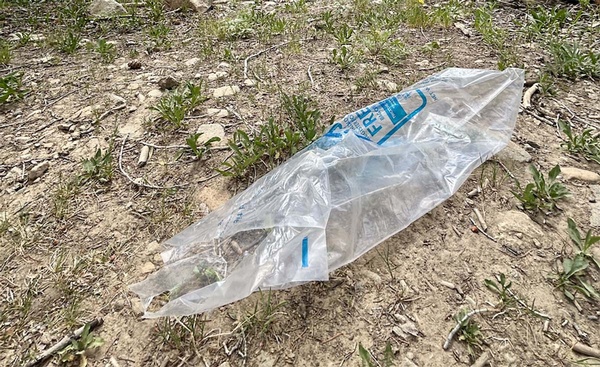
A plastic bag mars the landscape in La Plata Canyon recently. Light plastic film, like bags, is particularly vexing as it easily catches the wind and is carried into rivers, streams and other natural areas where it breaks down into microplastics. Wildlife also fall victim, mistaking small pieces of plastic for food./ Photo by Kathleen O'Connor
Most of us know the feeling: you’re standing over your recycling bin holding an empty bread bag or maybe some bubble wrap, wondering whether it’s even recyclable. More often than not, it isn’t. At least not through your curbside recycling service. These soft, flexible plastic films, often used to protect goods and materials, present some serious recycling challenges. According to the EPA, in 2018, Americans generated around 4.2 million tons of plastic film, most of which was landfilled, incinerated or inadvertently released into the environment, polluting our land and waterways. Here in Durango, the school district is tackling this problem head on.
In 2025, Durango School District, in partnership with Colorado’s Circular Transportation Network (CTN), participated in a pilot program to install green bins at the entrances of every district school for collecting plastic film and other soft plastics. Instead of ending up as waste, these hard-to-recycle plastics were transported back to the Front Range via truck delivery routes. Rather than returning empty after delivering goods, the trucks stop in mountain towns, such as Durango, to backhaul the collected plastics to regional end markets, including one participating company: Driven Plastics.
This Pueblo-based company chips up the plastic, cures it and adds it to asphalt for road construction, thereby extending the durability and service life of roadways and highways. Polyethylene, which includes plastic resins 2 and 4, is most widely used for plastic films. When heated or “cured,” this plastic becomes irreversibly hardened, making it a durable additive in asphalt. Ultimately, a re-sealable sandwich bag dropped into a school lobby collection bin in Durango could end up strengthening a highway somewhere in Colorado.
Leading the program in Durango is Ron Reed, Sustainability Lead and 15-year 9-R employee. Reed was first introduced to CTN through Marianne Mate, Southwest Regional Coordinator of the Circular Economic Development Center (CEDC), a state-run organization that created the Circular Transportation Network. Prior to meeting, Reed was already frustrated by the voluminous amount of thin plastic packaging on mail-order items. “At the schools, we do order large amounts of items online,” he said. “Almost every week, we get pallets of items delivered, all wrapped in plastic. Finding a way to keep it from ending up in the trash was huge for me.”
Part of what makes thin, plastic film uniquely difficult is that most recycling facilities cannot accept it. It gets easily tangled in recycling-sorting machinery and ends up causing more problems than solutions. Currently, only around 2% of U.S households have access to curbside recycling that take these materials. Also troublesome: light plastic film effortlessly catches the wind and is easily carried into rivers, streams and other natural areas where it breaks down into microplastics. Wildlife may also fall victim, mistaking small pieces of plastic film for food, as Reed has observed.
“You can watch birds in the parking lots picking up bits of plastic,” he said.
A 2022 study, reported in the Durango Telegraph, found microplastics in Colorado’s mountain snowpack, including the San Juans. It’s not a far stretch to imagine these microplastics reaching our headwaters and streams as well. Though diverting these hard-to-recycle materials through an upcycling process does not solve the problem at its source (we still need to reduce the amount of virgin plastic produced), it does offer an alternative to landfilling the waste. This is particularly important in light of La Plata County’s quickly filling Bondad landfill, which was reported in 2025 to have an estimated seven years left of capacity.
Additionally, microplastics have been found in human lungs and blood. Though we don’t yet fully understand what that means for human health, we do know that every ton of plastic film diverted from the landfill is one less source of the problem.
The Durango 9-R was one of 14 school districts statewide to join CTN’s plastic film collection pilot program launched early last year. Other participating districts include Telluride, Ridgway, Buena Vista and Ouray, to name a few. For Mate and the CEDC, the program aligns seamlessly with the organization’s mission: to keep materials out of landfills through circular-economy solutions – particularly in Colorado’s rural and mountain communities – and to find new end markets for materials that would otherwise be discarded. “Last year, we collected around 15,000 pounds of plastic film throughout the state,” Mate noted.
During the school year, students may take their household’s collected plastic film with them to school for drop-off in the green bins. Reed mentioned that late last year, drop-off availability was extended to the general public as well. “Residents can bring their plastic film either to the district’s Administration Building or to our facilities building,” he said. Both Mate and Reed hope to eventually partner with businesses around town to provide more accessible drop-off hubs for the public. Reed had worked briefly with one local gas station that collected ice bags for the program, but after a management change, that stopped. For now, he and Mate continue the search for a more permanent collection spot.
According to Mate, the pilot phase of the program has ended, and the CTN will transition to operating under Circular Colorado, a Denver-based nonprofit dedicated to eliminating waste by transitioning the state’s waste model into a circular economy. They are actively exploring funding opportunities to support a future phase of the program. During this time, however, the Durango School District will continue to collect plastic films for delivery to the Front Range.
In the meantime, there’s also hope that Colorado’s new EPR (Extended Producer Responsibility) law may help fill CTN’s funding gap. For years, the cost of recycling in Colorado has fallen on local governments and taxpayers who fund them. But HB 22-1355, signed by Governor Polis in 2022, shifts that financial burden to the companies that produce the packaging in the first place. Under the new law, any producer that sells packaged goods in Colorado – including those that use the ubiquitous plastic film – must pay an annual fee into a statewide recycling fund. Those funds will then be used to reimburse cities, counties and recycling-service providers for their costs. Though the new law applies to standard curbside recycling programs in the state, the EPR framework does include a reimbursement pathway for drop-off collection programs, such as the plastic films collection program.
In the meantime, Durango residents need not wait for the new policies to catch up: collection bins will once again be available to students and families at district schools in the fall. Residents can drop off their plastic films now at no cost at the 9-R Administration Building, 281 Sawyer Dr., Ste. 100, or at the Durango School District’s facilities building, 28745 Highway 160.
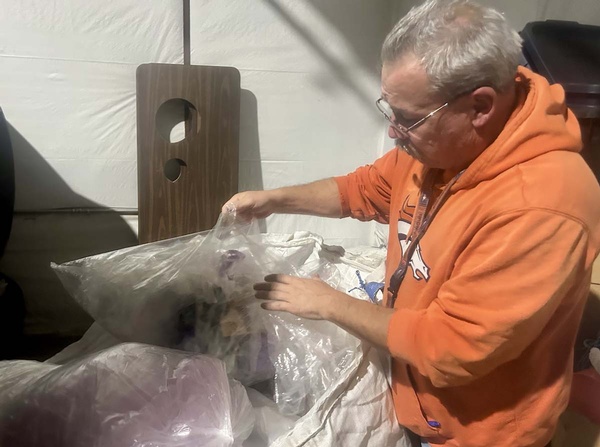
Durango School District 9-R Sustainability Lead Ron Reed goes through a bin full of plastic film recently. Driven by the amount of items the district received wrapped in plastic, Reed helped start a district-wide plastic film recycling initiative. Collection bins are located at district schools, the 9-R Administration Building, 281 Sawyer Dr., Ste, 100, and at the 9-R facilities building, 28745 Highway 160./ Courtesy photo