
Who you gonna call?
As revenues wane and calls increase, City moves ahead with fire & rescue tax
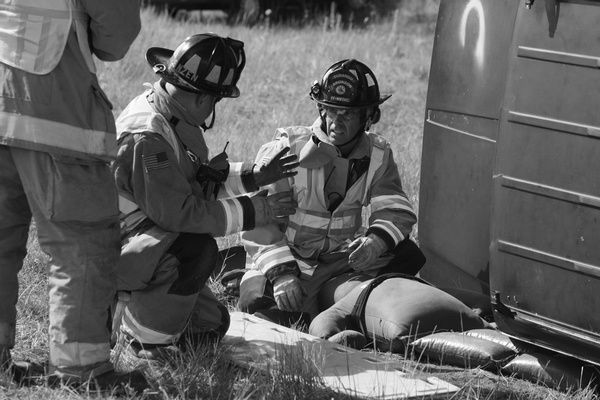
The Durango Fire Protection District covers 325 square miles in the central corridor of La Plata County. They fight both structure and wildland fires, and provide emergency medical services, including ambulance transport and swiftwater rescue. They also conduct fire safety inspections and investigations, and are involved with public outreach programs. Although the number of calls the department receives increase about 7 percent a year, the budget has dropped, which is the reason the City of Durango is looking to voters to help fund the department with a tax increase on the November ballot./File photo
The city is moving forward with a proposed property tax increase – even though it’s something nobody really wants to talk about, especially those who need it the most.
“We understand increasing taxes is something that isn’t popular,” Durango Fire Protection District Chief Hal Doughty said. “People are going to have to see real value in our organization to support that.”
Tuesday night, the Durango City Council voted unanimously – Councilor Dean Brookie was absent – to place a property tax increase on the November ballot to help fund operations for the Durango Fire Protection District, which provides all fire and emergency services for the city and central corridor of La Plata County.
The proposed property tax would be something everyone within the service area votes on. Those living within the city limits would be asked to increase the property tax so the city could raise enough money to pay the district through its contract. Outside city limits, residents would be asked to increase the tax rate to pay the Fire Protection District as part of their individual property tax bills.
How the money is funneled to the district would be different because of the city’s contract, but everyone would pay the same rate. For example, a house worth $400,000 currently pays $164.16 on a property tax rate of 5.7 mills. The district is proposing an increase of 2.5 mills, which would be an increase of $72 per year.
For a commercial property worth $1 million, the current tax rate is $1,653. The additional 2.5 mills would be an increase of $725.
Not only is everyone in the district’s service area in this together, they all have to be on the same page. If the mill levy passes in the city but not in the county – it fails. If the county residents approve the measure, but the city residents don’t – it fails.
Both county residents in the district’s service area and city residents need to approve the tax increase for it to pass. If they don’t both approve it, no one pays.
As part of the tax package, the city was considering extending its contract with the department, which would have also gone to the voters, and choosing a new site for the downtown fire station.
Those ideas were quickly nixed when the Council was made aware of limitations under the city charter.
According to Dee Wisor, a legal consultant for the city, the charter limits the city’s debt to 10 percent of its total assessed property value. Currently, that value comes to about $524 million, which means the debt limit is about $52.4 million.
Since the city has a contract with the Fire District, the amount of that contract is considered debt and would count toward that total. Over the 11 years remaining in the contract, the debt could be as high as $44 million – if the tax increase were to pass.
In the short term, this leaves the city with little wiggle room for future projects like facilities upgrades and stormwater issues. However, Wisor confirmed each year the city pays its contract with the district, the debt will decrease.
A handful of residents spoke during the public hearing portion of Tuesday’s meeting, however only one talked about the proposed tax increase.
Al Harper, owner of the Durango & Silverton Narrow Gauge Railroad, spoke passionately in support of it. “I’ll do anything I can to support passing the mill levy,” he said. “This is a great need for the community ... I’m 110 percent behind this.”
The other residents spoke about the proposed location of the new downtown fire station. The Council had been leaning toward putting it at the train station’s gravel parking lot, which was one of three proposed locations. The other options were to remodel the station at its current location between the Animas River and Camino del Rio or to build a new one on the city Transit Center parking lot.
Conversations over the need for a new home for the department’s downtown fire station started almost two years ago. Doughty didn’t anticipate then that they’d still be having those conversations today. In fact, no one thought this would be an issue in 2017. The station was intended to be a temporary spot for the Fire Department when it was built in 1982.
Unfortunately for Doughty, the tax issue and downtown fire station have come to the public in a perfect storm of district needs. However, he said they truly are separate issues, and the new station is likely to move forward regardless of the outcome of November’s vote.
The district has most of the funds needed for the new station set aside in its capital funds budget – the same one it has been tapping to fill the void from declining revenues.
Like many other public entities, the district is at the mercy of tax revenues from things like oil and gas, or property and sales taxes. Dropping oil and gas revenues have hit the district and La Plata County hard. Property taxes have also been down due to the way Colorado calculates rates under the Taxpayer Bill of Rights and other laws, and will see an even steeper decline in the coming years.
Those revenue losses are moving in the opposite direction of the number of emergency calls the district responds to – and this is what the property tax proposal is all about.
Last year, the district responded to 5,080 emergency calls, averaging about 14 calls a day. The year before, it was about 13 calls each day. Every year, the volume of calls increases about 7 percent, a trend that’s likely to continue, according to DFPD officials.
The department has been tightening its belts in recent years, Doughty said, but at some point they’ll cut themselves in half.
The one thing that won’t change is everyone at the Durango Fire Protection District will keep answering those calls. Whether it’s a bloody nose or a burning building, they’ll always pick up the phone.
For them, the concern is not having enough personnel or equipment to answer the call quickly.
Doughty said he understands residents don’t want to raise their taxes. He’s a taxpayer, too, and doesn’t want to raise his own. But, he knows what’s at stake.
He sees someone lying on the side of the road after a car accident, waiting for emergency responders to arrive. He sees the parent, desperate to get their children out of a burning
house, waiting for the firefighters to arrive. He sees a family watching their loved ones suffer a heart attack, waiting for the ambulance to arrive.
“The question that concerns me the most: How long do people have to wait to get our service?” Doughty said. “In our business, minutes can be the difference between life and death ... we take that very seriously.”
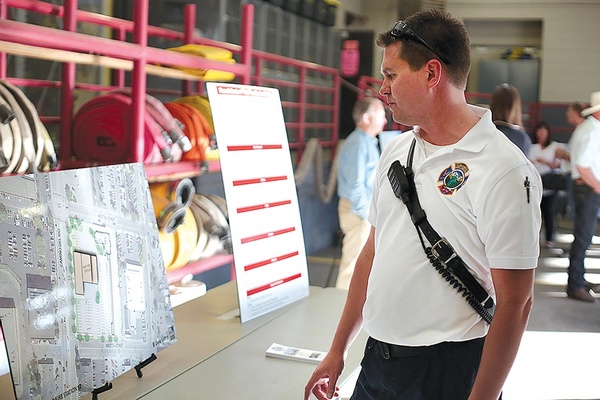
Micheal Krupa, Battalion Chief for the Durango Fire Protection District, attends a public meeting on pro- posed sites for a new downtown fire station in June. On Aug. 8, the City Council chose to put discussions on the new station on the backburner while it works to craft a ballot measure for a proposed property tax increase in time to make this year's November ballot./ File photo