
Wild at heart
Remembering Katrina Blair's crusade to reclaim the power of wild plants and lands
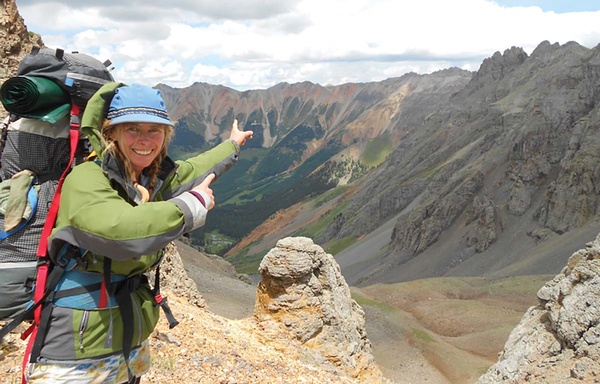
Katrina Blair during her annual "walkabout" in the San Juans, en route to the Telluride Mushroom Festival. During the weeklong trip, she subsisted entirely on plants and berries she foraged and was so confident in her skills, she doesn't even bother to bring a backup stove./Courtesy photo.
Editor’s note: Longtime local wild foods and lands advocate Katrina Blair passed away Fri., June 5, after a battle with cancer. She was 56.
Well known for her foraging of edible wild plants, in 1998 Blair founded the nonprofit Turtle Lake Refuge, which – among other things – featured bi-weekly lunches made from foraged, wild plants. A champion of pesticide and herbicide-free lands, she also founded Durango’s annual Dandelion Festival, held every May. She also wrote two books on the topic of wild foods.
“It’s incredibly heartbreaking to lose Katrina,” Sue Rudolph, who helped organize the Dandelion Festival, said in an email Wednesday. “She was such an incredibly beautiful and inspiring person who had a wonderful ability to help others feel valued and loved.”
Rudolph said before her death, Blair took steps to ensure her nonprofit and legacy live on.
Below is an edited Telegraph story from 2015 upon the release of Blair’s second book, “The Wild Wisdom of Weeds.” The story offers a quintessential look back at Blair’s life, work and philosophy.
Katrina Blair, the purveyor of Turtle Lake Refuge, has spent much of her adult life advocating the benefits of weeds, as well as fighting against the use of pesticides and herbicides, locally and afar. Her 2015 book, “The Wild Wisdom of Weeds,” sold out of its first run and is on its second printing. Thanks to a heightened interest in the subject, and a favorable review in the New York Times, Blair exceeded even her publisher’s expectations by selling out 4,000 books in just a couple months.
The book, her second, highlights 13 weeds that can be used for food and medicine, including such well-recognized ones as dandelion, lambsquarter, mallow, plantain and thistle. All the plants listed in her book grow on each of the seven continents. Blair remarks that she “fell in love with these plants all over again during the writing of the book,” and she even had a 10-day period during the research where she ate nothing but those 13 plants.
Blair notes that she considers herself more of an opportunist than a vegan or vegetarian but feels best when she eats a local-food diet. “The more we refine food, the more the vitality goes down,” said Blair. “I thrive on fresh, wild, local food, which gives me a high level of clarity and energy.”
Blair was raised to be resilient. Her father, Rob Blair, a retired geology professor from Fort Lewis College who passed away in 2014, taught her to ski, hike and climb. Her mother, Pat Blair, who started Durango Natural Foods, imparted an appreciation for plants and nutrition. “My dad opened the wild, and my mom opened the doors to health,” says Blair.
She was camping in the Tetons before she learned to walk and started climbing at the age of 10 at X-Rock. She spent her high school years in New Zealand, while her father worked on a sabbatical, and learned to appreciate the value of travel and understanding other cultures.
Perhaps her most formative and legendary experiences happened in the form of what she calls a walkabout. Blair simply hikes for days, feeding herself on the food she forages. August is typically the best month, and she boasts that in one day, while hiking to Silverton, she foraged 19 different kinds of berries. She says she’s always had a mystical connection to the land, with plants in particular. “As a kid floating on Haviland Lake, I felt drawn to the plants on the edge of the lake, and they seemed to say to me, ‘You’re going to live with us now.’”
And she has. Her most well-known walkabouts are the annual week-long pilgrimages she makes to Telluride late every summer for the Mushroom Festival, where she conducts educational workshops. She lives entirely on the plants and berries she forages and is so confident in her skills she doesn’t even bother to bring a backup stove. Blair notes that for the first three days she is typically lethargic. Then something happens, once the detoxing period is over, her energy reaches an all-time high. “By the time I arrive to Telluride, I’m riding a high, it’s as good as I feel at any point in the year. It’s like a cleanse.”
During the walkabouts, Blair also touches base with her roots as an explorer of the mountains. “I have this deep, profound trust in nature,” she shares. “While I’m in these precarious situations, I don’t have the luxury to have fear. I trust in myself and my intuition.”
As a kid, her only household rule was: be true to yourself. In all her experiences with edible plants, she’s only eaten something poisonous once, a twin berry, that is only considered mildly harmful. Fortunately, the effects were minimal, and she recovered quickly.
As one could expect, the book is full of detailed wisdom and creativity. Blair calls it “heavy,” containing more than 350 pages of information and a complete array of photographs of herself, the plants and many members of the Durango community and Turtle Lake family. Recipes range from Hollyhock strawberry baskets to Clover Flower Apple Pie and Plantain Breakfast Porridge.
In “The Wild Wisdom of Weeds,” Blair also features her battle against the use of herbicides in Durango’s city parks. She believes that as a community, Durango can lead the way for other communities to discontinue the use of herbicides, which she feels are harmful to those who visit the parks. She says that “changing anything is challenging, but as we remove those herbicides, it does increase our quality of life.” She adds that she is grateful that there has been some success in Durango, and that the City was a supporter in trying to make it happen.
Blair recommends moving toward eating these 13 plants gradually. “The integration should be small and slow. Wild food is so potent, starting with your morning green smoothie is a good idea for entry.”
She attributes her success with the book to the growing environmental awareness throughout the country. “The ground is prime. There’s so much awareness right now. It’s a small, yet perfect solution to start using these resources.”